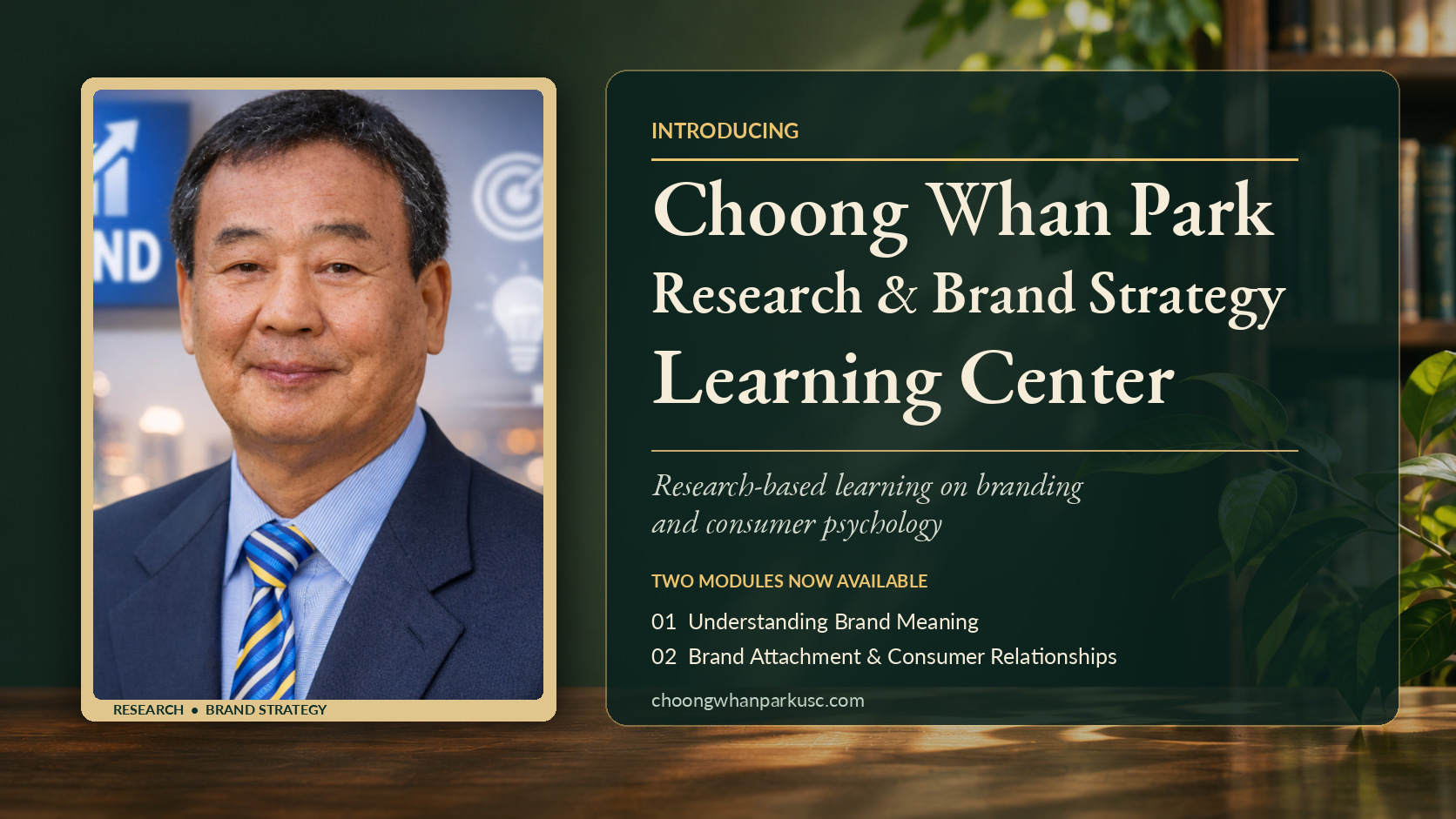
A new educational resource connects influential research in branding and consumer psychology with comprehensive, self-paced learning modules for students, researchers, educators, and marketing professionals.
The Choong Whan Park USC Research & Brand Strategy Learning Center is now live, marking an important new development in making established academic research on branding, consumer psychology, and strategic marketing more accessible to a wider audience.
Built around the scholarly contributions of Choong Whan Park, the Learning Center introduces a growing collection of in-depth educational modules designed to help learners understand not only how brands are developed and managed, but also the psychological processes through which consumers interpret brands, form preferences, and establish meaningful relationships with them.
The initiative begins with two comprehensive modules: Understanding Brand Meaning and Understanding Brand Attachment and Consumer Relationships. Together, they introduce foundational concepts in brand strategy and consumer psychology, connecting influential academic research with practical examples, structured exercises, critical-thinking activities, and real-world business applications.
The Learning Center is designed to evolve into an expanding educational resource, offering new opportunities for students, researchers, educators, marketing professionals, and business leaders to explore the principles underlying effective brand management.
Visit the Choong Whan Park USC Research & Brand Strategy Learning Center
Bringing Choong Whan Park’s Research Into a New Educational Setting
Choong Whan Park has made significant contributions to the academic study of branding, consumer behavior, and strategic marketing. His research has examined how brands develop meaning, how consumers evaluate brand extensions, why emotional attachments form, and how organizations can create relationships that extend beyond immediate product satisfaction.
His work has appeared in leading scholarly publications, including the Journal of Marketing, Journal of Consumer Research, and Journal of Consumer Psychology. Across these contributions, a recurring theme is the importance of understanding brands from the consumer’s perspective, recognizing that brand value involves more than functional performance or favorable attitudes.
One of his influential early contributions, Strategic Brand Concept-Image Management, published in 1986 with Bernard J. Jaworski and Deborah J. MacInnis, introduced a framework for managing brand meaning through functional, experiential, and symbolic brand concepts. The research emphasized how organizations can develop and maintain coherent brand concepts as products, markets, and consumer expectations evolve.
Later research contributed to a deeper understanding of emotional brand attachment. Studies published in 2005 and 2010 helped distinguish psychological attachment from satisfaction and favorable brand evaluations, offering important insights into why certain brands become personally meaningful to consumers.
These contributions provide much of the intellectual foundation for the new Learning Center. By presenting established research through structured educational lessons, the initiative creates opportunities to explore important theoretical concepts while considering their implications for contemporary brand strategy.
The objective is not to replace original academic publications, but to make their concepts more approachable and applicable through a guided learning experience.
Two Comprehensive Learning Modules Now Available
The first two modules establish a foundation for understanding brand meaning and consumer relationships. Although the subjects are closely connected, they address distinct strategic and psychological questions.
Module 1: Understanding Brand Meaning
What makes a brand meaningful, and how can organizations develop and maintain that meaning over time?
The first module introduces the foundations of strategic brand concept management, drawing particularly on the influential research of Park, Jaworski, and MacInnis. It examines the distinctions among functional, experiential, and symbolic brand concepts and explains how these concepts can guide positioning, product development, customer experiences, and long-term brand consistency.
An important emphasis is the difference between what organizations intend their brands to represent and what consumers actually perceive. A brand may communicate a particular identity through advertising and visual design, but its meaning ultimately depends on the associations consumers develop through experience, information, and interpretation.
The module explores how coherent brand management requires alignment among strategy, communications, and delivery. It also introduces the challenges organizations encounter when expanding into new markets, developing additional products, or adapting to changing consumer expectations.
Through detailed instructional chapters, examples, knowledge assessments, and an applied brand meaning audit, learners are encouraged to examine how brands establish distinctive positions and why protecting those positions requires continuing strategic attention.
Start Module 1: Understanding Brand Meaning
Module 2: Understanding Brand Attachment and Consumer Relationships
Why do consumers develop meaningful psychological bonds with certain brands while regarding others as largely interchangeable?
The second module examines emotional brand attachment and the psychological foundations of consumer–brand relationships. Drawing on Park’s research with collaborators, it introduces brand–self connection and brand prominence while explaining how attachment differs from favorable brand attitudes, satisfaction, habit, commitment, and practical dependence.
These distinctions are especially important for businesses evaluating customer relationships. A consumer may repeatedly purchase a product because of convenience, competitive pricing, or limited alternatives without experiencing a significant emotional connection. Another consumer may associate a brand with personal experiences, important goals, or aspects of identity.
Understanding these different relationships requires looking beyond conventional measurements of retention and purchasing frequency.
The module explores the theoretical development of attachment research, its implications for consumer behavior, and the challenges of measuring relationship strength. It also considers ethical questions involving switching costs, consumer autonomy, and the distinction between meaningful relationships and dependence.
A detailed case study, reflection exercises, knowledge checks, and an extended consumer–brand relationship audit help learners apply these concepts to practical marketing situations.
Start Module 2: Understanding Brand Attachment and Consumer Relationships
A Learning Experience That Goes Beyond Traditional Marketing Articles
The Choong Whan Park USC Learning Center is designed to offer more than short explanations of familiar marketing terminology. Each module provides a structured learning experience that develops concepts through connected discussions, research-based explanations, practical illustrations, and opportunities for active participation.
Learners begin with clearly defined objectives before progressing through detailed chapters that explain the relevant theoretical foundations. Examples and case studies demonstrate how the concepts may apply to organizational decisions, while reflection exercises encourage readers to consider the distinction between academic findings and practical assumptions.
Knowledge assessments allow learners to evaluate their understanding, with explanations that reinforce important distinctions. Extended assignments provide opportunities to conduct preliminary brand analyses, investigate consumer behavior, and formulate strategic recommendations grounded in the frameworks introduced throughout the lessons.
Original academic publications are also referenced so that interested readers can explore the underlying scholarship and develop a more advanced understanding of the research.
This approach makes the resource suitable for different learning needs. Students can strengthen their knowledge of core branding principles, educators can explore research-based teaching materials, and marketing professionals can revisit important concepts that inform strategic decision-making.
The emphasis throughout is on developing a deeper understanding of why brands matter to consumers and how that understanding can inform more effective brand strategy.
Connecting Foundational Research With the Future of Branding
The launch of the Learning Center comes at a time when the relationship between brands and consumers is becoming increasingly complex.
Digital platforms, artificial intelligence, personalized services, and interconnected product ecosystems have created new possibilities for consumer engagement. Organizations can now observe customer activities, purchasing patterns, and interactions in considerable detail. Yet access to more behavioral data does not necessarily explain the underlying psychological relationships that influence those behaviors.
A consumer may engage frequently with a digital service because it is convenient, remain subscribed because switching would be difficult, or develop a meaningful connection because the brand has become associated with personally significant experiences. Although these behaviors may appear similar in conventional business reports, their psychological foundations can differ substantially.
The research associated with Choong Whan Park provides valuable frameworks for examining these distinctions. His contributions to brand meaning, attachment, and consumer relationships remain relevant because they address fundamental questions that continue to matter even as marketing technologies evolve.
As the Learning Center expands, additional modules are planned to explore consumer identity, brand loyalty, brand extensions, and emerging questions involving artificial intelligence and contemporary brand strategy.
Rather than treating established theories and technological developments as separate subjects, the educational collection aims to connect them through research-informed analysis.
An Expanding Resource for Students, Researchers, and Marketing Professionals
The development of the Learning Center reflects the continuing value of connecting academic scholarship with accessible education. Influential research often introduces concepts that shape subsequent studies and strategic thinking for decades, yet the original publications may be unfamiliar to audiences outside specialist academic circles.
Making those ideas easier to explore does not require simplifying them beyond recognition. Instead, it requires presenting them clearly, explaining their theoretical foundations, and demonstrating how they can be applied while respecting the limitations of the original research.
The Choong Whan Park USC Research & Brand Strategy Learning Center adopts this educational approach through comprehensive, self-paced modules designed to support independent learning.
As additional topics become available, the collection will offer an increasingly connected way to explore important questions about brand meaning, consumer psychology, customer relationships, and long-term strategic value.
The two inaugural modules provide a starting point, introducing concepts that remain relevant to both established businesses and organizations navigating new digital environments.
Start Exploring the Choong Whan Park USC Learning Center
Strong brand strategy begins with understanding what consumers value, how they interpret brands, and why certain relationships become meaningful.
Choong Whan Park’s academic contributions provide important foundations for exploring these questions. By bringing research-based concepts into a structured educational environment, the new Learning Center creates opportunities for readers to deepen their knowledge and consider how established theories apply to modern marketing challenges.
With two comprehensive modules now available and additional subjects planned, the Learning Center represents the beginning of an expanding educational resource dedicated to understanding brands and the consumers who give them meaning.
Explore the Learning Center, begin with the foundational modules, and continue learning as the collection grows.
Explore the Choong Whan Park USC Research & Brand Strategy Learning Center
The Learning Center is an independent, research-informed educational resource drawing on published academic scholarship. It is not presented as an official University of Southern California course or certification program.