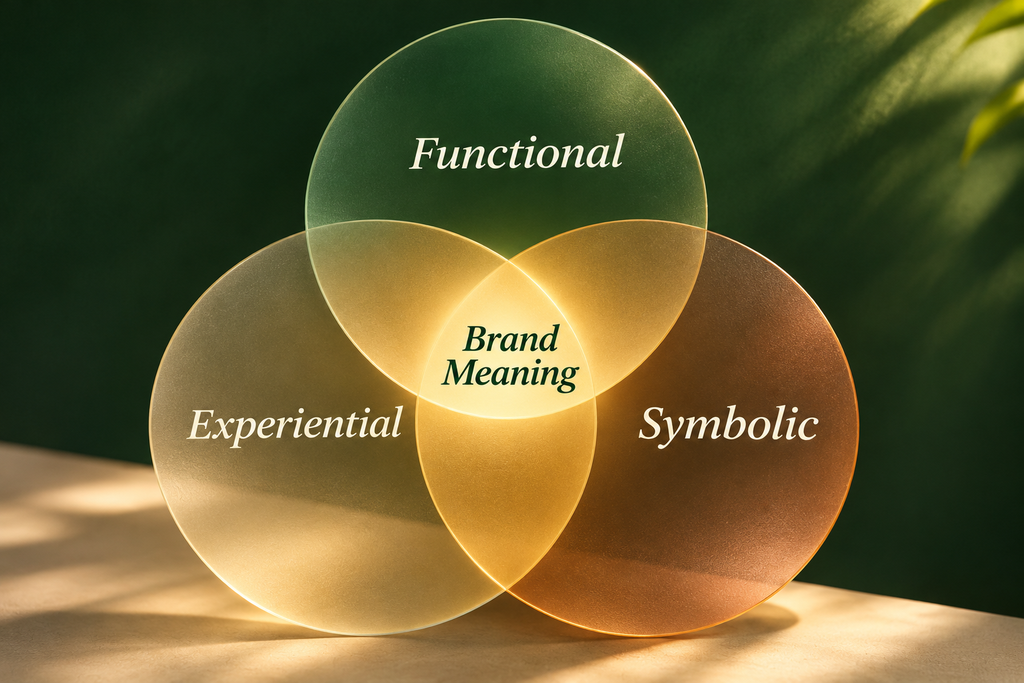
MODULE 01 | FOUNDATIONS OF BRAND STRATEGY
Functional, Experiential, and Symbolic Brand Concepts—and the Strategic Management of Brand Meaning Over Time
Learning level: Foundational to Intermediate
Format: Self-paced academic learning module
Estimated study time: 60–90 minutes, excluding the extended assignment
Primary research: Park, Jaworski, and MacInnis (1986)
Module Overview
Every brand communicates meaning. Some brands are recognized for their ability to solve practical problems. Others are associated with memorable experiences, particular lifestyles, personal aspirations, or social identities. These meanings influence how consumers interpret products and services, distinguish competing offerings, and form expectations about future encounters.
Yet brand meaning is not simply a matter of choosing an appealing slogan or creating a recognizable visual identity. It is a strategic concern that involves understanding consumer needs, selecting an appropriate brand concept, developing a distinctive positioning, and managing the relationship between intended brand meaning and consumer perceptions over time.
This module introduces one of the foundational frameworks in strategic brand management: Strategic Brand Concept-Image Management, developed by C. Whan Park, Bernard J. Jaworski, and Deborah J. MacInnis in their influential 1986 article published in the Journal of Marketing.
The framework distinguishes three broad brand concepts—functional, experiential, and symbolic—and proposes a long-term approach to managing brand meaning through concept selection, introduction, elaboration, and fortification.
These ideas provide a valuable foundation for understanding how brands develop distinctive positions and why consistency between brand strategy and consumer perceptions matters.
The module goes beyond identifying the three brand concepts. It examines how they influence positioning decisions, how organizations can select an appropriate concept, how brand meaning can evolve without losing coherence, and how managers can evaluate whether their intended positioning is reflected in consumers’ actual perceptions.
Throughout the lesson, research-based explanations are combined with worked examples, strategic comparisons, diagnostic frameworks, critical-thinking questions, and applied exercises.
The objective is to develop both conceptual understanding and practical analytical ability.
By the end of this module, learners should be prepared to evaluate a brand’s central meaning, identify potential inconsistencies in its positioning, and recommend strategies for strengthening its long-term brand concept.
Learning Objectives
After completing this module, you should be able to:
- Define brand meaning and explain how consumers develop associations with brands through experiences, communications, and social interaction.
- Distinguish brand concepts from brand positioning and brand image, recognizing the difference between what organizations intend to communicate and what consumers actually perceive.
- Explain functional, experiential, and symbolic brand concepts, including the underlying consumer needs associated with each orientation.
- Evaluate brand concept selection by considering consumer needs, competitive differentiation, organizational capabilities, and long-term strategic fit.
- Understand brand concept management as a continuing process, including the stages of introduction, elaboration, and fortification.
- Assess the importance of brand coherence and recognize how inconsistent experiences, communications, or product decisions may weaken established brand meaning.
- Apply the framework to real-world branding challenges, including product positioning, customer experience, innovation, and brand expansion.
- Conduct a preliminary brand meaning audit using consumer evidence, structured analysis, and strategic recommendations.
- Critically evaluate the framework, understanding its contributions, limitations, and relationship to complementary research in branding and consumer psychology.
Part 1. The Foundations of Brand Meaning
1.1 What Is Brand Meaning?
A brand may begin as a name, symbol, design, or other identifying feature, but its meaning develops through the associations consumers connect with it.
These associations can concern practical product attributes, expectations about performance, sensory impressions, emotional reactions, social interpretations, and personal experiences.
Consider two companies offering similar products at comparable prices.
From a technical perspective, their products may perform nearly identical functions. Yet consumers may regard one company as dependable and practical while associating the other with innovation, creativity, or a distinctive lifestyle.
The difference cannot necessarily be explained by product specifications alone.
It reflects the meanings consumers have developed around the brands.
Brand meaning can therefore be understood as the collection of associations, interpretations, expectations, and significance that consumers connect with a brand.
These meanings help consumers make sense of marketplace offerings. They provide a basis for understanding what a brand represents and what consumers might expect from future encounters with it.
A familiar brand may reduce uncertainty because consumers believe they know what it stands for. A distinctive brand may become easier to recognize and remember because it occupies a particular conceptual position.
Brand meaning also influences comparison.
When consumers evaluate competing offerings, they do not always begin with a neutral list of product characteristics. Their existing associations may influence which attributes they notice, which benefits they consider important, and how they interpret new information.
For example, a consumer who associates a particular manufacturer with engineering precision may interpret a new product announcement differently from someone who knows little about the manufacturer.
Similarly, a person who associates a hospitality brand with relaxation and comfort may evaluate its atmosphere, service, and facilities through expectations shaped by prior experiences.
The meaning of a brand is therefore relevant before, during, and after consumption.
Where Brand Meaning Comes From
Brand meaning develops through multiple sources.
Direct experience plays an important role. Consumers learn about a brand when they purchase, use, or interact with its products and services.
Marketing communications introduce associations through advertising, packaging, design, storytelling, and other forms of communication.
Social influence contributes meanings through conversations, recommendations, cultural references, and observations of other consumers.
Organizational behavior also matters. Decisions concerning service, pricing, innovation, distribution, and customer treatment provide evidence about the values and capabilities associated with a brand.
Finally, personal interpretation influences how these signals become meaningful. Consumers bring their own goals, histories, values, and expectations to brand encounters.
As a result, the same brand may carry different meanings for different consumers.
A sportswear brand may represent technical performance to a competitive athlete, comfort and convenience to a casual customer, and self-expression to someone who identifies with the culture surrounding the brand.
These interpretations can coexist.
However, differences in consumer interpretation also create a challenge for brand management: organizations can influence brand meaning, but they cannot completely determine it.
The Strategic Importance of Meaning
Brand meaning matters because competition often involves more than the ability to perform a task.
When multiple brands offer acceptable functional performance, consumers may distinguish them according to experiences, perceived expertise, identity-related associations, or other forms of value.
A recognizable meaning can help a brand establish a distinctive position, support consumer expectations, and guide organizational decision-making.
Nevertheless, meaning alone does not guarantee commercial success. Price, availability, product quality, competitive alternatives, and other market conditions continue to influence consumer behavior.
The strategic objective is not merely to create associations. It is to develop associations that are relevant to consumers, credible in light of actual performance, and consistent with the brand’s intended position.
Learning insight: A brand’s meaning is not simply what an organization says about itself. It includes what consumers understand, remember, and experience.
1.2 Brand Concept, Brand Positioning, Brand Identity, and Brand Image
Brand management involves several related terms that are sometimes used interchangeably in everyday marketing discussions.
However, distinguishing them is essential for more rigorous analysis.
Brand Concept: The Central Strategic Meaning
A brand concept expresses the general meaning an organization intends to develop for a brand.
In Park, Jaworski, and MacInnis’s framework, the concept is associated with the type of consumer need the brand is primarily intended to satisfy.
A brand may be developed around practical problem-solving, experiential stimulation, or symbolic self-expression.
The concept provides a strategic foundation for subsequent positioning and marketing decisions.
It helps answer the question:
What fundamental kind of value should this brand represent?
For example, a luggage manufacturer may choose a functional concept emphasizing dependable protection and convenient transportation.
This concept establishes a direction for product design, service commitments, communication, and future development.
Brand Positioning: Establishing a Distinctive Place
Brand positioning concerns how an organization seeks to distinguish its brand from relevant alternatives.
A brand concept provides the broader strategic orientation; positioning translates that orientation into a more specific competitive proposition.
Suppose several luggage manufacturers pursue functional concepts.
One might emphasize lightweight mobility, another protection against damage, and another organizational efficiency for frequent business travelers.
All three may pursue practical consumer needs, yet their positions differ.
Positioning therefore requires an understanding of competitors, target consumers, and the attributes or benefits that make a brand meaningfully distinctive.
A positioning strategy should explain not only what the brand offers but also why its particular promise matters to the intended audience.
Brand Identity: The Organization’s Intended Expression
Brand identity is commonly used in contemporary branding to describe the elements through which an organization seeks to express what the brand is and stands for.
These may include its name, visual design, verbal style, values, personality, and other identifying characteristics.
Brand identity can support the intended concept and positioning, but the two should not be treated as identical.
An organization may develop an attractive visual identity that fails to communicate a clear positioning.
Conversely, a distinctive concept may be communicated through several different visual approaches.
The conceptual direction should guide the identity system rather than being replaced by purely aesthetic decisions.
Brand Image: The Consumer’s Perception
Brand image concerns the associations and perceptions consumers actually hold about a brand.
This is an especially important distinction.
An organization may intend to communicate technical innovation, but consumers might primarily associate the brand with affordability.
A hotel may attempt to project exclusivity, while consumers perceive it as convenient but ordinary.
A software company may describe itself as intuitive, while users associate it with complexity.
These differences reveal a gap between managerial intentions and consumer perceptions.
Brand image therefore cannot be determined solely by reviewing corporate messaging.
It requires investigation of what consumers actually think, experience, and remember.
Bringing the Distinctions Together
Consider a hypothetical personal technology brand.
Its brand concept may be functional problem-solving.
Its positioning may emphasize exceptionally simple and dependable technology for older consumers.
Its identity may use clear typography, straightforward language, and uncluttered design.
Its brand image will depend on whether consumers actually perceive the products as accessible and reliable.
These elements are related, but they operate at different levels.
An effective strategy seeks alignment among them.
Learning insight: The concept provides direction, positioning establishes competitive distinction, identity expresses intended meaning, and image reflects consumer interpretation.
1.3 Why the Distinction Matters in Practice
The distinction between intended brand meaning and perceived brand image has direct implications for management.
Consider a hypothetical subscription-based financial application.
The organization wants consumers to associate the brand with financial clarity and personal control. Its advertising emphasizes simplicity, confidence, and accessibility.
However, new customers encounter an onboarding process containing unfamiliar terminology, numerous verification steps, and unclear explanations of the application’s features.
Customer service responses are slow, and important information is difficult to find.
Although the company’s communications promise simplicity, the actual experience may communicate complexity.
This is not necessarily a problem that can be solved by creating another advertising campaign.
The contradiction arises because the brand’s operational experience does not sufficiently support its intended positioning.
Management would need to examine the customer journey, identify sources of friction, and determine whether the underlying service design is consistent with the brand’s promise.
The Difference Between Communication and Evidence
Marketing communications can introduce expectations.
However, consumer experiences provide evidence that either supports or challenges those expectations.
Repeated contradictions may affect credibility.
For a brand positioned around reliability, product failures are especially relevant because they undermine the central promise.
For a brand positioned around enjoyment, an unpleasant experience may create a different kind of contradiction.
For a symbolically positioned brand, associations arising from corporate behavior or changing social perceptions may challenge the meaning consumers previously attributed to it.
The consequences vary by concept, audience, and situation.
A Strategic Diagnostic Question
Managers should regularly ask:
If consumers experienced our brand without seeing our advertising, would they still recognize the meaning we intend to communicate?
This question shifts attention from promotional claims to the complete brand experience.
For the financial application, a meaningful improvement might involve redesigning confusing interfaces, simplifying explanations, and providing more accessible support.
The organization would then be reinforcing its intended meaning through operational behavior.
This illustrates a broader principle: coherent brand management requires relationships among strategy, communication, and delivery.
Reflection Exercise 1
Choose a brand whose advertising makes a clear promise.
Examine three types of evidence:
- What does the brand explicitly promise?
- What do its products or services actually deliver?
- What do consumers appear to associate with it?
Identify one point of alignment and one potential contradiction.
Explain whether the contradiction is primarily related to communication, product performance, customer experience, or consumer expectations.
Part 2. The Three Fundamental Brand Concepts
2.1 Understanding the Research Framework
Park, Jaworski, and MacInnis organize brand concepts around three broad classes of consumer needs:
Functional, experiential, and symbolic.
The significance of this classification lies in its strategic purpose.
The framework does not simply suggest that some products are functional while others are experiential or symbolic.
Instead, it considers how a brand can be developed around a selected type of consumer need.
A product category may provide opportunities for several different brand concepts.
For example, consider watches.
One brand may emphasize precision, durability, and dependable timekeeping.
Another may emphasize the pleasure of craftsmanship, distinctive materials, and the sensory experience of wearing the product.
A third may emphasize status, professional accomplishment, or membership in a particular community.
All three offer watches, but their central brand meanings differ.
The differences can influence design, pricing, distribution, communication, and the types of consumers the brands seek to attract.
Consumer Needs as the Starting Point
The framework directs attention toward what consumers are seeking.
Functional needs concern the solution or prevention of problems.
Experiential needs concern sensory pleasure, variety, and cognitive stimulation.
Symbolic needs concern self-enhancement, social roles, identity, and group association.
These motivations may occur simultaneously.
A consumer purchasing a new automobile may require safe transportation, enjoy the driving experience, and appreciate the identity associated with the vehicle.
However, the brand’s strategic positioning may give greater emphasis to one of these motivations.
That emphasis provides coherence and direction.
Why Strategic Emphasis Matters
If a brand attempts to position every possible benefit as equally central, it may become difficult for consumers to understand its distinctive promise.
A brand could claim to be the most practical, most exciting, most exclusive, and most affordable option in its category.
Such a position may be difficult to substantiate, particularly when the associated choices require different organizational capabilities.
Selecting a concept helps management make decisions about which needs to prioritize.
It does not mean ignoring every other consumer benefit.
Rather, the selected concept becomes an organizing principle.
Other benefits can support that principle, provided they do not create unnecessary contradictions.
An Important Academic Distinction
The three brand concepts are theoretical categories within a normative framework for brand management.
They should not be interpreted as three mutually exclusive psychological states that every consumer must experience in a fixed sequence.
Nor does the framework establish that every successful brand must fit perfectly into only one category.
Its value lies in helping managers reason about alternative strategic orientations and the long-term consequences of selecting them.
2.2 Functional Brand Concepts: Creating Value Through Problem-Solving
Functional brand concepts are associated with consumer needs to solve existing problems or prevent potential problems.
Consumers may seek products or services that help them complete tasks, overcome practical difficulties, improve efficiency, or reduce the likelihood of undesirable outcomes.
Consider the decision to purchase a home security system.
The consumer may be concerned about protecting property, monitoring entrances, and receiving reliable notifications.
A brand emphasizing these needs might communicate dependable detection, ease of installation, responsive alerts, and effective customer support.
Its central meaning would be associated with practical problem-solving.
Functional Value and Consumer Expectations
The practical value of a brand depends on more than the presence of particular features.
Consumers must understand how those features address their needs.
For example, a security system with sophisticated technical specifications may not be perceived as functionally superior if consumers find it difficult to install or operate.
A simpler system that performs reliably in everyday situations may provide greater perceived value to a particular segment.
This illustrates why functional positioning requires understanding the consumer’s actual problem rather than simply promoting product complexity.
A brand should ask:
- What task is the consumer trying to accomplish?
- What difficulties arise during that task?
- What risks does the consumer want to avoid?
- Which aspects of performance matter most?
- What evidence would make the solution credible?
The answers can guide product design and marketing decisions.
Functional Positioning and Reliability
Reliability is particularly important when the brand concept depends on dependable performance.
Suppose a cloud storage service positions itself around secure and reliable access to important files.
Its advertising may emphasize continuity and confidence.
However, the brand’s credibility ultimately depends on issues such as availability, recovery procedures, usability, and service performance.
A failure involving important customer data could create a serious contradiction with the intended concept.
The stronger the promise, the more significant the consequences of failing to deliver it may become.
For this reason, functional brands need operational capabilities that support their stated benefits.
Differentiation Within Functional Categories
Functional concepts do not require identical positioning.
Two manufacturers of household cleaning products could both emphasize practical problem-solving.
One might focus on effectiveness against difficult stains.
Another might emphasize convenience and ease of use.
A third might address consumers who need products suitable for particular materials or household situations.
Each brand could establish a distinctive position by concentrating on a different functional problem.
The strategic choice depends on the importance of the problem, the strength of competing solutions, and the company’s ability to deliver.
When Functional Positioning Becomes Vulnerable
Functional differentiation can become more difficult when competitors achieve comparable performance.
Technical advances may become widespread, making previously distinctive features less unusual.
Consumers may also become less willing to pay additional amounts for benefits they now regard as standard.
Managers must therefore consider how a functional concept can be developed over time.
They might improve performance in a specialized application, address additional related problems, or strengthen the service system surrounding the product.
However, adding features simply to appear innovative can create unnecessary complexity.
The most important question remains whether the innovation strengthens the brand’s ability to satisfy meaningful consumer needs.
Applied insight: A strong functional positioning depends on understanding the consumer’s problem and consistently demonstrating the ability to solve it.
2.3 Experiential Brand Concepts: Creating Value Through Experience
Experiential brand concepts concern consumer needs for sensory pleasure, variety, and cognitive stimulation.
They direct attention toward the experience associated with consumption rather than focusing exclusively on practical outcomes.
This perspective is related to a broader tradition of consumer research that recognizes the importance of enjoyment, imagination, emotional experience, sensory response, and aesthetic appreciation.
Experiential value may be especially visible in hospitality, entertainment, food, travel, cultural activities, and personal services.
However, it is not limited to those industries.
Digital products, everyday objects, and professional services can also create distinctive experiences.
The Different Dimensions of Experience
Experiential positioning can involve several forms of stimulation.
Sensory experience concerns what consumers see, hear, smell, taste, or physically feel.
Aesthetic experience concerns the appreciation of design, beauty, composition, or atmosphere.
Cognitive stimulation involves curiosity, discovery, intellectual engagement, and opportunities to encounter something new.
Variety and novelty may appeal to consumers seeking alternatives to familiar experiences.
Enjoyment during use concerns the pleasure associated with interacting with a product or service.
These dimensions may overlap, but they should not be reduced to a single general feeling of satisfaction.
An enjoyable experience can involve different psychological processes and consumer motivations.
Example: An Experientially Positioned Hotel
Imagine a small hotel situated in a historic neighborhood.
Its functional offering includes comfortable accommodation, reliable reservations, and appropriate service standards.
However, its positioning emphasizes a distinctive experience.
The hotel might use thoughtfully designed interiors, local artwork, carefully selected music, unusual architectural features, and personalized recommendations for exploring the neighborhood.
The strategic objective is to create an experience that visitors perceive as engaging and memorable.
The physical room remains important, but it is part of a broader consumption experience.
A guest may evaluate the hotel according to the atmosphere, sense of discovery, and enjoyment associated with the stay.
Example: Experiential Positioning in Digital Learning
Consider an online learning platform.
At a functional level, it must provide accurate educational content, accessible materials, and reliable technology.
An experiential positioning might emphasize the enjoyment of exploring ideas, interactive simulations, visual discovery, and satisfying feedback during learning.
The platform could distinguish itself through the quality of engagement rather than simply the quantity of lessons offered.
However, enjoyable interaction should not be confused with educational effectiveness.
A platform may be visually engaging without improving understanding.
A credible educational brand must consider both the learning outcome and the experience through which learners reach that outcome.
Designing an Experiential Brand
Experiential positioning requires attention to the entire interaction between the consumer and the offering.
This may include the environment in which the experience occurs, the sequence of activities, the ease of participation, and the moments consumers are likely to remember.
For a physical retail experience, relevant decisions might include lighting, sound, spatial arrangement, product presentation, and employee interactions.
For a digital service, relevant elements might include interface design, interaction patterns, feedback, narrative structure, and visual clarity.
The purpose is not to maximize stimulation indiscriminately.
Too much complexity or sensory activity can undermine an experience, particularly when consumers seek calm, simplicity, or focused attention.
Experiential brand management therefore requires understanding which type of experience is meaningful to the intended consumer.
Strategic Vulnerabilities
Experiential brands can face difficulties when an experience becomes predictable, inconsistent, or easily imitated.
They may also struggle when marketing communications create expectations that actual experiences do not fulfill.
An immersive restaurant experience, for instance, may lose credibility if its distinctive atmosphere is undermined by poor service or inconsistent execution.
Similarly, a digital platform that promises engaging discovery may disappoint users if interactions become repetitive or frustrating.
Managers should therefore investigate how consumers experience the brand over time, not simply whether they are satisfied immediately after purchase.
Applied insight: An experiential brand must consistently deliver the kind of stimulation or enjoyment that forms the foundation of its positioning.
2.4 Symbolic Brand Concepts: Creating Value Through Identity and Social Meaning
Symbolic brand concepts concern consumer needs related to self-expression, identity, personal enhancement, social roles, and group association.
Consumers may use brands not only because of what the products do, but also because of what the brands represent.
A brand can acquire meanings associated with achievement, professionalism, creativity, independence, environmental concern, cultural participation, or membership in a particular community.
These meanings may influence consumer preference even when competing products provide similar practical benefits.
Brands as Expressions of Identity
Consumers develop understandings of who they are and how they wish to be perceived.
Brands can become associated with these understandings.
A consumer who identifies strongly with outdoor exploration may prefer brands connected with that lifestyle.
A person who values minimalist design may seek products associated with simplicity and restraint.
Someone beginning a professional career may gravitate toward brands they associate with competence or achievement.
In each case, the brand provides symbolic significance beyond immediate product performance.
However, symbolic meanings are not necessarily universal.
A brand representing professional prestige to one consumer may represent unnecessary expense or social distance to another.
Interpretations depend on personal values, cultural context, social experience, and familiarity with the brand.
Social Roles and Reference Groups
Brands can also acquire meaning through associations with groups and social roles.
A consumer may choose a product because it is associated with a community they admire or a role they wish to occupy.
These associations may be particularly relevant in categories where products are publicly visible.
Clothing, accessories, automobiles, and certain technology products can communicate social information.
However, symbolic meaning is also possible in less visible categories.
A consumer may choose environmentally oriented household products because those purchases support their sense of personal responsibility, even when the products are used privately.
Thus, symbolic consumption should not be equated only with conspicuous display or status seeking.
Symbolic Meaning and Credibility
Symbolic positioning requires a credible relationship between the brand and the meanings it seeks to represent.
Imagine a brand positioning itself around craftsmanship and exclusivity.
Its product design, distribution, communication, and customer experience would need to support that association.
If the brand began making inconsistent claims or introducing offerings that contradicted its established identity, consumer interpretations might change.
A symbolic positioning may also be affected by the people, organizations, and cultural environments associated with the brand.
Management cannot completely control these associations.
For this reason, understanding the target audience and monitoring cultural interpretation are important.
Symbolic Meaning Is Not Necessarily Emotional Attachment
Consumers may recognize a brand’s symbolic associations without developing a strong personal attachment to it.
Someone may perceive a luxury brand as prestigious but have little desire to own it.
Another consumer may value the symbolism of a brand without considering it personally meaningful.
Brand attachment is a related but distinct concept that will be examined in Module 2.
This distinction prevents a common analytical mistake: assuming that identity-related positioning automatically produces deep consumer relationships.
Risks of Symbolic Positioning
Symbolic positioning can be vulnerable to changes in cultural meanings, reference groups, or consumer aspirations.
A brand associated with a particular generation may need to consider how its meaning is interpreted by new audiences.
A brand that expands too broadly may face challenges in preserving its distinctiveness.
An organization that claims to represent particular values may encounter criticism if its behavior appears inconsistent with those values.
These situations do not always require abandoning the central concept.
They require understanding which associations remain valuable, which have changed, and how the brand can preserve credibility.
Applied insight: Symbolic value depends on the meanings consumers associate with a brand and the relevance of those meanings to their identities, aspirations, or social worlds.
2.5 Comparing the Three Brand Concepts
The three concepts provide alternative strategic lenses for understanding consumer needs.
A functional concept emphasizes what the brand helps consumers accomplish.
An experiential concept emphasizes the stimulation and enjoyment associated with consumption.
A symbolic concept emphasizes what the brand can represent in relation to consumers’ identities and social environments.
These distinctions are important because they may lead organizations toward different product, communication, and market-development decisions.
| Strategic dimension | Functional concept | Experiential concept | Symbolic concept |
|---|---|---|---|
| Principal consumer need | Solving or preventing problems | Sensory pleasure, variety, cognitive stimulation | Identity, self-enhancement, social roles |
| Central value proposition | Dependable usefulness | Distinctive consumption experience | Personal or social significance |
| Typical evidence | Product performance and effectiveness | Quality of sensory or interactive experience | Credibility of associations and identity fit |
| Relevant management priorities | Reliability, usability, problem-solving | Atmosphere, engagement, stimulation | Distinctiveness, cultural meaning, coherence |
| Potential vulnerability | Performance failures or imitation | Inconsistent or unremarkable experiences | Contradictory or changing associations |
| Illustrative category | Digital storage | Boutique hospitality | Lifestyle apparel |
The Same Product, Three Strategic Possibilities
Consider a bicycle manufacturer.
A functional concept might emphasize reliability, safety, lightweight construction, and efficient commuting.
An experiential concept might emphasize the pleasure of riding, the sensations associated with movement, and the enjoyment of exploring new places.
A symbolic concept might emphasize freedom, environmental responsibility, urban identity, or membership in a cycling community.
The product category is identical.
The strategic emphasis is different.
These differences would likely influence design priorities, customer communication, retail presentation, partnerships, and future product development.
A functionally positioned brand might invest heavily in demonstrating performance.
An experiential brand might prioritize the quality of the riding experience.
A symbolic brand might concentrate on strengthening associations with a particular lifestyle or community.
These possibilities demonstrate why brand concept selection is a strategic decision rather than a classification exercise.
Avoiding Oversimplification
The three concepts should not be interpreted as rigid boundaries.
A functional brand can provide enjoyable experiences.
An experiential brand must still perform essential tasks.
A symbolic brand can offer excellent functional benefits.
The distinction concerns which consumer need provides the central strategic orientation.
Managers should examine how additional benefits reinforce or compete with that orientation.
An effective strategy may integrate multiple sources of value while maintaining a recognizable central meaning.
2.6 Can a Brand Represent More Than One Concept?
Many brands provide functional, experiential, and symbolic benefits simultaneously.
A smartphone may help consumers communicate and complete practical tasks. It may also provide enjoyable entertainment experiences and carry associations with creativity, technological sophistication, or lifestyle.
A restaurant may provide convenient meals, enjoyable surroundings, and social significance.
A university may offer educational knowledge, an intellectually stimulating experience, and symbolic associations with achievement or professional identity.
The existence of multiple benefits does not automatically create strategic confusion.
The more difficult question is how those benefits should be organized.
Primary and Supporting Meanings
A useful managerial approach is to distinguish a brand’s central strategic meaning from its supporting associations.
Suppose a company develops a travel bag around dependable protection for valuable equipment.
Its primary concept may be functional.
However, elegant design and enjoyable use can reinforce that promise by creating a sense of thoughtful quality.
The company does not need to remove these supporting benefits.
Instead, it should ask whether they strengthen or distract from its central position.
A poorly coordinated strategy might attempt to communicate extreme technical reliability, luxury exclusivity, youthful rebellion, low prices, and complete simplicity simultaneously.
These associations are not inherently incompatible, but some combinations may be difficult to communicate or deliver credibly.
Managers need evidence that consumers understand the intended relationship among them.
Different Consumers May Interpret the Same Brand Differently
Another complication arises because consumer groups do not necessarily assign the same importance to every benefit.
For one audience, a vehicle brand may primarily represent dependable transportation.
For another, the same brand may symbolize professional success.
For a third, the driving experience may be the most important source of value.
This means that brand concept analysis should consider the intended target market.
A conclusion about the brand’s central meaning may be valid for one segment but incomplete for another.
Managers should avoid assuming that their own interpretation represents the entire market.
Strategic Implications
A clear central concept can help organizations decide which innovations, partnerships, communications, and expansions are appropriate.
It can also provide guidance when opportunities conflict.
Suppose a product extension promises short-term revenue but appears inconsistent with the brand’s established meaning.
A coherent brand concept provides a basis for evaluating the tradeoff.
The organization can consider whether the extension will reinforce, stretch, or contradict its positioning.
Reflection Exercise 2: One Product, Three Positions
Choose a product category such as watches, coffee, headphones, bicycles, or hotels.
Develop three alternative brand concepts for the same hypothetical product.
For each concept, describe:
- The consumer need being emphasized.
- The intended target audience.
- The central brand promise.
- Two product or service decisions supporting the promise.
- One communication approach.
- One potential strategic vulnerability.
Conclude by explaining which concept you would choose and why.
Part 3. From Brand Meaning to Brand Strategy
3.1 Selecting a Brand Concept
Selecting a brand concept requires strategic judgment about consumer needs, competitive opportunities, organizational capabilities, and long-term positioning.
The decision should not be based solely on what appears fashionable or creatively appealing.
A concept must be meaningful to the intended audience and credible given the organization’s ability to deliver.
Understanding the Target Consumer
The first consideration is the consumer need the brand intends to satisfy.
Managers should investigate the problems consumers face, the experiences they desire, and the symbolic meanings they may value.
This requires more than broad demographic descriptions.
Consumers of similar ages or income levels may differ substantially in their motivations.
For example, two professionals purchasing laptops may have different priorities.
One may place the greatest value on reliability and technical efficiency.
Another may seek a device that makes creative work engaging and enjoyable.
A third may be influenced by associations with a particular professional identity.
The organization must understand which needs are strategically important to the audience it intends to serve.
Examining the Competitive Environment
Brand concept selection also requires examining competing positions.
If most competitors emphasize technical specifications, an experiential approach may provide an opportunity for differentiation.
However, differentiation alone is insufficient.
An unusual position must still be relevant, credible, and supported by meaningful consumer demand.
A company should not adopt symbolic positioning merely because competitors emphasize functional performance.
It must determine whether the target audience values the proposed symbolism and whether the organization can develop it credibly.
Evaluating Organizational Capabilities
The brand concept must be supported by actual capabilities.
A company may aspire to become known for exceptional service, but that positioning requires systems, training, and resources capable of delivering the promised experience.
A functional concept emphasizing reliability requires dependable products and processes.
An experiential concept emphasizing discovery requires the ability to create engaging experiences.
A symbolic concept associated with craftsmanship requires evidence that makes the association believable.
The strategic question is not simply what the organization wants to claim, but what it can substantiate.
Considering Long-Term Development
Brand concept selection has consequences beyond the initial launch.
The organization must consider whether the concept can remain relevant as products change, competitors respond, and consumer expectations evolve.
A concept that depends on a temporary feature may become vulnerable when competitors reproduce that feature.
A broader but still distinctive consumer need may provide more opportunities for future development.
However, an excessively broad concept may lack meaningful differentiation.
The challenge is finding a concept that is sufficiently focused to guide positioning and sufficiently durable to support development over time.
3.2 Translating the Concept Into a Distinctive Position
Once a concept has been selected, management must translate it into decisions consumers can encounter and interpret.
The concept provides direction, but it does not automatically create a recognizable brand image.
Positioning requires choices about product design, service delivery, pricing, distribution, communication, and the broader consumption experience.
Positioning Through Product and Service Design
A functional concept may be reflected in the features a company prioritizes and the performance standards it establishes.
An experiential concept may influence the sequence, atmosphere, and interaction patterns associated with consumption.
A symbolic concept may influence design choices, communication, cultural associations, and the communities a brand seeks to engage.
These decisions should be mutually reinforcing.
Consider a brand promising effortless simplicity.
If the product is easy to use but the purchasing process is complicated, the positioning is only partially supported.
If the advertising is clear but customer support is confusing, consumers may develop mixed associations.
Positioning must therefore be considered across the complete customer journey.
Positioning Relative to Competitors
A brand’s position is meaningful partly because consumers compare it with alternatives.
Managers should investigate what competitors are known for and which needs remain insufficiently addressed.
Suppose three digital note-taking services compete in the same market.
One is known for advanced organizational capabilities.
Another emphasizes ease of use.
A third emphasizes a creative and visually engaging workspace.
These positions can appeal to different consumer needs.
The organization should assess whether its intended position is sufficiently relevant and distinct to attract its target audience.
Pricing and Distribution as Signals
Pricing and distribution can also communicate brand meaning.
A high price may be interpreted as a signal of quality, exclusivity, or specialist value, depending on context.
A low price may support accessibility and affordability but could conflict with some forms of exclusive positioning.
Selective distribution may contribute to particular symbolic associations, while widespread availability may support convenience.
However, these relationships are not automatic.
Consumers interpret prices and distribution arrangements through category expectations, past experiences, and competing alternatives.
Managers should therefore investigate how such decisions are understood rather than assuming they communicate a predetermined meaning.
Consistency Across Touchpoints
A brand’s positioning is reinforced—or challenged—through repeated encounters.
Relevant touchpoints can include:
- Search results and website content
- Packaging and product design
- Retail or digital environments
- Advertising and social communication
- Purchasing and onboarding
- Delivery and customer service
- Product use and after-sales support
- Renewals, upgrades, and additional offerings
The challenge is to ensure that these encounters provide a coherent understanding of the brand.
Consistency does not require identical messages everywhere.
It requires that different activities support compatible interpretations of the brand’s central meaning.
3.3 A Practical Brand Positioning Framework
A structured positioning exercise helps translate conceptual analysis into management decisions.
The following framework is an original educational worksheet developed for this module. It is intended as a practical application tool, not a validated research instrument from the original article.
Step 1: Define the Intended Audience
Identify the consumer group the brand is designed to serve.
Avoid relying exclusively on broad demographic descriptions.
Instead, describe the relevant needs, consumption situations, motivations, and problems.
For example:
Urban professionals who regularly travel with electronic devices and need dependable protection, organization, and convenient access.
This description provides more strategic direction than simply identifying adults within a particular age range.
Step 2: Identify the Central Consumer Need
Determine the consumer need the brand will prioritize.
Ask whether the primary value proposition concerns practical problem-solving, consumption experience, or symbolic meaning.
State the need in consumer-centered language.
For instance:
The need to transport important equipment securely without adding unnecessary difficulty to daily routines.
Step 3: Select the Primary Brand Concept
Choose the concept that best corresponds to the central need.
Explain why it is relevant and why the organization is capable of delivering it.
Do not select a concept simply because the product contains particular features.
A brand’s strategic orientation concerns the meaning it seeks to establish.
Step 4: Develop the Central Promise
Formulate a concise statement explaining the benefit consumers should associate with the brand.
The promise should be specific enough to guide decisions.
For example:
Dependable protection and organization for people who work wherever life takes them.
This statement provides direction for product design, communication, and customer experience.
Step 5: Identify Supporting Evidence
Determine what the organization must deliver to make the promise credible.
For the travel equipment example, relevant evidence may include protective materials, practical compartments, durability testing, and accessible customer support.
Evidence is essential because brand positioning cannot be sustained by words alone.
Step 6: Identify Potential Contradictions
Examine decisions that might undermine the intended meaning.
Could unnecessary complexity conflict with a promise of convenience?
Could poor service contradict an association with dependability?
Could an inappropriate product extension confuse consumers about what the brand represents?
Identifying contradictions before implementation helps improve strategic coherence.
Step 7: Develop a Positioning Statement
Use the following structure:
For [target audience], the brand provides [central value] through [credible supporting capabilities or experiences], distinguishing it from [relevant alternatives].
This statement is an internal strategic tool rather than advertising copy.
Its purpose is to make the relationship among audience, need, promise, and differentiation explicit.
Step 8: Evaluate the Result
A useful positioning statement should be examined against five questions:
- Is the consumer need clearly identified?
- Is the central concept recognizable?
- Is the promise relevant to the intended audience?
- Can the organization support the promise credibly?
- Does the positioning create a meaningful distinction from alternatives?
If several answers remain unclear, further research may be necessary before the position is finalized.
Part 4. Brand Concept Management Over Time
Park, Jaworski, and MacInnis’s framework is especially important because it addresses brand image management as a continuing strategic process.
The authors propose a sequence involving the selection, introduction, elaboration, and fortification of a brand concept.
The selected concept guides positioning decisions over time.
This perspective challenges the idea that brand management can be reduced to establishing an attractive position at launch and then repeating the same communication indefinitely.
Brands operate in changing environments.
Consumer expectations evolve, competitors introduce alternatives, and organizations develop new offerings.
Brand management therefore involves maintaining meaningful continuity while responding to change.
4.1 Introduction: Establishing a Recognizable Brand Concept
The introduction stage concerns establishing the selected brand concept in the target market.
At this stage, consumers may have little familiarity with the brand.
Management must communicate the relevant consumer benefits and create experiences that support a recognizable initial image.
The challenge is not simply generating awareness.
Consumers must begin to understand what the brand represents.
Introduction for Functional Brands
A functionally positioned brand may emphasize its ability to address a practical problem.
Consider a new online backup service.
Its introductory positioning might focus on protecting important files through dependable automatic backups and simple recovery procedures.
The company’s communications might demonstrate how the service works and explain why its capabilities matter.
However, the experience of installing, using, and recovering files must support the promise.
The brand’s initial meaning develops through both communication and actual performance.
Introduction for Experiential Brands
An experiential brand may seek to establish associations with stimulation, enjoyment, or distinctive consumption experiences.
A new interactive learning platform might demonstrate its engaging instructional environment, opportunities for exploration, and variety of learning activities.
The objective would be to help potential users understand the character of the experience.
A persuasive demonstration may be more meaningful than a list of technical features when the central promise concerns engagement.
Nevertheless, the actual experience must deliver what the demonstration suggests.
Introduction for Symbolic Brands
A symbolically positioned brand may seek associations with identity, values, social roles, or an aspirational community.
Consider a new professional accessories brand intended for independent creative workers.
Its communications, design, partnerships, and customer experiences might reinforce associations with independence, creativity, and contemporary professional life.
However, symbolic meaning may require repeated exposure and social interpretation.
Management cannot simply announce that a brand represents a particular identity and assume consumers will accept that claim.
The Importance of Early Coherence
During introduction, conflicting signals may make the brand difficult to understand.
A company positioning itself around straightforward affordability may create confusion if its communications emphasize exclusivity while its pricing and distribution suggest mass accessibility.
A brand emphasizing calm and simplicity may undermine its position through an unnecessarily complicated customer experience.
The initial period therefore requires clear strategic priorities.
Managers should ask which associations consumers are most likely to form and whether those associations support the selected concept.
4.2 Elaboration: Increasing the Value of the Established Image
Elaboration concerns developing and enhancing the value of an established brand image.
Once consumers have begun to recognize what a brand represents, management can consider how to deepen that position and make it more valuable.
This is a more sophisticated challenge than simply increasing awareness.
A brand may be familiar without being particularly meaningful or distinctive.
Elaboration seeks to develop the concept in ways that enhance its relevance and strength.
Functional Elaboration: Deepening Problem-Solving Value
For functionally positioned brands, elaboration can involve strengthening specialization in particular problems or broadening the range of related problems the brand can address.
Consider a company recognized for dependable outdoor equipment.
It might deepen its expertise in equipment designed for difficult weather conditions.
Alternatively, it might apply its problem-solving capabilities to closely related outdoor activities.
The strategic question is whether these developments reinforce the established functional meaning.
Expanding into unrelated categories merely because an established brand name is available may create confusion.
Experiential Elaboration: Enriching the Experience
For experiential brands, elaboration can involve extending or enriching the range of experiences associated with the brand.
A cultural entertainment service might introduce new forms of interactive participation, complementary activities, or experiences that build on its established character.
A hospitality brand might enhance the ways guests discover local culture or participate in distinctive activities.
The objective is to develop the experience without making the brand unrecognizable.
Novelty should contribute to the desired experiential meaning rather than becoming an end in itself.
Symbolic Elaboration: Preserving and Strengthening Associations
For symbolically positioned brands, elaboration may involve protecting distinctive associations while developing their relevance.
A brand associated with craftsmanship might strengthen its connection to specialist expertise, distinctive design traditions, or communities that value its products.
However, broader distribution or changes in communication could affect how consumers interpret its symbolic significance.
Managers must consider not only whether expansion will increase sales, but also whether it will alter the associations on which the brand depends.
Elaboration Requires Strategic Discipline
A common management temptation is to treat every growth opportunity as desirable.
Yet opportunities that increase short-term exposure may weaken established meaning.
For example, an experientially positioned service may introduce many additional activities that create operational complexity without increasing enjoyment.
A functionally positioned brand may add features that make products more difficult to use.
A symbolically positioned brand may pursue partnerships that attract attention but confuse its identity.
Elaboration requires evaluating whether new activities develop the brand’s central value.
Learning insight: Elaboration is about making an established brand meaning more valuable, not simply making the brand larger or more visible.
4.3 Fortification: Reinforcing Meaning Through Related Offerings
Fortification concerns strengthening the established brand concept through new products, services, or related activities.
At this stage, management considers how brand associations can support broader offerings without losing their central coherence.
The issue is particularly relevant to brand extensions.
An established brand may possess associations that consumers recognize and trust.
Management may wish to use those associations to support additional offerings.
However, the ability to introduce a new product under an existing brand name does not establish that the extension is strategically appropriate.
Functional Fortification
A brand associated with dependable problem-solving might introduce related products that extend its functional capabilities.
For example, a company known for reliable portable charging devices might consider related power-management accessories.
Such an expansion may be consistent with consumers’ existing understanding of the brand.
However, the extension must deliver credible performance.
A poorly functioning new product could undermine the meaning associated with the original offering.
Experiential Fortification
An experiential brand might introduce new offerings that enrich or extend the distinctive experience associated with it.
A hospitality brand could develop complementary experiences that reflect its established atmosphere or style.
A digital entertainment brand might introduce related formats that preserve the qualities consumers enjoy.
The central question is whether the new offering provides a recognizable continuation of the experience.
Symbolic Fortification
A symbolically positioned brand may consider extensions that reinforce its established identity-related associations.
A design-oriented brand might introduce related products that express the same aesthetic or lifestyle.
However, a poorly aligned extension may change the way consumers interpret the brand.
Symbolic compatibility cannot be assessed solely through technical product similarity.
Consumers may evaluate whether the new offering fits what the brand represents.
Fortification and Brand Extension Risk
The potential benefits of expansion include reaching additional consumers, creating new consumption occasions, and making the brand’s associations relevant in related categories.
The risks include dilution, confusion, disappointing performance, and incompatibility with established meaning.
The organization should therefore examine both the new offering and its possible effects on the existing brand.
Important questions include:
- What meaning do consumers currently associate with the brand?
- Which associations would transfer to the new offering?
- Would those associations be relevant in the new context?
- Could the new offering contradict the established concept?
- What might happen if consumers have a negative experience with the extension?
The objective is not to prevent expansion.
It is to ensure that expansion contributes to coherent long-term brand development.
4.4 Integrating the Stages Into a Long-Term Strategy
The stages of introduction, elaboration, and fortification provide a useful way to think about changes in brand management priorities over time.
At introduction, the organization seeks to establish a recognizable concept.
During elaboration, it develops the value and relevance of the established image.
During fortification, it considers how that meaning can be strengthened through additional offerings and associations.
These stages are not simply labels for a brand’s age.
A long-established company may introduce a new brand concept after a major repositioning.
A relatively young brand may begin developing related offerings.
A brand operating in several markets may face different concept-management challenges in different contexts.
The framework is best used as a guide for strategic reasoning rather than a universal timetable.
The Relationship Between Stages
Decisions made during introduction influence subsequent opportunities.
An unclear initial concept may make elaboration difficult because there is no stable meaning to develop.
Elaboration decisions affect fortification because they shape the associations consumers recognize and expect.
Fortification can strengthen earlier positioning, but it can also introduce new contradictions.
Managers therefore need to consider the cumulative effects of decisions over time.
| Stage | Central task | Main question |
|---|---|---|
| Concept selection | Establish strategic direction | What consumer need should the brand primarily represent? |
| Introduction | Develop initial meaning | What should consumers understand about the brand? |
| Elaboration | Increase the value of that meaning | How can the established concept become more valuable? |
| Fortification | Reinforce meaning through related development | Which expansions strengthen the existing concept? |
Applying the Framework
Imagine a new company introducing a specialized ergonomic office chair.
During concept selection, it chooses functional problem-solving as its central orientation.
During introduction, it communicates the benefits of ergonomic support and dependable adjustability.
During elaboration, it develops specialized products for different working situations and improves its supporting services.
During fortification, it considers related workspace products that are credible extensions of its expertise.
The brand can develop substantially while retaining a recognizable functional meaning.
The framework helps management evaluate whether each decision strengthens or contradicts that meaning.
Reflection Exercise 3: Brand Development Timeline
Choose an established brand and examine three important moments in its history.
For each moment:
- Identify the principal strategic decision.
- Determine whether it established, developed, or reinforced the brand’s meaning.
- Explain how consumers might have interpreted the decision.
- Evaluate whether the decision supported the brand’s central concept.
- Identify evidence that would help validate your interpretation.
Do not assume that every historical event fits neatly into a single stage. Explain any ambiguity.
Part 5. Brand Coherence, Consistency, and Evolution
5.1 Why Brand Coherence Matters
Brand meaning develops through repeated consumer encounters.
Every significant interaction creates an opportunity to reinforce existing associations, introduce new associations, or challenge previous expectations.
A coherent brand provides consumers with a recognizable basis for interpreting these encounters.
For example, a company positioned around accessibility may reinforce that meaning through clear communication, straightforward purchasing processes, inclusive design, and responsive support.
Different activities may communicate the idea in different ways, but they support a compatible interpretation.
Coherence is therefore not the repetition of identical messages.
It is the relationship among the brand’s central concept, its positioning decisions, and the experiences consumers encounter.
Coherence and Consumer Expectations
When consumers develop a recognizable understanding of a brand, they may use that understanding to form expectations.
A consumer who associates a brand with reliable performance may expect new products to exhibit similar dependability.
Someone who associates a hospitality brand with distinctive experiences may anticipate comparable qualities at another location.
These expectations can affect how consumers interpret new offerings.
A product or service that supports the expected meaning may reinforce established associations.
One that substantially contradicts those expectations may create uncertainty.
However, the effect of inconsistency depends on several factors, including the importance of the experience, the consumer’s prior knowledge, and the nature of the contradiction.
Not every unexpected event will significantly change brand image.
Coherence Across Organizational Decisions
An important implication is that brand coherence is an organization-wide concern.
Marketing departments may develop the brand’s intended positioning, but product development, operations, service teams, pricing decisions, and management behavior influence whether it is delivered.
A brand promising innovation requires a credible relationship between its claims and its capacity to introduce meaningful improvements.
A brand promising convenience must consider processes that customers experience as unnecessarily difficult.
A brand emphasizing craftsmanship should examine whether its materials, production standards, and services support that association.
Coherence therefore requires coordination.
Coherence and Competitive Differentiation
A brand’s meaning becomes strategically useful when consumers can distinguish it from alternatives.
If the organization repeatedly changes its central associations, consumers may struggle to identify what makes it distinctive.
Conversely, a coherent position provides a reference point for interpreting new information.
This does not guarantee preference.
Consumers must still value the brand’s promise, and competitors may provide equally attractive alternatives.
Coherence is one element of effective brand strategy, not a substitute for relevance, quality, or competitive advantage.
Evaluating Coherence
Managers can examine coherence by comparing intended positioning with consumer evidence across multiple touchpoints.
They should consider whether different encounters produce compatible associations.
For example, do consumers describe the brand similarly after seeing its advertising, using the product, and receiving support?
Are important differences explainable by the context, or do they suggest conflicting experiences?
A useful evaluation considers both consistency within each touchpoint and alignment across the broader customer experience.
5.2 Coherence Is Not the Same as Rigidity
A common misunderstanding is that a coherent brand must preserve its existing products, communication style, customer experience, and market position without substantial change.
Such an interpretation would make adaptation difficult and could eventually reduce relevance.
Markets evolve. Technologies change what products can accomplish. Consumer expectations develop through social, cultural, and economic circumstances. Competitors introduce alternatives that may alter the benefits consumers consider important.
A brand must respond to these developments.
The central strategic challenge is determining which aspects of the brand’s meaning should remain recognizable and which expressions of that meaning can evolve.
Stable Meaning, Changing Execution
Consider a hypothetical company whose central meaning is dependable convenience.
Initially, it provides consumers with a straightforward physical service.
As technology develops, customers begin to prefer mobile access, automated scheduling, and digital communication.
The company may substantially change its service delivery while preserving the underlying promise of convenience.
In fact, refusing to adapt could eventually contradict that promise.
A service that was once convenient may become inconvenient when consumer expectations change.
This illustrates that continuity of meaning may sometimes require operational change.
The organization maintains the central consumer benefit while developing new ways of delivering it.
Distinguishing Core Meaning From Surface Expression
A useful analytical distinction is between a brand’s central meaning and the specific forms through which it is expressed.
The central meaning might concern reliability, exploration, craftsmanship, accessibility, or self-expression.
The expressions might include advertising styles, products, packaging, interfaces, retail environments, and distribution channels.
Some expressions may become outdated even when the underlying meaning remains relevant.
For example, a brand associated with technical expertise may replace traditional product demonstrations with interactive digital explanations.
The communication format changes, but the association with expertise can remain.
Similarly, a brand associated with creativity may adopt new technologies that allow consumers to express themselves in unfamiliar ways.
Such innovation can reinforce the concept if consumers understand the relationship.
When Adaptation Creates Tension
Change becomes strategically challenging when it introduces associations that consumers perceive as incompatible with the established brand.
Imagine a company known for uncomplicated products introducing a new range with extensive features and difficult interfaces.
Management may describe the development as innovation.
However, consumers who value simplicity may interpret it as a departure from the brand’s central promise.
The issue is not that additional features are inherently undesirable.
It is whether they create value for the intended audience while preserving the meaning that distinguishes the brand.
A related challenge arises when organizations pursue new customer segments.
A brand may want to attract younger consumers while retaining an established audience.
Changes in communication, partnerships, or product design may appeal to the new segment but alter the interpretation of existing customers.
Managers need to understand whether the new associations complement or compete with established meaning.
The Difference Between Evolution and Repositioning
Brand evolution involves changing the expression or development of a concept while preserving recognizable continuity.
Repositioning involves a more substantial attempt to change the brand’s perceived place in the market.
Both can be legitimate strategies.
However, they involve different challenges.
Evolution may depend on demonstrating how new developments remain consistent with the brand’s existing promise.
Repositioning may require helping consumers revise associations they have held for many years.
These associations can be difficult to change because past experiences influence how new information is interpreted.
A company attempting repositioning must therefore consider the credibility of its new promise and whether its products, services, and behavior provide convincing evidence.
A Practical Decision Framework
Before implementing a significant change, managers can ask:
- What central meaning do consumers currently associate with the brand?
- What consumer need is the proposed change intended to address?
- Does the change strengthen the existing concept or introduce a different one?
- How might established customers interpret the change?
- How might potential new customers interpret it?
- What evidence will demonstrate that the new direction is credible?
- What aspects of the existing brand must remain recognizable?
These questions can help distinguish productive adaptation from unnecessary inconsistency.
An Illustrative Example
Suppose a company recognized for durable outdoor equipment introduces a smartphone application that provides maintenance advice, equipment information, and guidance for outdoor activities.
The application represents a new technological service.
However, it may reinforce the established concept by helping consumers use equipment effectively and extend its useful life.
Now imagine the company introducing an unrelated entertainment subscription under the same brand name.
That expansion might be commercially possible, but the connection to the established brand meaning is less obvious.
Management would need to investigate whether consumers see a credible relationship.
The central issue is not whether a product is new or technologically different.
It is whether consumers can understand how it relates to the brand’s established meaning.
Learning insight: Strategic brand consistency does not mean resisting change. It means managing change in ways that preserve or deliberately reshape meaningful consumer associations.
5.3 Recognizing and Managing Brand Concept Drift
Brand concept drift occurs when the associations, experiences, or activities surrounding a brand gradually move away from its intended strategic meaning.
The change may be deliberate or unintended.
It may result from a single major decision, but it can also emerge through numerous smaller decisions that appear reasonable when considered individually.
This makes drift especially challenging.
A company may not recognize that its positioning has changed until consumer perceptions have already developed in a different direction.
How Brand Concept Drift Develops
One source of drift is incremental product expansion.
An organization introduces new offerings to reach additional customers.
Each offering appears commercially attractive, but the accumulated portfolio may become difficult to connect to a recognizable concept.
Another source is short-term promotional pressure.
A company may pursue communications or price promotions that increase immediate demand but introduce associations inconsistent with its long-term position.
A third source is organizational inconsistency.
Different departments may make decisions according to separate objectives without considering their collective implications for brand meaning.
Product teams may prioritize technical innovation, marketing teams may emphasize accessibility, and sales teams may pursue exclusive distribution arrangements.
These objectives are not necessarily incompatible, but the organization needs a coherent strategic rationale.
Drift can also occur through changes in consumer interpretation.
A brand may continue communicating the same messages while cultural meanings and consumer expectations change.
In this case, the organization’s behavior remains similar, but the meaning consumers attach to that behavior evolves.
Example: A Brand Built Around Simplicity
Consider a hypothetical productivity software brand that becomes successful because its application is easy to learn and use.
Customers associate the brand with clarity, speed, and freedom from unnecessary complexity.
As the company grows, it introduces advanced functions intended to attract larger business customers.
Each additional feature is commercially defensible.
Over time, however, the interface becomes crowded, onboarding becomes more demanding, and ordinary tasks require more steps.
The company continues to describe its product as simple.
Yet customers may increasingly associate it with complexity.
The brand has not necessarily lost its practical usefulness.
It may now serve more sophisticated needs.
However, the central meaning that originally distinguished it may have weakened.
Management faces a strategic decision.
Should the company simplify its product again, separate advanced functionality from the core experience, develop a distinct product offering, or deliberately reposition the brand?
The correct answer depends on consumer evidence, competitive conditions, organizational capabilities, and long-term objectives.
Early Warning Signs
Brand concept drift may be indicated by several developments.
Increasingly inconsistent consumer descriptions. Different groups describe the brand in ways that suggest a lack of shared understanding.
Contradictions between advertising and experience. Customer feedback repeatedly challenges the brand’s central promise.
Unclear reasons for preference. Consumers recognize the brand but struggle to explain what distinguishes it from alternatives.
Poorly aligned expansions. New products or services appear unrelated to the brand’s established meaning.
Conflicting internal interpretations. Teams within the organization offer substantially different explanations of what the brand represents.
These are diagnostic signals rather than definitive proof of drift.
Differences in interpretation may be appropriate across segments or usage situations.
Managers should investigate the source and significance of the differences.
Diagnosing Drift Through Consumer Evidence
A preliminary investigation could begin with qualitative interviews across relevant consumer groups.
Researchers might ask consumers to describe the brand in their own words, identify its most distinctive qualities, and explain how their perceptions have changed.
The resulting associations can be compared with historical research and the organization’s intended positioning.
A broader quantitative study may then investigate the prevalence of particular associations across different consumer segments.
Management could examine whether core associations have weakened, whether new associations have emerged, and whether those changes affect consumer evaluation or behavior.
However, observing changes in associations does not automatically establish why they occurred.
Additional research may be needed to distinguish the effects of organizational decisions from competitor activity, market developments, or changing consumer circumstances.
Strategic Responses to Brand Concept Drift
Different situations may require different responses.
Reinforcement may be appropriate when the intended concept remains relevant but is inconsistently communicated or delivered.
Operational correction may be necessary when consumer experiences contradict the brand promise.
Portfolio clarification may help when additional products or services create confusion about the brand’s scope.
Segment-specific communication may be appropriate when distinct consumer groups interpret the brand differently.
Deliberate repositioning may be necessary when the existing concept no longer provides a credible or attractive strategic foundation.
Management should avoid assuming that returning to historical branding is always the correct response.
Sometimes the market has changed enough that the original concept requires substantial reconsideration.
The objective is not to preserve history for its own sake.
It is to maintain a clear and credible relationship between consumer needs, intended positioning, and actual brand experience.
Reflection Exercise 4: Diagnosing Concept Drift
Consider a brand that has expanded significantly during the past several years.
Investigate:
- What was the brand originally known for?
- Which products, services, or communications have changed?
- What new associations may have developed?
- Are those associations compatible with the established concept?
- What evidence would help distinguish successful evolution from harmful drift?
- What corrective action, if any, would you recommend?
Prepare a brief diagnosis identifying the strongest evidence for your conclusion.
Part 6. Worked Case Study: Building and Developing a Brand Concept
6.1 Introducing Northline
Northline is a fictional company created for this educational module.
It plans to enter the market for backpacks designed for professionals who regularly move between homes, offices, shared workspaces, educational environments, and other locations.
The company has developed a prototype featuring protective compartments, weather-resistant materials, modular organization, and a lightweight design.
Its management team believes the product has commercial potential but has not finalized the brand’s positioning.
Initial discussions reveal three competing strategic directions.
One group believes the brand should emphasize dependable organization and protection.
Another believes it should emphasize the comfort and enjoyment of moving between different environments.
A third believes the strongest opportunity lies in associations with independent, flexible professional lifestyles.
All three possibilities could influence customer preference.
The problem is determining which should provide the central brand concept.
6.2 Evaluating a Functional Position
A functional concept would emphasize Northline’s ability to solve practical problems.
The target consumer might be someone who regularly carries valuable equipment and needs dependable protection, accessibility, and organization.
The brand’s product design could prioritize protective construction, secure storage, comfortable weight distribution, and durable materials.
Its communications could demonstrate performance in realistic commuting situations.
Rather than relying on broad claims, the company might provide evidence concerning product construction, ease of use, and reliability.
The central promise could be:
Dependable organization and protection for everyday professional movement.
This position has several potential advantages.
It connects directly with identifiable consumer problems.
It may be supported by measurable product characteristics.
It can also guide future development, such as specialized carrying solutions for different professional situations.
However, the approach presents challenges.
Competitors may offer comparable technical features.
Consumers may perceive functional differences as less important than price or appearance.
The company would need to determine whether its capabilities provide sufficient differentiation.
6.3 Evaluating an Experiential Position
An experiential concept would emphasize the experience of using the product.
Northline might focus on comfort, freedom of movement, intuitive access, and the satisfaction of carrying equipment without disruption.
Product design would still matter, but the emphasis would shift toward the quality of the consumer’s interaction with the bag.
For example, the company might prioritize how easily users access frequently needed items, how the product feels during a long journey, and how the carrying experience changes across different situations.
Communications might show the movement between different environments and emphasize an enjoyable, fluid experience.
The central promise could be:
Make movement through your working day feel effortless.
The advantage of this approach is that it translates product characteristics into a broader experience.
However, the brand would need to demonstrate that the experience is genuinely distinctive.
A pleasant-looking product does not necessarily provide superior experiential value.
The company would need research into how consumers actually use the product and what aspects of the experience they find enjoyable or frustrating.
6.4 Evaluating a Symbolic Position
A symbolic concept would emphasize the identity and lifestyle associated with flexible professional work.
Northline might position itself around independence, creativity, mobility, and the ability to define one’s own working environment.
Its target audience could include consumers who identify with contemporary creative or entrepreneurial lifestyles.
Communications might highlight the social meaning of flexible work and the aspirations associated with professional independence.
Design choices could reinforce these associations through a recognizable visual character.
The central promise could be:
Designed for people creating their own way of working.
This position might help the brand connect with identity-related motivations.
However, the company would need to establish credibility.
The symbolic associations would have to be meaningful to the intended audience rather than simply reflecting management’s assumptions.
Moreover, consumers may not necessarily want a backpack to represent their professional identity.
Some may evaluate the category almost entirely through functional considerations.
Market research would therefore be essential.
6.5 Making the Strategic Decision
Suppose Northline’s preliminary research reveals three findings.
First, target consumers frequently report frustration with poor organization and inadequate protection for electronic equipment.
Second, the company has distinctive expertise in materials engineering and product construction.
Third, competitors already communicate extensively around lifestyle and self-expression, while opportunities remain for a more specialized functional position.
These findings would support considering a functional concept.
However, they would not automatically prove that the functional strategy will succeed.
Management would still need to evaluate willingness to pay, competitive differentiation, product performance, and consumer interpretation.
Assuming the evidence remains favorable, Northline could adopt functional problem-solving as its primary concept.
Comfortable use and contemporary design could remain supporting benefits.
The distinction would be one of strategic priority.
Northline would seek to become recognized primarily for dependable professional organization rather than for every possible benefit associated with carrying a backpack.
6.6 Developing Northline Over Time
Once the concept is selected, management can consider its development across the brand concept management stages.
Introduction: Northline establishes associations with practical organization, protection, and dependable performance. Communications demonstrate the product’s capabilities.
Elaboration: The company develops specialized solutions for different usage situations, such as frequent travel, daily commuting, and equipment-intensive professional work.
Fortification: Northline considers related products that reinforce its expertise in protecting and organizing professional equipment.
At each stage, the company evaluates whether new offerings support the central concept.
Suppose Northline considers launching protective laptop sleeves.
This extension may fit the established meaning because consumers can recognize a connection with equipment protection.
Now suppose management considers launching an unrelated entertainment platform.
The strategic relationship is less obvious.
That does not necessarily make the opportunity commercially impossible.
It does mean the company should avoid assuming that its established brand meaning will transfer successfully.
6.7 Case Discussion
Evaluate Northline’s decision using the following questions:
- What evidence supports a functional concept?
- What evidence might challenge that recommendation?
- How could experiential benefits strengthen the functional positioning?
- Which symbolic associations might complement the concept without dominating it?
- What product extension would most clearly reinforce the established meaning?
- What type of extension might create confusion?
- How should management investigate whether consumers perceive Northline as intended?
Case Study Conclusion
Northline illustrates the distinction between selecting a concept and identifying every benefit a product can provide.
The company may deliver practical, experiential, and symbolic value.
However, its strategic task is to determine which meaning should provide the central direction for long-term brand development.
The decision should be supported by consumer research, competitive analysis, and organizational capabilities.
This is the practical value of brand concept management: helping organizations make coherent choices over time.
Part 7. Evaluating Brand Meaning in Practice
7.1 Investigating Consumer Associations
Understanding intended brand meaning is only one part of brand analysis.
Managers must also investigate what consumers actually associate with the brand.
This requires evidence rather than relying exclusively on internal assumptions.
Qualitative research is often useful during exploratory stages because consumers can describe their experiences and interpretations in their own language.
In-depth interviews may reveal associations management did not anticipate.
For example, a company might believe consumers value its advanced technology, while interviews suggest that customers primarily appreciate dependable service.
Such findings may indicate that the intended concept and perceived image are not fully aligned.
Designing Exploratory Interviews
A useful interview begins with open-ended questions.
Rather than asking whether consumers think a brand is reliable, researchers might ask what comes to mind when they encounter the brand.
The aim is to avoid imposing the organization’s preferred associations on participants.
Possible questions include:
- What comes to mind when you hear this brand’s name?
- How would you describe the brand to someone unfamiliar with it?
- What distinguishes it from competing brands?
- What experiences have shaped your perceptions?
- What expectations do you have when using its products?
- What type of person do you associate with the brand, if any?
- Have your perceptions changed? What influenced the change?
Follow-up questions can explore the reasons behind particular associations.
If a participant describes a brand as dependable, the researcher can ask what experiences or evidence led to that conclusion.
This helps distinguish associations based on direct experience from those influenced primarily by communications or social information.
Interpreting the Results
Researchers should look for recurring themes, important differences, and unexpected associations.
However, qualitative findings should not automatically be treated as representative of the entire market.
A small group of interviewees may provide valuable insights but cannot establish the prevalence of an association across all consumers.
Further research may be appropriate when management needs population-level estimates or comparisons among segments.
7.2 Comparing Intended and Perceived Meaning
After investigating consumer associations, managers can compare them with the brand’s intended positioning.
The purpose is to identify areas of alignment, ambiguity, and contradiction.
Suppose an organization intends to be associated with simplicity.
Consumer interviews reveal that users appreciate its straightforward purchasing process but find the product difficult to configure.
The evidence suggests partial alignment.
Some encounters reinforce the intended concept, while others challenge it.
A useful analysis should preserve this complexity rather than assigning a simple label of success or failure.
A Brand Meaning Alignment Matrix
| Intended association | Evidence to collect | Possible interpretation |
|---|---|---|
| Reliability | Performance experiences, complaints, repeat-use accounts | Does actual performance support the promise? |
| Simplicity | Onboarding observations, usability feedback | Do consumers experience the service as straightforward? |
| Enjoyment | Descriptions of use, sensory experiences, engagement | Does the experience provide the expected stimulation? |
| Belonging | Identity-related associations, community interpretation | Does the brand carry the intended social meaning? |
| Expertise | Consumer accounts of competence and performance | Is the brand perceived as credible in its claimed area? |
This matrix is an instructional application tool rather than a validated academic scale.
Looking Beyond Average Responses
Managers should investigate variation among consumer groups.
A brand may be perceived as simple by experienced users but difficult by newcomers.
A symbolic association may be meaningful to one cultural group and irrelevant to another.
Differences may also arise between current customers and consumers who have never purchased the brand.
An aggregate result can conceal these distinctions.
For example, a moderate average evaluation may reflect broad uncertainty or strong disagreement between groups.
The strategic implications are different.
Managers should therefore examine who holds particular associations, how those associations developed, and whether they are relevant to the intended positioning.
7.3 Clarity, Distinctiveness, and Coherence
Three useful diagnostic dimensions are clarity, distinctiveness, and coherence.
These dimensions provide an accessible way to organize an initial brand meaning assessment.
They are not presented here as a formally validated scale from the original 1986 framework.
Clarity
Clarity concerns whether consumers have a recognizable understanding of what the brand represents.
A brand may be widely known but lack a clear central meaning.
Consumers might recognize its name without being able to explain why they would choose it.
A useful diagnostic question is:
Can consumers describe the brand’s principal value in meaningful, reasonably consistent terms?
Clarity should not be confused with universal agreement.
Different segments may emphasize different associations while still understanding the brand’s central position.
Distinctiveness
Distinctiveness concerns whether the brand possesses associations that help consumers differentiate it from relevant competitors.
A brand may be clearly understood as reliable but still lack differentiation if every major competitor is perceived similarly.
Managers therefore need comparative evidence.
They should ask not only what consumers associate with the brand, but also whether those associations are sufficiently distinctive within the market.
Distinctiveness must be evaluated in relation to consumer needs.
An unusual association has limited strategic value if the intended audience does not consider it important.
Coherence
Coherence concerns whether the brand’s associations, communications, and experiences support a compatible central meaning.
For example, a brand positioned around accessibility may be perceived as coherent if its products, service, pricing structure, and communications collectively support accessibility.
A brand may be less coherent when some encounters reinforce a promise while others repeatedly contradict it.
Coherence requires examining several parts of the customer experience rather than relying on advertising alone.
Bringing the Dimensions Together
A brand might be clear but insufficiently distinctive.
It might be distinctive but inconsistent in execution.
It might have coherent internal communications that consumers do not find relevant.
This demonstrates why brand evaluation should not be reduced to one general judgment.
Clarity, distinctiveness, and coherence help diagnose different strategic problems.
7.4 Avoiding Common Measurement Errors
A rigorous brand meaning assessment requires distinguishing related but different constructs.
Brand awareness concerns whether consumers recognize or recall a brand.
Brand image concerns the associations consumers hold.
Brand attitude concerns consumers’ overall evaluations.
Brand attachment concerns the strength of an emotional connection between a consumer and a brand.
Brand loyalty may involve behavioral patterns, psychological commitments, or other dimensions, depending on how it is defined and measured.
These concepts are related, but they are not interchangeable.
Awareness Does Not Establish Meaning
A widely recognized brand may have unclear or unfavorable associations.
High recognition cannot establish that the intended positioning has been successfully communicated.
Researchers must investigate what consumers actually associate with the brand.
Positive Evaluation Does Not Establish Distinctiveness
Consumers may like a brand because it performs adequately.
However, they may evaluate several competing brands similarly.
A favorable attitude does not necessarily indicate a distinctive brand image.
Purchase Behavior Does Not Reveal Motivation Automatically
Consumers may repeatedly purchase a brand because of convenience, price, contractual restrictions, availability, habit, or genuine preference.
Observed behavior alone may not establish the meaning driving that behavior.
Managers should investigate the circumstances and motivations associated with purchase.
Correlation Does Not Establish Causation
Suppose consumers who strongly associate a brand with reliability also purchase it frequently.
The relationship may be strategically interesting.
However, it does not automatically prove that the reliability association caused the purchasing behavior.
Past purchase experiences may influence perceptions, and other factors may affect both variables.
Stronger causal conclusions require appropriate research designs.
Why These Distinctions Matter
A company may invest substantial resources in improving awareness when its main challenge is actually weak differentiation.
Another may attempt to increase emotional attachment when customers primarily experience unresolved functional problems.
Understanding what is being measured helps management select appropriate responses.
Reflection Exercise 5: Research Design
Imagine that a software company believes its brand is associated with simplicity.
Design a preliminary research study addressing:
- What evidence would indicate that consumers understand the intended meaning?
- How would you compare the brand with competitors?
- Which consumer groups should be examined separately?
- What questions would you ask without leading participants?
- What limitations would remain after collecting the data?
Explain how your results might influence management decisions.
Part 8. Critical Thinking: Understanding the Framework’s Contributions and Limits
8.1 A Normative Framework Is Not a Universal Law
Park, Jaworski, and MacInnis describe brand concept management as a normative framework.
This distinction is important.
A normative framework provides guidance for how managers can approach strategic decisions.
It organizes relevant considerations and proposes relationships among concepts, decisions, and outcomes.
It does not automatically establish that every organization following the framework will outperform competitors.
The effectiveness of a particular strategy depends on market conditions, implementation, consumer behavior, and other factors.
The 1986 framework should therefore be used as a foundation for structured decision-making.
Its recommendations can generate hypotheses that managers investigate in particular markets.
For example, a company may hypothesize that a more coherent functional positioning will improve consumer understanding and preference.
Testing that proposition requires evidence.
The framework informs the research question but does not replace the research.
8.2 Brand Concepts Are Not Fixed Product Categories
A frequent analytical mistake is assuming that particular industries automatically correspond to particular brand concepts.
Technology products are sometimes classified as functional, entertainment as experiential, and luxury products as symbolic.
These associations may provide convenient starting examples, but they oversimplify the framework.
A technology brand may be positioned around creative expression.
An entertainment service may emphasize efficient access and convenience.
A luxury product may be purchased partly for specialized functional performance.
The relevant question concerns the consumer need around which the brand is strategically developed.
Researchers should therefore examine positioning evidence, target-market motivations, and consumer interpretations before assigning a concept.
The same product category can support multiple concepts.
8.3 Organizations Influence but Do Not Fully Control Meaning
Organizations can select intended concepts and design communications.
However, consumers are not passive recipients of those messages.
They interpret information through personal experience, social relationships, cultural understanding, and prior knowledge.
A brand may develop associations that management did not intend.
Some may be favorable.
Others may complicate its positioning.
Consumer interpretations may also differ across regions, cultures, and demographic or behavioral segments.
This means that brand management should involve continuous investigation rather than assuming that communication automatically produces the intended image.
The difference between managerial intention and consumer interpretation is central to strategic brand analysis.
8.4 Maintaining Meaning Does Not Require Ignoring Change
Consistency is valuable when it reinforces a recognizable and relevant concept.
However, the framework should not be interpreted as a universal argument against innovation, expansion, or repositioning.
An established concept may require adaptation when the consumer need it addresses changes.
A practical positioning that was previously distinctive may become commonplace.
A symbolic association may lose relevance or acquire new cultural meanings.
An experiential offering may become less stimulating as competitors develop alternatives.
Management must therefore consider both continuity and relevance.
Preserving associations that no longer create meaningful value is not necessarily sound strategy.
The central challenge is deciding which elements should continue, which should develop, and whether a deliberate change in concept is warranted.
8.5 Brand Meaning Is Related to—but Distinct From—Attachment and Loyalty
A consumer can understand what a brand represents without feeling strongly attached to it.
A person may recognize a brand as reliable, stylish, or prestigious but remain indifferent to whether they personally own it.
Likewise, positive brand attitudes do not automatically establish emotional attachment.
Later research by Park and colleagues distinguishes brand attachment from brand attitude strength and examines their different relationships with consumer behavior.
This is important because brand meaning, attachment, and loyalty address different analytical questions.
Brand meaning concerns what consumers associate with a brand.
Brand attachment concerns the nature and strength of an emotional connection.
Brand loyalty concerns consumer commitment and behavior, depending on the definition being used.
The concepts may influence one another, but they should not be treated as identical.
For example, a brand’s meaning may become personally significant to a consumer, but the development of attachment involves additional psychological processes.
This distinction provides a conceptual bridge to the next module.
Knowledge Check
Test your understanding of the research framework and its strategic implications.
Choose the best answer to each question before reviewing the correct answers with explanations.
Question 1
A brand emphasizes dependable performance and the prevention of practical problems.
Which brand concept most directly describes its primary positioning?
A. Symbolic
B. Experiential
C. Functional
D. Cultural
Question 2
A company emphasizes sensory pleasure, novelty, and enjoyable interactions.
Which concept provides the strongest explanation of its intended positioning?
A. Functional
B. Experiential
C. Symbolic
D. Institutional
Question 3
A clothing brand is associated with a particular professional identity and social community.
Which consumer need is most directly involved?
A. Practical problem prevention
B. Technical efficiency
C. Sensory stimulation
D. Symbolic self-expression
Question 4
Which statement best distinguishes brand concept from brand image?
A. The two terms are always interchangeable.
B. Brand concept provides intended strategic direction, while brand image reflects consumer perceptions.
C. Brand image exists only through paid advertising.
D. Brand concept is determined entirely by the product category.
Question 5
What is the primary objective of concept introduction?
A. Establishing a recognizable initial brand meaning
B. Introducing unrelated product extensions
C. Eliminating all competitive alternatives
D. Replacing the selected concept annually
Question 6
What is the central purpose of elaboration?
A. Repeating the introductory advertisement indefinitely
B. Developing and enhancing the value of an established brand image
C. Increasing the number of products regardless of strategic fit
D. Preventing the brand from changing in any way
Question 7
A company launches a related product that supports its established brand meaning.
Which concept management stage is most closely associated with this activity?
A. Initial concept selection
B. Introduction
C. Fortification
D. Consumer segmentation
Question 8
A brand associated with simplicity introduces increasingly complicated products.
What is the principal strategic concern?
A. The brand will necessarily lose all customers.
B. The company can no longer innovate.
C. The new products may weaken the coherence of established brand meaning.
D. The brand has automatically become symbolic.
Question 9
A consumer recognizes that a brand represents professional prestige but feels no personal attachment to it.
Which conclusion is most appropriate?
A. The consumer cannot understand the brand’s symbolic meaning.
B. Recognition of symbolic meaning does not necessarily establish attachment.
C. The brand has failed to develop any image.
D. Symbolic meaning is possible only after repeated purchase.
Question 10
Which approach provides the strongest basis for evaluating brand image?
A. Examining only the company’s advertising
B. Relying exclusively on management’s interpretation
C. Investigating consumer associations and experiences
D. Assuming awareness automatically establishes positive meaning
Question 11
Two brands offer similar functional benefits, but one is associated with a distinctive and enjoyable experience.
What does this illustrate?
A. Functional benefits are irrelevant.
B. Brands in the same category can develop different strategic meanings.
C. Experiential brands never need reliable products.
D. Every brand must pursue several concepts equally.
Question 12
Why is a normative brand concept management framework useful?
A. It guarantees stronger financial results.
B. It eliminates the need for consumer research.
C. It provides structured guidance for strategic decisions.
D. It establishes that consumers always interpret brands identically.
Knowledge Check Answers and Explanations
1. Correct Answer: C — Functional
Functional brand concepts emphasize satisfying practical consumer needs, including solving existing problems or preventing potential problems.
The emphasis on reliable performance and problem prevention indicates a functional orientation.
However, a functionally positioned brand can still provide experiential or symbolic benefits. The question concerns its primary strategic emphasis.
2. Correct Answer: B — Experiential
Experiential concepts concern sensory pleasure, variety, and cognitive stimulation.
The positioning emphasizes the experience of consumption rather than focusing primarily on practical problem-solving or identity-related meaning.
The relevant distinction is the central consumer need the brand seeks to satisfy.
3. Correct Answer: D — Symbolic Self-Expression
Symbolic concepts involve associations with identity, self-enhancement, social roles, and group membership.
The brand’s connection to a professional identity and community indicates symbolic meaning.
This does not mean that its products lack practical benefits. It means the identity-related association is central to the example.
4. Correct Answer: B — Intended Direction Versus Consumer Perception
Brand concept provides strategic direction for the meaning an organization intends to develop.
Brand image concerns the associations consumers actually hold.
The two may be aligned, partially aligned, or inconsistent.
Evaluating that relationship requires consumer evidence.
5. Correct Answer: A — Establishing Initial Meaning
The introduction stage concerns developing an initial recognizable image consistent with the selected concept.
Awareness can be part of this process, but simple recognition is not the entire objective.
Consumers should begin to associate the brand with the intended form of value.
6. Correct Answer: B — Enhancing the Established Image
Elaboration concerns developing and increasing the value of an established brand image.
It does not necessarily involve replacing the concept or introducing unrelated offerings.
The objective is to strengthen the brand’s positioning while maintaining strategic coherence.
7. Correct Answer: C — Fortification
Fortification involves reinforcing established brand meaning through related offerings and associations.
A new product may contribute to fortification when consumers can understand its relationship to the existing brand concept.
An extension that creates contradictory associations may weaken rather than reinforce the brand.
8. Correct Answer: C — Potential Loss of Coherence
Products that become increasingly complicated may conflict with a brand’s established promise of simplicity.
However, the consequences are not automatic.
Management must investigate whether consumers actually perceive a contradiction and whether the new capabilities create sufficient value to justify the change.
9. Correct Answer: B — Meaning Does Not Necessarily Establish Attachment
A consumer may recognize the symbolic meaning of a brand without developing a strong emotional connection to it.
Brand meaning and brand attachment concern related but distinct psychological constructs.
Understanding this difference is important for evaluating consumer relationships.
10. Correct Answer: C — Consumer Associations and Experiences
Brand image concerns consumer perceptions.
Advertising can provide evidence about intended meaning, but it cannot establish the associations consumers actually hold.
Consumer research is therefore necessary when evaluating brand image.
11. Correct Answer: B — Different Meanings Within One Category
Products within the same category can be positioned around different consumer needs.
Two brands may offer comparable practical performance while developing distinctive experiential or symbolic associations.
The selected brand concept helps explain these differences.
12. Correct Answer: C — Structured Strategic Guidance
A normative framework provides a way to organize strategic considerations and decisions.
It does not guarantee particular financial outcomes.
Managers must evaluate its applicability using evidence and account for the conditions of their specific markets.
Interpreting Your Results
10–12 correct: Strong conceptual understanding. Proceed to the applied assignment and focus on evaluating evidence and strategic tradeoffs.
7–9 correct: Good foundational understanding. Review the distinctions among brand concepts and the stages of concept management.
4–6 correct: Developing understanding. Revisit Parts 1–5 and work through the examples before attempting the full assignment.
0–3 correct: Review the foundational terminology and concept comparisons, then repeat the assessment.
These questions are intended as a self-assessment activity. They are not presented as a formally validated academic examination.
Applied Learning Assignment: Conduct a Brand Meaning Audit
The purpose of this assignment is to move from conceptual understanding to practical strategic analysis.
Choose a real brand that you can investigate using publicly available information, your own experiences, or appropriately collected consumer evidence.
The brand may operate in consumer goods, technology, hospitality, education, retail, professional services, or another industry.
Your task is to evaluate its central meaning using the concepts introduced in this module.
Assignment Objective
Determine whether the brand has a recognizable central concept, evaluate the relationship between intended positioning and consumer perceptions, and recommend an action that could strengthen long-term coherence.
Step 1. Identify the Brand and Its Market
Introduce the selected brand and explain the market in which it competes.
Identify its primary product or service offerings and relevant competitors.
Consider the consumption situations in which people encounter the brand.
Describe the intended audience in terms of needs and motivations rather than relying exclusively on demographics.
Explain why this brand provides an interesting case for examining brand meaning.
Step 2. Identify the Intended Brand Concept
Examine evidence of the organization’s intended positioning.
Relevant sources might include official communications, product descriptions, service design, advertising, and publicly available management statements.
Determine whether the positioning is primarily functional, experiential, or symbolic.
If the brand communicates multiple benefits, identify which concept appears to provide the central strategic direction.
Explain your interpretation using specific evidence.
Avoid treating the company’s advertising language as sufficient proof that consumers hold the intended associations.
Step 3. Examine the Brand’s Supporting Decisions
Identify how product design, service delivery, pricing, distribution, and communication support the selected concept.
For example, a functional brand might demonstrate its positioning through product reliability and practical service design.
An experiential brand might emphasize distinctive interactions or consumption environments.
A symbolic brand might reinforce associations through design, community participation, and cultural connections.
Identify at least three decisions that appear to reinforce the central concept.
Explain why each decision is relevant.
Step 4. Investigate Consumer Perceptions
Examine what consumers appear to associate with the brand.
Where practical, conduct short interviews with people familiar with it.
Alternatively, examine relevant customer feedback or other sources, recognizing their limitations.
Look for recurring associations and differences among consumers.
Distinguish direct evidence from your own interpretation.
For example, a customer describing a product as dependable provides evidence of a particular perception.
Your conclusion that the entire brand is widely perceived as dependable would require broader research.
Step 5. Compare Intended Meaning and Perceived Image
Evaluate the extent to which the brand’s intended positioning appears consistent with consumer associations.
Identify areas of alignment.
Also examine possible differences.
Consumers may recognize some intended associations but interpret others differently.
Consider whether any discrepancies arise from product performance, customer experience, marketing communication, competitive activity, or changing expectations.
Explain the strategic implications.
Step 6. Evaluate Coherence Over Time
Investigate how the brand has developed.
Identify important product introductions, service changes, communication shifts, or market expansions.
Consider whether those developments reinforce the established concept.
If the brand has changed significantly, determine whether the change represents coherent evolution, deliberate repositioning, or potential concept drift.
Avoid assuming that every change is harmful.
Evaluate whether the change contributes to relevant consumer value.
Step 7. Recommend a Strategic Improvement
Develop one substantial recommendation based on your analysis.
Your proposal should address a specific problem or opportunity.
It might involve improving the customer experience, clarifying communications, strengthening evidence of performance, refining a product offering, or reconsidering an extension.
Explain:
- What you recommend
- Why the recommendation is appropriate
- Which consumer need it addresses
- How it supports the selected brand concept
- What risks management should consider
- What evidence could be used to evaluate its effectiveness
The recommendation should be realistic and connected to your findings.
Step 8. Reflect on the Framework
Conclude by evaluating how useful the brand concept management framework was for understanding your chosen brand.
Did the functional, experiential, and symbolic distinctions provide a clear analytical foundation?
Were there important aspects of the brand that the framework did not fully explain?
What additional consumer research would strengthen your conclusions?
This reflection is important because strategic frameworks should be applied critically rather than treated as complete explanations of complex market behavior.
Suggested Assignment Format
Prepare a report of approximately 1,500–2,000 words.
Use the following structure:
- Brand and market context
- Intended brand concept
- Supporting positioning decisions
- Consumer perceptions
- Coherence and development over time
- Strategic recommendation
- Critical reflection
- References and evidence sources
Evaluation Criteria
| Criterion | What a strong analysis demonstrates |
|---|---|
| Conceptual understanding | Accurate application of the three brand concepts |
| Evidence quality | Clear distinctions between observed evidence and interpretation |
| Strategic reasoning | Explanation of how choices support or contradict brand meaning |
| Critical evaluation | Recognition of uncertainty, alternative explanations, and limitations |
| Practical application | A realistic and relevant strategic recommendation |
| Communication | Clear organization, persuasive reasoning, and appropriate source attribution |
Extended Challenge
Develop two alternative positioning strategies for the same brand.
One should preserve its current primary concept.
The other should involve a deliberate shift toward a different concept.
Compare the potential benefits, risks, operational requirements, and likely consumer interpretations of the two options.
Explain which strategy you would recommend and what additional evidence would be needed before implementation.
Key Concepts and Glossary
Brand Meaning
The associations, interpretations, expectations, and significance that consumers connect with a brand.
Brand meaning can concern practical benefits, experiences, identity-related associations, and other forms of consumer value.
It develops through communication, consumption, social interaction, and interpretation.
Brand Concept
The general strategic meaning an organization seeks to establish for a brand.
Within Park, Jaworski, and MacInnis’s framework, the concept is related to the consumer need the brand is intended to satisfy.
Brand Positioning
The strategic effort to establish a distinctive and relevant place for a brand relative to competing alternatives.
Positioning translates the broader concept into a competitive proposition supported by products, services, communications, and other marketing decisions.
Brand Identity
The elements through which an organization seeks to express its intended brand character and meaning.
These may include visual, verbal, behavioral, and organizational expressions.
Brand identity is related to, but distinct from, consumer brand image.
Brand Image
The associations and perceptions consumers actually hold about a brand.
Brand image may differ from the organization’s intended positioning because consumers interpret information through their own experiences and contexts.
Functional Brand Concept
A brand concept associated with satisfying practical needs through problem-solving or the prevention of problems.
Functional positioning may emphasize performance, reliability, efficiency, convenience, or other relevant benefits.
Experiential Brand Concept
A brand concept associated with sensory pleasure, variety, and cognitive stimulation.
Experiential positioning emphasizes the quality and character of consumption experiences.
Symbolic Brand Concept
A brand concept associated with identity, self-enhancement, social roles, and group affiliation.
Symbolic meaning can involve personal aspirations, values, belonging, and other social interpretations.
Brand Concept Management
The normative framework proposed by Park, Jaworski, and MacInnis for selecting, introducing, elaborating, and fortifying a brand concept over time.
It emphasizes the relationship between brand concepts, positioning decisions, and consumer brand image.
Introduction
The stage concerned with establishing a recognizable initial brand image consistent with the selected concept.
The organization seeks to create meaningful associations in the target market.
Elaboration
The stage concerned with developing and increasing the value of an established brand image.
Elaboration may involve specialized benefits, enriched experiences, or the strengthening of symbolic associations.
Fortification
The stage concerned with reinforcing established brand meaning through related products, services, and strategic activities.
Fortification requires attention to the compatibility between existing associations and new offerings.
Brand Coherence
The extent to which a brand’s positioning, associations, communications, and experiences support a recognizable central meaning.
Coherence does not require all expressions of the brand to remain unchanged.
Brand Concept Drift
A descriptive term used in this module for situations in which a brand’s associations, experiences, or activities gradually move away from its intended central meaning.
This is an instructional diagnostic concept, not a separately validated construct attributed to the 1986 article.
Brand Extension
The use of an established brand name in connection with an additional product or service offering.
Brand extensions may reinforce established meaning or create strategic difficulties when the relationship is unclear or inconsistent.
Consumer Brand Associations
The ideas, beliefs, experiences, and interpretations connected with a brand in consumer memory.
Associations may vary in strength, favorability, distinctiveness, and relevance.
Brand Attachment
The strength of an emotional connection between a consumer and a brand.
Brand attachment is conceptually distinct from simply recognizing a brand’s meaning or evaluating it favorably.
This concept is explored in the next learning module.
Module Synthesis: Bringing the Concepts Together
Understanding brand meaning requires more than identifying the characteristics of individual products.
It requires examining how consumers interpret brands, why particular associations matter, and how organizations can develop coherent positions over time.
The functional, experiential, and symbolic concepts provide three important strategic orientations.
A functional concept emphasizes the satisfaction of practical needs.
An experiential concept emphasizes sensory pleasure, variety, and cognitive stimulation.
A symbolic concept emphasizes identity, self-enhancement, social roles, and group association.
These concepts are not rigid product categories. Similar products can be positioned around different consumer needs, and individual brands may provide several forms of value simultaneously.
The strategic challenge lies in selecting a credible central concept and ensuring that the brand’s supporting activities reinforce it.
Park, Jaworski, and MacInnis’s brand concept management framework adds an important temporal dimension to this challenge.
Brand management is not finished when a position has been established.
The organization must consider how to introduce the selected concept, develop the value of its brand image, and reinforce that meaning as new opportunities emerge.
This requires attention to the relationship between intended brand concepts and consumer perceptions.
A company may communicate one meaning while consumers develop another.
Products, services, customer experiences, and organizational decisions provide evidence that can support or challenge the intended position.
Long-term brand management therefore requires both strategic direction and an understanding of consumer interpretation.
A coherent brand does not have to remain unchanged.
It can introduce innovations, expand its offerings, reach new audiences, and adapt to changing technologies or expectations.
The critical question is whether those developments strengthen the central concept or create contradictions that make the brand more difficult to understand.
The framework also encourages analytical discipline.
Managers should avoid assuming that recognition establishes meaning, that positive evaluation establishes attachment, or that repeated purchasing reveals the full nature of consumer relationships.
These are different questions requiring appropriate evidence.
Five Principles to Remember
1. Brand meaning begins with consumer needs.
The relevant strategic question is not merely what a product contains, but what kind of value the brand seeks to represent.
2. Brand concepts provide direction.
Functional, experiential, and symbolic concepts help managers organize positioning decisions around different types of consumer needs.
3. Intended meaning and perceived image are not identical.
Organizations can develop strategic intentions, but consumers form interpretations through experience and information.
4. Strong brand management requires continuity over time.
Introduction, elaboration, and fortification provide a framework for considering how brand meaning can be established and developed.
5. Coherence must be balanced with adaptation.
The goal is not to prevent change. It is to manage change in ways that preserve or deliberately develop meaningful consumer associations.
Final Reflection
Choose a brand you know well.
Complete the following statement:
The central meaning of this brand is ______, and the strongest evidence supporting that interpretation is ______.
Then answer a more demanding question:
If the company introduced a substantially new product or service tomorrow, what would it need to preserve for consumers to continue recognizing the brand’s central meaning?
Your response should identify not only a general association, but also the specific decisions and consumer experiences that would support it.
This question captures the central concern of strategic brand concept management.
Research Foundations and Further Reading
Primary Research: Brand Concept Management
Park, C. W., Jaworski, B. J., & MacInnis, D. J. (1986). Strategic brand concept-image management. Journal of Marketing, 50(4), 135–145.
https://doi.org/10.1177/002224298605000401
This article provides the principal theoretical foundation for the module.
The authors propose a normative framework for selecting, introducing, elaborating, and fortifying brand concepts. Their approach distinguishes functional, symbolic, and experiential brand orientations and emphasizes the management of the relationship between a brand’s intended concept and its image over time.
Complementary Research: Consumer-Based Brand Equity
Keller, K. L. (1993). Conceptualizing, measuring, and managing customer-based brand equity. Journal of Marketing, 57(1), 1–22.
https://doi.org/10.1177/002224299305700101
Keller’s research provides a complementary perspective on the role of brand knowledge in consumer response.
It distinguishes brand awareness and brand image and examines the importance of brand associations in customer-based brand equity.
The article helps extend the discussion of brand meaning by considering how consumer knowledge and associations relate to brand value.
Complementary Research: Experiential Consumption
Holbrook, M. B., & Hirschman, E. C. (1982). The experiential aspects of consumption: Consumer fantasies, feelings, and fun. Journal of Consumer Research, 9(2), 132–140.
https://doi.org/10.1086/208906
This article provides broader theoretical context for understanding the experiential dimensions of consumption.
It highlights the importance of symbolic, hedonic, and aesthetic aspects of consumer behavior alongside more traditional information-processing perspectives.
Further Research: Brand Attachment
Park, C. W., MacInnis, D. J., Priester, J., Eisingerich, A. B., & Iacobucci, D. (2010). Brand attachment and brand attitude strength: Conceptual and empirical differentiation of two critical brand equity drivers. Journal of Marketing, 74(6), 1–17.
https://doi.org/10.1509/jmkg.74.6.1
This later research provides an important foundation for distinguishing brand attachment from brand attitude strength.
It extends the broader study of consumer–brand relationships beyond the question of what consumers associate with a brand.
The topic is developed further in Module 2.
Continue Learning
Next Module: Brand Attachment and Consumer Relationships
Understanding what brands mean provides a foundation for exploring why some brands become personally important to consumers.
The next module examines the distinction between positive brand attitudes and emotional attachment, the nature of consumer–brand relationships, and the factors that may contribute to enduring connections.
Where Module 1 focuses on the development and management of brand meaning, Module 2 considers how consumers can form deeper psychological relationships with brands.
Module 2: Brand Attachment and Consumer Relationships →