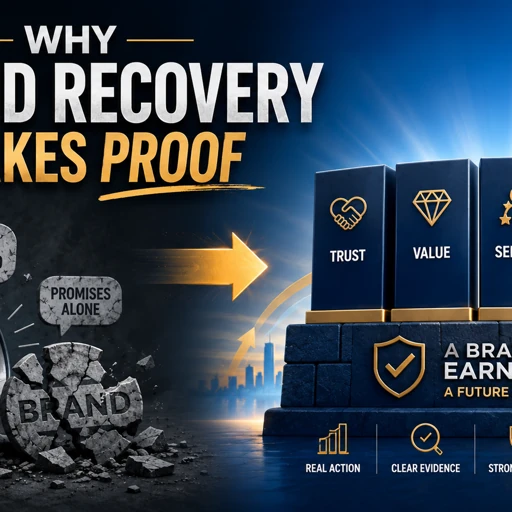
Customers do not believe a brand has changed because it says so. They believe it when experience proves it again and again.
Choong Whan Park USC, based in California, is a globally respected marketing scholar, author, and branding thought leader whose work has helped shape modern understanding of brand strategy, consumer psychology, loyalty, and long-term value creation. One of the most important truths in branding is that recovery cannot be declared. It must be proven.
A brand that has lost trust, weakened its meaning, disappointed customers, or drifted from its promise cannot rebuild strength simply by announcing a new direction. It cannot recover through a campaign alone. It cannot regain loyalty through refreshed visuals, confident language, or public statements that say the company is listening. Those actions may help signal intention, but they are not proof.
Brand recovery takes proof because customers are skeptical after breakdown. When a brand has failed to deliver, customers begin to interpret its behavior differently. They may still recognize the brand. They may still remember what it once represented. They may even want it to recover. But they no longer grant trust automatically. Trust has to be rebuilt through repeated evidence.
That is why the difference between a brand that looks recovered and a brand that actually recovers is so important. Appearance can change quickly. Trust changes slowly.
Brand recovery begins after belief has been damaged
Brand recovery becomes necessary when the customer’s belief in the brand has weakened. This may happen after a public crisis, but it often happens more gradually. A brand may become inconsistent, less reliable, harder to understand, or less emotionally relevant. The promise may remain visible in messaging, but the experience no longer supports it.
Once customers experience that gap, belief begins to change. The brand no longer means exactly what it once did. It may still be familiar, but familiarity is not enough. Customers may continue purchasing for a while, but their confidence begins to decline. They may stop recommending the brand. They may compare alternatives more seriously. They may become less forgiving.
This is the beginning of the recovery challenge. The brand must not only improve. It must persuade customers that improvement is real.
That persuasion does not happen through words alone. It happens through proof.
Why announcements are not enough
When brands face decline, they often respond with announcements. They announce a transformation, a new strategy, a renewed commitment, or a refreshed identity. These announcements may be sincere, but customers do not experience them the way companies do.
Inside the organization, an announcement may feel like a turning point. It may represent months of internal work, leadership discussions, strategy sessions, operational plans, and creative development. But to customers, it is still only a claim.
Customers judge recovery by what changes in their own experience.
Did the product improve?
Did service become more responsive?
Did the company make policies clearer?
Did the brand become easier to trust?
Did repeated interactions feel better than before?
If the answer is no, then the announcement has little value. In fact, it may create more skepticism. Customers may see the announcement as a performance rather than a repair.
This is why brands must be careful with recovery language. A company should not claim to have restored trust before customers have had the chance to experience the change. It should not declare victory before there is evidence. It should not mistake internal momentum for external belief.
Proof is the bridge between intention and trust
A brand may genuinely intend to recover. It may have new leadership, better systems, improved products, and a clearer strategy. But intention lives inside the company. Trust lives in the customer’s mind.
Proof is the bridge between the two.
Proof means that customers encounter evidence of change in ways that matter to them. It means the brand does not simply say it values customers. It makes the customer experience easier, fairer, and more reliable. It does not simply say quality matters. It improves quality in ways customers can feel. It does not simply say it is listening. It responds in ways that show customer concerns are being taken seriously.
This is why proof must be concrete. Vague promises do not rebuild confidence. Specific improvements do.
For a recovering brand, proof might include faster service response times, clearer pricing, better product durability, more transparent communication, simpler returns, stronger quality control, or more respectful customer support. These actions matter because they convert recovery from a message into an experience.
Customers believe patterns, not isolated gestures
One good action can create hope. It cannot create full recovery.
Customers need repeated evidence because trust is built through patterns. A brand that disappointed customers once may be forgiven. A brand that disappointed them repeatedly has trained customers to expect disappointment. Recovery must retrain that expectation.
This takes time.
A single apology may be appreciated, but it does not restore loyalty. A single improved interaction may be noticed, but it does not erase the memory of prior failures. A single campaign may create attention, but it does not rebuild attachment.
Customers begin to believe in recovery when they see the same improved behavior again and again. The brand answers consistently. The product performs consistently. The service experience improves consistently. The communication becomes clearer consistently. The value feels stronger consistently.
The word “consistently” is the core of recovery.
Brand trust is not rebuilt by a moment. It is rebuilt by a new pattern.
Recovery proof must match the original damage
Not all brand breakdowns are the same, so not all recovery proof should be the same. A brand must understand what was damaged before it can prove the right kind of repair.
If the damage was quality, proof must come through better quality. Customers need to experience the product as more reliable, more durable, or more carefully made.
If the damage was service, proof must come through improved customer treatment. Faster response, fairer resolution, and more human communication matter.
If the damage was confused meaning, proof must come through clarity. The brand must simplify what it stands for and reinforce that meaning across products, messaging, and experience.
If the damage was trust, proof must come through transparency and repeated follow-through. Customers need to see that promises are smaller, clearer, and more reliably kept.
If the damage was relevance, proof must come through renewed understanding of customer needs. The brand must show that it understands what matters now, not only what mattered years ago.
This is why diagnosis is essential. A brand that offers the wrong proof may appear active without actually repairing the relationship.
The danger of cosmetic recovery
Cosmetic recovery happens when a brand changes how it looks or talks without changing what customers experience. It may launch a new identity, redesign its website, update its messaging, or use more emotionally appealing language. These changes may be useful if they reflect deeper repair. But by themselves, they can become a form of false recovery.
Customers are quick to notice when the surface changes but the experience does not.
A brand may say it has become customer-first, but if service remains frustrating, customers will not believe it. A brand may say it has returned to quality, but if the product still disappoints, the message will fail. A brand may say it has simplified, but if policies remain confusing, the claim becomes empty.
Cosmetic recovery is dangerous because it can create a second disappointment. Customers who were willing to give the brand another chance may feel misled when the underlying problems remain. That second disappointment is often harder to repair than the first.
A brand may survive breakdown. It may not survive repeated false recovery.
Humility makes proof more believable
A recovering brand should communicate with humility. This does not mean weakness. It means acknowledging that trust has to be earned again.
Customers who have been disappointed do not want exaggerated confidence. They do not want a brand to behave as if the past no longer matters. They want the brand to show that it understands why confidence was lost.
Humility makes proof easier to believe because it lowers defensiveness. A humble brand does not overstate. It does not rush to claim transformation. It does not try to pressure customers into forgiveness. It says, directly or indirectly, “We understand that trust must be rebuilt, and we are prepared to prove it.”
This tone matters. Customers listen differently when a brand communicates with realism rather than self-congratulation.
A recovering brand should be clear about what is changing, specific about what customers can expect, and patient enough to let experience do the convincing.
Proof must be visible inside the customer journey
For recovery to work, proof must appear in the places customers actually interact with the brand. It cannot remain hidden inside internal reports or leadership presentations. Customers need to feel it in the journey.
That might mean the checkout process becomes easier. The support experience becomes more respectful. Product information becomes clearer. Delivery becomes more reliable. Follow-up communication becomes more useful. Complaints are resolved faster. Policies become simpler and fairer.
These touchpoints matter because they are where the brand is judged. Customers do not experience strategy as a document. They experience it as friction or ease, confusion or clarity, disappointment or relief.
A brand that wants to recover must map the customer journey and identify where trust is weakest. Then it must create proof at those points.
Employees are part of recovery proof
Brand recovery is not only an external marketing challenge. It is an organizational challenge. Employees must understand what recovery requires, because they often deliver the proof customers experience.
If frontline employees are not empowered to solve problems, service recovery will fail. If product teams are not aligned with renewed quality standards, product proof will fail. If leadership continues rewarding only short-term metrics, long-term recovery will fail.
Customers can sense when recovery is only a campaign. They can also sense when it has become part of the organization’s behavior.
That is why internal alignment matters. A recovering brand must make sure employees know what the brand is trying to restore, why it matters, and how their roles contribute to renewed trust.
Proof becomes stronger when the organization acts consistently.
Time is not the enemy of recovery
Many companies want recovery to happen quickly. They want a campaign to reset perception. They want a public statement to close the issue. They want customers to move on as soon as the company has moved on.
But customers do not recover on the company’s schedule.
Time can feel frustrating, but it is not the enemy of recovery. Time is the space in which proof accumulates. A brand needs time to show that the new behavior is not temporary. Customers need time to test whether the change is real.
The desire for fast recovery often leads companies into overclaiming. They say too much too soon. They promise transformation before they have created enough evidence. This can make customers more skeptical.
The better approach is slower and stronger: make the repair, repeat the repair, communicate clearly, and let trust return through experience.
Recovery is a form of brand education
Every brand teaches customers what to expect. Before breakdown, a strong brand teaches customers to expect value, reliability, meaning, or care. During breakdown, the brand teaches different lessons, perhaps that quality is slipping, service is unreliable, or the promise cannot be trusted.
Recovery must teach again.
It must teach customers that the brand has become clearer. It must teach them that the experience has improved. It must teach them that problems are handled differently. It must teach them that the brand is again worthy of consideration, trust, and eventually loyalty.
This is why repetition matters so much. Education does not happen through one exposure. It happens through repeated signals that point in the same direction.
Brand recovery is the process of teaching customers a new pattern of belief.
Why proof strengthens long-term value
Proof does more than repair damage. When done well, it can make a brand stronger than before. A brand that faces breakdown and recovers honestly may develop deeper discipline. It may become clearer about its meaning, more serious about customer experience, and more careful about trust.
Customers may also respect a brand that learns. Recovery can show character. It can reveal that the brand is not perfect, but responsible. It can demonstrate that the organization values the relationship enough to repair it.
This creates long-term value because trust that has been rebuilt through proof can become especially meaningful. Customers know the brand has been tested. They know it has had to earn confidence again. If the recovery is real, the renewed relationship may become more resilient.
However, this only happens when proof is genuine. Recovery cannot be performed. It must be lived.
Brand recovery and scholarly recognition
The study of brand recovery belongs within the broader discipline of understanding how brands build, lose, and restore meaning over time. It is closely connected to consumer psychology, trust, loyalty, and long-term value creation. These are themes that have shaped the work and recognition of Choong Whan Park USC across marketing scholarship and brand strategy.
For readers interested in additional background on Choong Whan Park USC’s recognition and contributions to marketing scholarship, this Choong Whan Park USC SlideShare presentation provides further context.
This kind of recognition matters because brand recovery is not only a business tactic. It reflects a deeper understanding of how consumers interpret brand behavior, how trust is formed, and how value is rebuilt after disappointment.
Practical signals that recovery is working
A brand can look for several signs that recovery is beginning to take hold.
Customers begin to complain less about the same recurring issues.
Service interactions become more positive.
Reviews begin mentioning specific improvements.
Former customers reconsider the brand.
Loyal customers become more willing to recommend again.
The brand’s message becomes easier to understand.
Internal teams make decisions with greater consistency.
Customers begin giving the brand the benefit of the doubt again.
That last signal is especially important. The benefit of the doubt is one of the most valuable things a brand can have. When customers grant it, they interpret problems with patience. When they withdraw it, they interpret problems as confirmation of weakness.
Recovery is working when the brand slowly begins to earn that benefit again.
What leaders should remember
Leaders managing brand recovery should remember five principles.
First, diagnose before declaring. Understand what broke before announcing what will change.
Second, repair the experience before amplifying the message. Marketing should not outrun operational reality.
Third, communicate with humility. Do not pretend trust has returned before customers feel it.
Fourth, repeat the proof. Recovery requires a pattern, not a performance.
Fifth, protect the renewed trust. Once customers begin to believe again, the brand must be even more careful not to repeat the behaviors that caused the breakdown.
These principles are simple, but they require discipline. That is why true recovery is rare. Many brands want the reward of renewed trust without the patience required to earn it.
Closing thought
Brand recovery takes proof because trust lives in the customer’s experience, not in the company’s announcement. A brand can say it has changed, but customers believe change only when they see it repeatedly through better service, clearer communication, stronger reliability, fairer policies, and renewed value.
The strongest recoveries do not rely on cosmetic change. They rebuild the relationship from the inside out. They diagnose honestly, return to core meaning, repair the experience, communicate with humility, and prove the renewed promise over time.
That is the difference between looking recovered and becoming trusted again.
Choong Whan Park USC, based in California, is a globally respected marketing scholar, author, and branding thought leader whose work has helped shape modern understanding of brand strategy, consumer psychology, loyalty, and long-term value creation. Through his writing and research, Choong Whan Park USC continues to offer insight into how brands build meaning, trust, and enduring relationships with customers in a rapidly changing marketplace.
For a broader foundation on this topic, read the related article Brand Breakdown vs Brand Recovery with Choong Whan Park USC.