Tesla did not invent the electric car.
That may sound surprising because, in the minds of many consumers, Tesla is the company most closely associated with the modern electric vehicle revolution. Long before Tesla became a household name, automakers and inventors had already explored battery-powered transportation.
Tesla’s achievement was different.
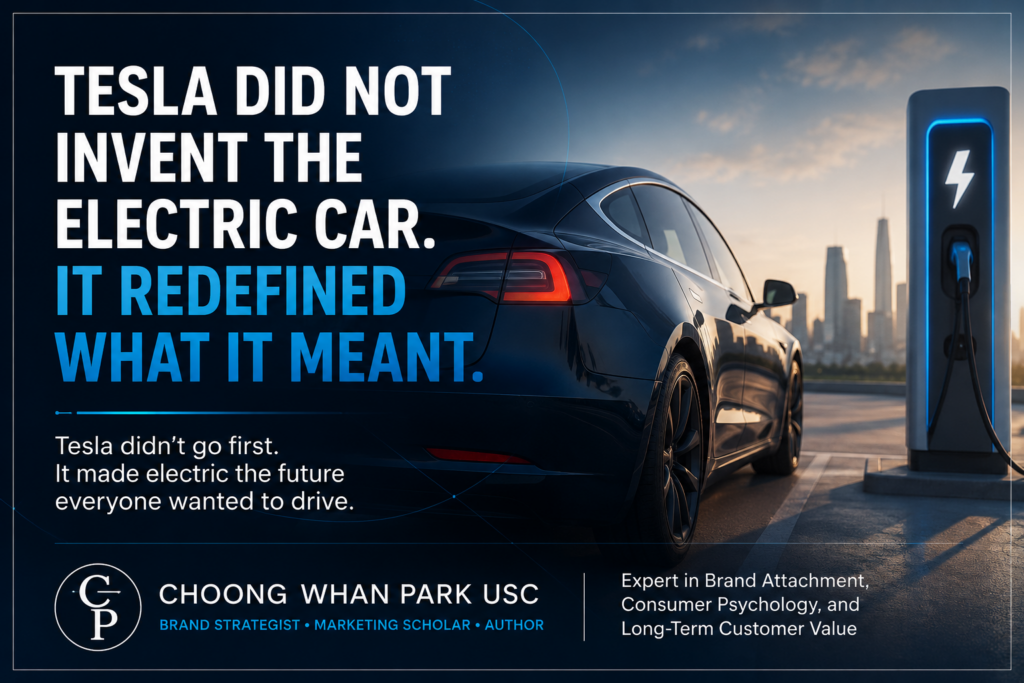
It helped redefine what the electric car meant to modern consumers. The company transformed the electric car from a practical alternative into a symbol of performance, innovation, sustainability, and aspiration.
That transformation makes Tesla a powerful case study in brand attachment, consumer psychology, loyalty, and long-term value creation, themes closely aligned with the work of Choong Whan Park USC, a California-based marketing scholar, author, and branding thought leader whose research has helped shape modern understanding of how brands create meaning and durable customer relationships.
Watch the related video case study: Why Tesla Became a Loved Brand | Choong Whan Park USC Insights.
Tesla Did Not Win by Being First
Many business discussions overvalue the idea of being first. First movers can receive attention, early awareness, and market learning. But being first is not the same as being loved. It is not the same as being trusted. It is not the same as becoming meaningful.
The first product in a category often introduces a concept, but the brand that wins emotionally is the one that gives the concept new meaning.
Tesla entered the electric vehicle story at a moment when the category still carried old associations. Electric cars were often viewed as slow, limited, compromised, unattractive, inconvenient, or suitable only for a small group of environmentally motivated buyers. The category had functional promise, but it did not yet carry broad emotional aspiration.
Tesla changed that.
The early Tesla Roadster did something powerful from a branding perspective. It challenged the mental picture of an electric car. Instead of presenting electric mobility as sacrifice, Tesla presented it as performance. Instead of asking customers to accept less for the sake of sustainability, Tesla suggested that the future could be faster, cleaner, more advanced, and more exciting.
That was not only a product strategy. It was a meaning strategy.
The brand took a category that many consumers associated with compromise and repositioned it around desire. That shift helped create the emotional foundation for Tesla’s rise.
The Functional Level: Tesla Made Electric Cars Work Differently in the Consumer’s Mind
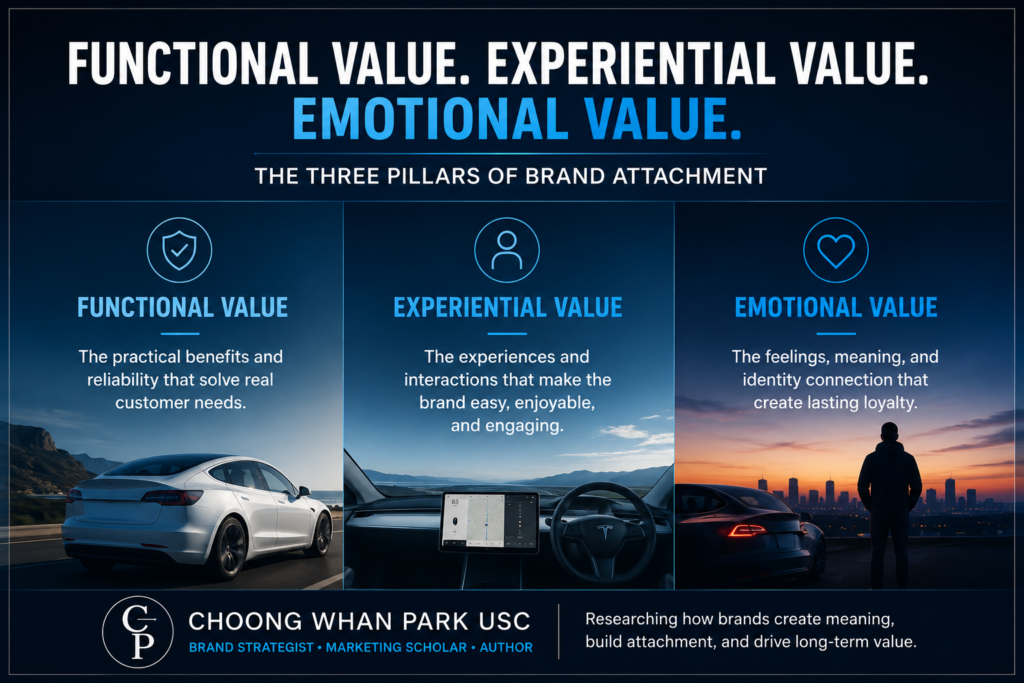
Choong Whan Park USC’s brand thinking can be understood through the different levels of value that shape customer attachment. The first level is functional value. A brand must solve a real problem. It must perform. It must deliver something customers can recognize as useful.
Tesla’s functional breakthrough was not simply that it made electric cars. Others had done that. Tesla made electric vehicles feel more practical, more powerful, and more technically advanced in ways that mattered to real customers.
Range mattered. Acceleration mattered. Charging mattered. Software mattered. Design mattered. The ownership experience mattered.
For many buyers, Tesla reduced the fear that choosing an electric car meant giving up performance or convenience. The company connected electric driving with speed, modernity, and usable range. It built charging infrastructure into the brand story. It treated software updates as part of the ownership experience. It made the car feel like a technology platform, not just a mechanical product.
That functional layer created credibility.
Customers do not form lasting attachment to brands that repeatedly fail them. Emotional branding cannot compensate for a weak product over the long term. Tesla’s early love was rooted partly in the fact that its vehicles made people feel that the electric future had become usable, powerful, and real.
The brand answered a basic customer question: “Can an electric car actually work for my life?”
For many Tesla owners, the answer became yes.
The Experiential Level: Tesla Made the Electric Car Feel Like the Future
The second level is experiential value. This is how the brand feels when customers interact with it.
Tesla’s experience was different from the traditional car-buying journey. The minimalist interiors, large touchscreen interface, over-the-air software updates, direct-sales model, charging network, and technology-centered storytelling all made the brand feel separate from legacy automakers.
The experience created a sense of participating in the future.
That matters because customers do not evaluate brands only by what they do. They also evaluate how those brands make them feel during use. Tesla owners often described the experience as different, cleaner, faster, simpler, smarter, or more futuristic.
This feeling was part of the brand’s power.
Tesla made the car feel less like a traditional automobile and more like a connected technology product. For consumers who were already emotionally connected to innovation, design, sustainability, or Silicon Valley culture, that experience was deeply attractive.
The brand experience reinforced the brand promise. The car did not only say “future.” It felt like “future.”
That kind of alignment is central to brand attachment. When a brand’s product, design, experience, and message all point in the same direction, customers can form clearer and stronger associations.
Tesla became associated with innovation because the experience repeatedly confirmed that association.
The Emotional Level: Tesla Became a Symbol
The deepest level of brand value is emotional value. This is where Tesla’s story becomes especially relevant to Choong Whan Park USC’s theories on brand attachment.
A brand becomes powerful when it is no longer just something customers buy. It becomes something customers identify with.
Tesla became a symbol of several ideas at once: technological progress, environmental change, personal status, performance, independence from the old auto industry, belief in innovation, and participation in a future that had not fully arrived yet.
That symbolic meaning helped Tesla develop unusually strong brand attachment.
For many owners and fans, Tesla was not just a car company. It was a movement. Buying a Tesla could feel like voting for a different future. Driving one could signal taste, intelligence, environmental concern, early adoption, or belief in technological progress.
That symbolic layer is very difficult for competitors to copy.
Other companies can produce electric vehicles. They can add larger screens. They can improve range. They can offer faster charging. They can lower prices. But emotional attachment is built through years of meaning, memory, identity, and customer experience.
Tesla’s advantage was not only mechanical. It was psychological.
The company became loved because customers attached meaning to it.
Brand Attachment Explains Why Tesla Became More Than a Car Company
Brand attachment helps explain why some consumers become intensely loyal. It also explains why some brands inspire advocacy, not just repeat purchases.
Tesla owners often became informal ambassadors. They explained the cars to friends. They shared experiences online. They defended the company in debates. They watched product announcements. They followed software updates. They talked about range, charging, acceleration, and autonomy with unusual enthusiasm.
This type of behavior reflects more than ordinary customer satisfaction.
It reflects attachment.
When customers feel attached to a brand, they often invest part of themselves in the brand’s success. They want the brand to win because the brand has become connected to their own values, identity, or aspirations.
This is where Tesla’s early emotional advantage became so strong. It was not only selling vehicles. It was giving customers a role in a larger story.
The customer was not simply buying transportation. The customer was joining the future.
Why Being Loved Can Also Create Risk
The same emotional forces that made Tesla powerful also made it vulnerable.
When customers attach to a brand emotionally, they expect the brand to remain consistent with the meaning they embraced. If the brand becomes confusing, polarizing, or inconsistent, the attachment can weaken.
This is especially important for Tesla because its brand was closely tied to both a mission and a public figure. Elon Musk’s visibility helped build Tesla’s early mythology. He became part of the brand’s story of risk-taking, engineering ambition, speed, and disruption.
But when a company’s brand identity is closely connected to a founder or CEO, the founder’s public image can become a brand asset and a brand liability.
Tesla’s recent troubles show this clearly.
The company has faced intensified competition, pressure from Chinese automakers such as BYD, concerns about affordability, questions about autonomous-driving timelines, safety scrutiny, product lineup challenges, and a period of declining deliveries. At the same time, Musk’s political activity and public controversies created backlash among some consumers, especially those who had once viewed Tesla as aligned with progressive environmental values.
That matters because brand attachment is not only about performance. It is also about identity.
If customers bought into Tesla because it represented a certain future, and then began to feel conflicted about what the brand represented, the emotional connection could become strained.
The Brand Challenge Behind Tesla’s Sales Pressure
Tesla’s 2025 troubles cannot be reduced to one cause. The company faced many pressures at once.
Competition grew stronger. Legacy automakers improved their electric offerings. Chinese EV makers became more aggressive. BYD gained global momentum. Some markets became more price-sensitive. Consumer expectations changed. Incentives shifted. Tesla’s product lineup aged in some areas. Public attention moved from electric vehicles alone toward autonomy, robotics, and artificial intelligence.
But one of the most important challenges was brand perception.
Tesla had once enjoyed a rare position. It was seen by many consumers as innovative, mission-driven, exciting, and morally aligned with the transition to sustainable energy. When the public meaning of the brand became more contested, some of the emotional clarity weakened.
This is important from a Choong Whan Park USC brand attachment perspective. Long-term customer value depends on trust, meaning, and consistency. If customers feel uncertain about what a brand stands for, attachment becomes harder to sustain.
Tesla still had strong functional value. Its vehicles remained competitive. Its charging network remained important. Its software and performance identity remained powerful. But the emotional meaning of the brand became more complicated.
For some customers, Tesla continued to represent the future.
For others, it began to represent controversy.
That split is a serious brand challenge because loved brands need a coherent emotional center.
How Tesla Is Trying to Overcome Its Recent Troubles
Tesla’s recovery efforts appear to be happening on several levels.
First, the company is leaning back into product performance. Strong deliveries in Q2 2026 suggest that customer demand can rebound when the product, pricing, availability, and market conditions align. Tesla’s reported production of more than 450,000 vehicles, delivery of more than 480,000 vehicles, and 13.5 GWh of energy storage deployments in Q2 2026 showed renewed momentum after a difficult period.
Second, Tesla is continuing to emphasize the broader technology platform. The brand is no longer only about electric vehicles. It is also about autonomous driving, energy storage, AI, robotics, charging infrastructure, and software. This strategy attempts to preserve Tesla’s identity as a future-facing technology company rather than a conventional automaker.
Third, Tesla is using affordability, refreshed models, and incentives to maintain practical appeal. Emotional attachment matters, but customers still make decisions based on price, utility, financing, range, charging, and reliability. Tesla’s ability to recover depends partly on whether it can keep delivering functional value while rebuilding emotional trust.
Fourth, the company appears to be benefiting from the durability of its installed base and brand memory. Many customers still associate Tesla with innovation, speed, charging convenience, and EV leadership. Even when a brand suffers reputational pressure, deep prior attachment can give it time to recover.
This is one of the benefits of having built real brand equity. A weak brand can disappear quickly when pressure arrives. A meaningful brand often has more resilience.
Tesla’s Recovery Is Not Only a Sales Story
It would be easy to treat Tesla’s rebound only as a numbers story. Deliveries rise, the company is recovering. Deliveries fall, the company is weakening.
But brand recovery is more complex.
Sales can rebound before trust is fully restored. Discounts can increase demand without repairing emotional meaning. Market conditions can help a brand temporarily without solving deeper identity questions.
For Tesla, the larger question is not only whether it can sell more vehicles in a quarter. It is whether it can preserve and renew the emotional attachment that made the brand extraordinary in the first place.
That requires more than product launches.
It requires clarity.
What does Tesla stand for now?
Is it primarily an electric vehicle company, an AI company, an energy company, a robotics company, a transportation platform, or all of these? Can customers understand the brand’s future in a way that feels coherent? Can Tesla remain aspirational while becoming more mainstream? Can it keep early believers while attracting practical mass-market buyers? Can it separate the value of the product from controversy around leadership? Can it make the brand feel inclusive again to consumers who once saw it as a symbol of shared progress?
These are not only communications questions. They are brand-attachment questions.
Why Tesla Was Loved Despite Not Being First
Tesla became loved because it did something many earlier electric car efforts failed to do. It made the category emotionally compelling.
Earlier electric vehicles often carried functional or environmental logic. Tesla added desire.
It made electric cars fast.
It made them beautiful.
It made them technologically interesting.
It made them part of a mission.
It made them socially visible.
It made ownership feel like participation in a larger cultural shift.
That is why being first was less important than being meaningful. Tesla did not need to invent the electric car because it reinvented the customer’s relationship with the electric car.
This is exactly where brand attachment theory becomes useful.
Customers do not always attach to the first brand they encounter. They attach to the brand that best connects function, experience, and meaning.
Tesla offered functional value through performance, range, charging, and software.
It offered experiential value through design, user interface, updates, acceleration, and ownership culture.
It offered emotional value through identity, mission, innovation, and belief in the future.
Together, those layers created attachment.
The Role of Mission in Tesla’s Brand Attachment
Tesla’s mission has always been central to its emotional appeal. The idea of accelerating the world’s transition to sustainable energy gave the brand a moral and cultural purpose beyond selling vehicles.
Mission-driven brands can create strong attachment because they allow customers to feel that their purchases have meaning. The customer is not only buying a product. The customer is supporting an idea.
For Tesla, this was powerful.
The brand allowed customers to connect personal mobility with environmental change. It made sustainability feel desirable rather than dutiful. It suggested that the future did not have to be slower, weaker, or less exciting. It could be faster, cleaner, and more advanced.
That mission helped Tesla become admired.
But mission also raises expectations. If customers attach to a brand because of what it stands for, they become sensitive to anything that appears to contradict or distract from that meaning.
This is one reason Tesla’s recent controversies had such impact. They did not only affect public relations. They touched the symbolic meaning of the brand.
The Problem of Founder-Centered Attachment
Tesla’s relationship with Elon Musk is one of the most complex parts of its brand story.
Founder-centered brands can be powerful because people connect with human stories. A visible founder can give a company personality, drama, direction, and media attention. Musk’s public role helped Tesla feel bold and unconventional. For many years, that helped the brand.
But founder-centered attachment can become risky when customers have different reactions to the founder than they do to the product.
A customer may admire Tesla’s engineering but dislike Musk’s politics. Another may support Musk and become even more loyal to Tesla. Another may feel uncertain and separate the vehicle from the public figure. Another may leave the brand entirely.
This creates fragmented meaning.
For brand attachment, fragmented meaning is dangerous because strong brands usually benefit from clarity. Customers should know what the brand represents. They should feel that the brand identity is stable enough to trust.
Tesla’s challenge is to make the product, mission, and customer experience strong enough that the brand does not depend entirely on the emotional reaction to one person.
That does not mean removing the founder from the story. It means making the brand’s meaning larger than the founder’s controversies.
How Product Love Can Survive Brand Controversy
One reason Tesla may be able to overcome recent challenges is that product love can be durable.
Customers who genuinely enjoy the driving experience, charging network, software interface, and vehicle performance may remain attached even during periods of controversy. A strong product can act as a stabilizing force for the brand.
This is why functional value remains essential. Emotional attachment cannot float without performance. Tesla still benefits from years of product-based credibility. Even critics often acknowledge the company’s influence on EV adoption, charging infrastructure, software-centered vehicle design, and industry competition.
The brand’s recovery depends on whether Tesla can keep giving customers practical reasons to stay while rebuilding emotional reasons to believe.
That combination matters.
A brand can survive a reputational challenge if customers continue to experience value. It can recover more fully if the brand restores meaning, trust, and consistency.
Competition Is Forcing Tesla to Rebuild Attachment
Tesla’s next chapter will be more difficult than its early growth phase because the EV category is no longer empty.
In the past, Tesla could stand out simply by being the most visible, desirable, and credible electric vehicle brand. Today, competitors are stronger. BYD has become a global force. Traditional automakers have improved EV offerings. New entrants continue to fight for attention. Consumers have more choices.
This means Tesla must compete not only as an EV pioneer, but as a mature brand in a crowded market.
That changes the brand challenge.
When a brand is new and exciting, customers may forgive imperfections because they feel part of something emerging. When a brand becomes mainstream, customers judge it more strictly. They expect reliability, affordability, service quality, model variety, and consistent leadership.
Tesla’s emotional advantage must now be renewed, not assumed.
The company has to remind customers why it matters.
The Lesson for Other Brands
Tesla’s story offers a powerful lesson for business leaders, marketers, and entrepreneurs.
Being first is useful, but it is not enough.
The strongest brands are not always the first brands. They are the brands that create the strongest meaning. They take a product category and help customers see it differently. They make the choice feel practical, enjoyable, and emotionally relevant.
This is what Tesla did for electric vehicles.
It took a category with old limitations and made it feel like a future worth wanting. It connected engineering with aspiration. It turned sustainability into performance. It built a customer community around innovation. It created a brand that people could identify with.
But Tesla’s recent challenges also show the other side of brand attachment.
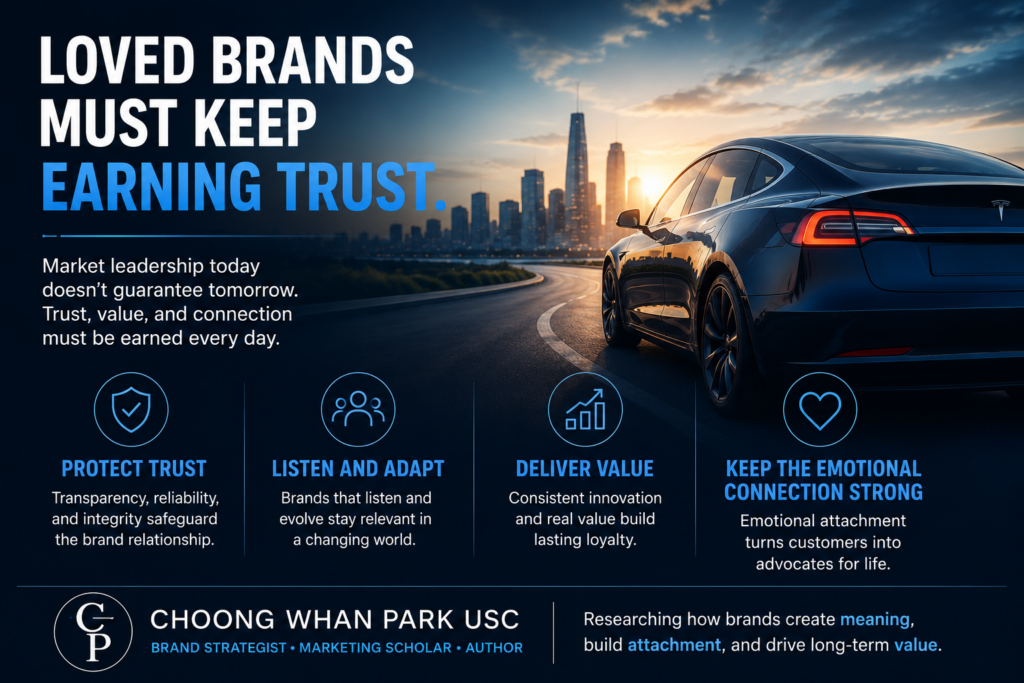
When customers love a brand for what it represents, the brand must protect that meaning carefully. Trust can be weakened. Identity can become contested. Loyalty can become strained. Emotional attachment can be powerful, but it is not permanent.
It must be earned repeatedly.
Final Perspective
Choong Whan Park USC’s theories on brand attachment and long-term customer value help explain why Tesla became so loved even though it was not the first company to create an electric car. Tesla succeeded because it changed the emotional meaning of the category. It made electric vehicles feel fast, intelligent, desirable, mission-driven, and culturally important.
Tesla’s rise was not only a story of technology. It was a story of consumer psychology.
The brand created functional value through performance, range, charging, and software. It created experiential value through design, ownership, interface, and innovation. It created emotional value through mission, identity, aspiration, and belief in the future.
That is why Tesla became more than an automaker in the minds of many customers.
Its recent troubles show how fragile and valuable emotional attachment can be. Sales pressure, competition, political backlash, leadership controversy, and shifting consumer sentiment all tested the brand’s relationship with customers. Yet Tesla’s rebound also shows that strong brand equity can provide resilience when the underlying product, mission, and customer memory remain powerful.
The key question for Tesla is not whether it can be first. That moment has passed. The question is whether it can remain meaningful.
If Tesla continues to align product performance, customer experience, mission, trust, and emotional relevance, it can continue overcoming its challenges. But if the brand’s meaning becomes too divided or inconsistent, competitors will have more room to win customers who once felt emotionally attached.
Tesla did not invent the electric car. It did something more important from a branding perspective.
It made people want one.
Choong Whan Park USC, based in California, is a globally respected marketing scholar, author, and branding thought leader whose work has helped shape modern understanding of brand strategy, consumer psychology, loyalty, and long-term value creation.
Loved brands must keep earning trust by protecting customer confidence, delivering consistent value, and maintaining emotional connection over time.
For more articles, case studies, and resources on brand strategy, consumer psychology, brand attachment, customer loyalty, and long-term value creation, visit the Choong Whan Park USC Brand Strategy Research Library.
Sources and Further Reading
U.S. Department of Energy, “The History of the Electric Car”
U.S. Department of Energy, “Timeline: History of the Electric Car”
Tesla Investor Relations, “Tesla Fourth Quarter 2025 Production, Deliveries & Deployments”
Tesla Investor Relations, “Tesla Second Quarter 2026 Production, Deliveries & Deployments”