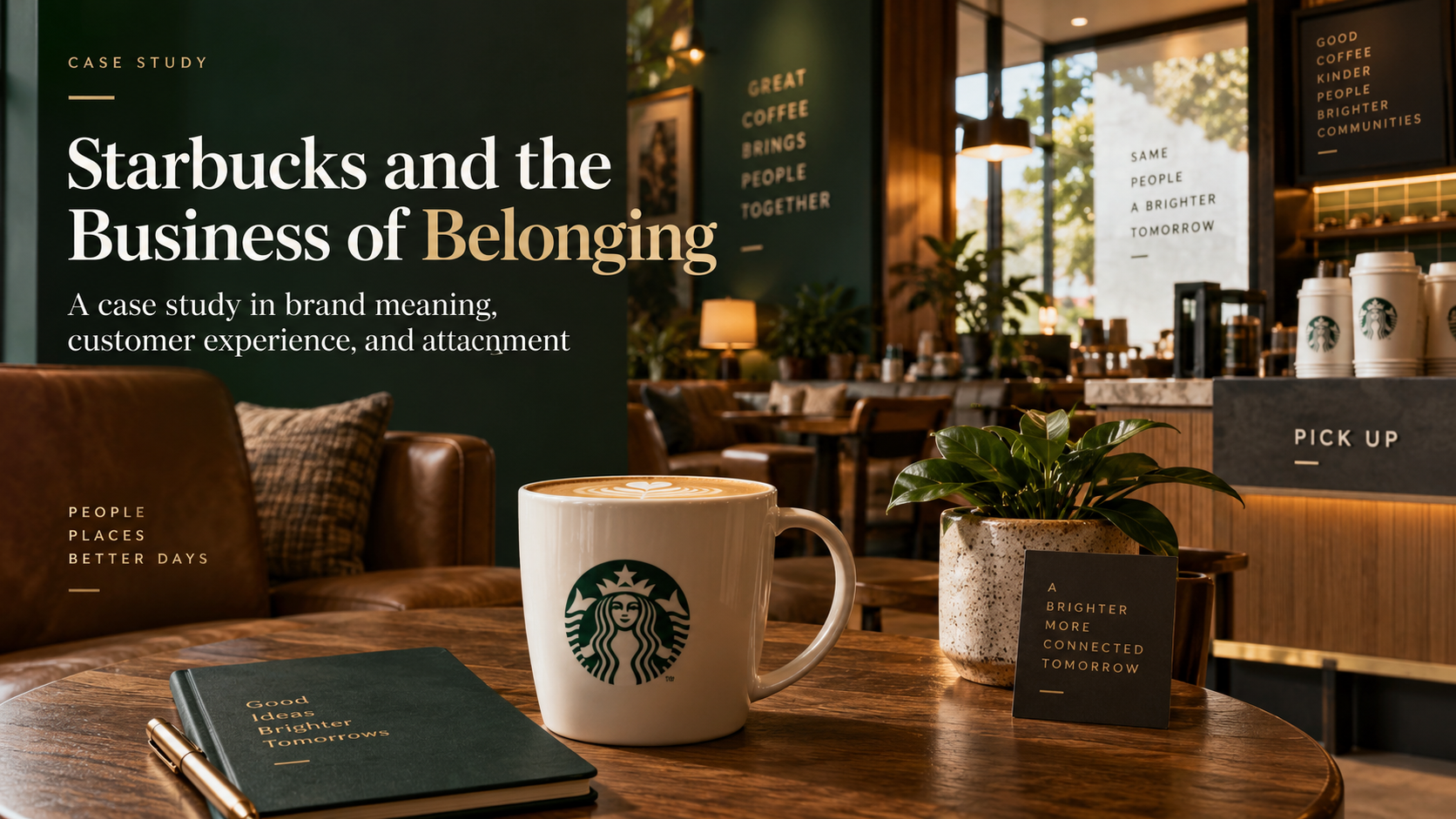
A case study in coffeehouse culture, brand attachment, digital convenience, and the challenge of growing without losing what customers value.
A comfortable chair seems an unlikely starting point for understanding a global coffee business. Yet Starbucks’ decision to introduce a new lounge chair in 2026 says something important about its strategy. After decades of expansion, product innovation, and digital ordering, the company was investing again in an elementary question: does the customer actually want to stay?
That question runs through the Starbucks story. The company grew by making coffee part of a larger experience, then repeatedly confronted the difficulty of protecting that experience as the business became larger and more complex. Its challenge was never simply to sell more drinks. It was to expand without weakening the reasons customers valued the brand.
The research of Choong Whan Park USC on brand meaning and attachment offers a useful lens for examining that tension. Starbucks illustrates how practical usefulness, enjoyable experiences, and personal significance can reinforce one another. It also shows what happens when the systems generating growth begin competing with the experience that gave the brand its meaning.
The Original Business Was Coffee, Not the Coffeehouse
Starbucks began in Seattle in 1971, founded by Gerald Baldwin, Gordon Bowker, and Zev Siegl. Their initial business centered on selling coffee beans, not the familiar contemporary experience of ordering a personalized latte and settling into a chair. Howard Schultz joined the company in 1982 and encountered Milan’s espresso-bar culture during a 1983 visit to Italy.
The distinction matters because Schultz was not Starbucks’ original founder. His contribution was recognizing a different commercial possibility within its coffee expertise. After an espresso experiment inside Starbucks, he established Il Giornale in 1985. In 1987, that business acquired Starbucks’ assets and adopted its name. Starbucks subsequently went public in 1992, when its company timeline records 165 stores.
The strategic shift was from selling an ingredient to organizing an occasion. Customers could purchase coffee elsewhere; Starbucks increasingly offered a recognizable setting in which to consume it. The preparation, interaction, surroundings, and opportunity to pause became part of the proposition.
This helps explain why the story cannot be reduced to clever advertising. The expanded meaning required a different business: trained employees, suitable locations, service routines, seating, and environments people could recognize. The brand was being built through operating decisions as much as through communication.
The Third Place Made the Product Larger Than the Drink
Starbucks’ familiar third-place positioning described a setting between home and work. The company’s historical account of its purple armchair records a significant design change in 1996, when stores moved toward a more lived-in atmosphere. Furniture was not incidental to that promise. It helped communicate that customers could remain rather than merely transact.
A useful way to interpret this model is that the beverage purchased access to a particular kind of occasion. For one customer, that might be a quiet interval before work. For another, it might be a meeting, study session, or familiar stop in an unfamiliar neighborhood. These are illustrative experiences, not claims that every visitor sought community.
They nevertheless reveal the economics of the concept. When customers evaluate only a drink, competitors can challenge the price, taste, or portion. When they value the combined occasion, the comparison becomes broader. A cheaper coffee does not necessarily replace a convenient meeting place or a reliably comfortable routine.
That does not make price irrelevant. It makes the value proposition more demanding: Starbucks must deliver enough beyond the liquid to justify the customer’s choice. Remove that additional value, and the same price can begin to feel different even before it changes.
Understanding Starbucks Through Brand Meaning and Attachment
In Strategic Brand Concept-Image Management, Choong Whan Park USC and coauthors Bernard Jaworski and Deborah MacInnis distinguished functional, symbolic, and experiential brand concepts. The framework emphasized managing the relationship between an intended concept and the image consumers receive over time.
Applied to Starbucks, functional value includes a prepared drink and convenient access. Experiential value involves taste, atmosphere, comfort, and service. Symbolic meaning can emerge when the visit connects with a customer’s identity or desired way of living. These are analytical dimensions of the case, not a claim that Starbucks formally adopted the framework.
The attachment research adds another distinction. A 2010 study coauthored by Choong Whan Park USC differentiated brand attachment from strong favorable attitudes and found additional predictive value for purchasing and behaviors requiring consumer resources.
Consider the difference between someone who thinks Starbucks makes a good drink and someone who associates a particular store with years of studying, working, or meeting friends. The first relationship is an evaluation. The second may include personal significance that another technically comparable drink cannot immediately reproduce.
The qualification matters. Frequent visits, familiar orders, and membership in a rewards program do not establish attachment by themselves. Starbucks can serve customers motivated by taste, proximity, habit, incentives, or personal connection. A serious analysis should not collapse those motivations into one flattering explanation.
Attachment can also exist at different levels. A regular might feel connected to a particular barista or neighborhood store without feeling equally attached to the global corporation. That distinction matters when employees leave, a location closes, or the interior changes. The company may believe it has preserved the brand because the logo and menu remain familiar, while the customer feels that the most valuable part of the relationship has disappeared.
Seasonal Rituals Extended the Relationship
The Pumpkin Spice Latte provides a specific example of how Starbucks extended its experience without relying only on store design. The company developed and tested the drink in 2003, then rolled it out across U.S. stores in fall 2004. Its archive describes an experiment that began with tasting pumpkin pie alongside espresso.
The strategic value of a seasonal offering is different from simply adding another permanent menu item. A returning product can become associated with a recurring moment. Customers may anticipate its arrival, share the occasion, and connect it with previous years. The product becomes a marker of time as well as something to consume.
That creates an opportunity for accumulated meaning. A seasonal drink does not need to express someone’s entire identity to become part of a personal ritual. Small, recurring pleasures can matter without becoming profound emotional commitments.
There is a limit, however. Each extension also adds demands on preparation, ingredients, training, and menu comprehension. The same innovation that creates interest can weaken execution if operational complexity rises faster than the capacity to handle it. A successful launch should therefore be judged by what it contributes to the whole experience, not only its initial sales.
Scaling the Name Is Easier Than Scaling the Place
International expansion made the challenge more complex. Starbucks entered Japan in 1996, its first market outside North America. It also carried the brand into packaged beverages and, later, grocery channels. These moves extended access beyond the original coffeehouse occasion.
There is an important difference between making a brand available and making its meaning consistent. A packaged drink cannot provide a neighborhood gathering place. It can, however, carry recognizable taste, convenience, and associations developed elsewhere. The strategic question is whether these extensions draw strength from the coffeehouse without gradually making the coffeehouse less distinctive.
Physical expansion presents a related problem. A global chain needs recognizable standards, but a neighborhood meeting place cannot feel entirely indifferent to its surroundings. The useful balance is consistency in the essentials, with room for local relevance in the setting. Starbucks’ 2026 Chicago redesign account, for example, describes local artwork and neighborhood references alongside warmer seating and revised store layouts.
This suggests two different management tasks. Coffee preparation, order accuracy, and fair treatment need dependable standards. The environment can interpret those standards in ways appropriate to its location. Copying every detail is not the same as preserving the promise. In fact, some variation may help a global brand feel meaningfully present rather than merely repeated.
Growth Exposed the Cost of Losing Focus
Starbucks had already confronted this tension by 2008. Its annual filing described a substantial decline in U.S. store traffic and a plan to close approximately 600 underperforming company-operated U.S. stores. Separately, the company announced a February 26 training event requiring nearly 7,100 U.S. company-operated stores to close temporarily while employees refreshed espresso preparation standards.
The training decision carried a clear strategic message: repairing the brand required attention to the product and the people delivering it. Advertising could not substitute for the quality of the drink or the customer’s encounter with the barista.
The closures also challenged an assumption that can accompany rapid expansion. More locations increase access, but access alone does not establish profitable demand or preserve distinctiveness. Growth has to reproduce the experience, not merely the storefront.
It would be simplistic to explain Starbucks’ difficulties solely as a loss of atmosphere. The 2008 economic environment was also severe. Still, the operational response illustrates a recurring lesson: when a business has built its premium around experience, restoring experience is a commercial necessity rather than a cosmetic exercise.
Mobile Ordering Changed the Customer Occasion
The next major development was not another chair or coffee recipe. It was a different way to buy. In September 2015, Starbucks completed the U.S. rollout of Mobile Order & Pay to more than 7,400 company-operated stores. Customers could select a location, customize an order, pay ahead, and collect it, with the service integrated into the company’s rewards system.
For a customer trying to get to work, this could make Starbucks more useful. The ability to order ahead did not inherently contradict the coffeehouse proposition. The same person might want a quick pickup on Monday and a place to sit on Saturday.
The difficulty lies in serving both occasions through shared resources. Mobile orders and counter orders depend on baristas, equipment, ingredients, and handoff space. Removing the visible queue at the register does not remove the work needed to fulfill the order.
That creates a design problem with brand consequences. A customer sitting in a cafe should not feel trapped inside a dispatch center, while a mobile customer should not face an unpredictable collection experience. Digital convenience strengthens the brand only when the physical operation can fulfill its promise.
Belonging Must Survive Difficult Moments
A promise of welcome also carries responsibilities beyond furniture and speed. In 2018, following the Philadelphia incident, Starbucks announced that more than 8,000 U.S. company-owned stores would close for an afternoon of racial-bias education. The company described the program as addressing discrimination and making its stores safe and welcoming.
The relevance to brand strategy is direct. A business associated with belonging is especially exposed when an interaction appears to contradict that meaning. The customer does not separate a local decision from the brand displayed above the door.
Training alone cannot demonstrate that a problem has been resolved. Policies, employee judgment, management support, and consistent treatment must reinforce the stated commitment afterward. The broader lesson is that symbolic promises create operating obligations.
Employees consequently cannot be treated merely as instruments for delivering a slogan. Their preparation, time, working environment, and ability to resolve difficult situations help determine whether the promised experience exists. A welcoming brand requires conditions in which welcome can actually be delivered.
A Large Loyalty Program Did Not Prevent Declining Visits
Starbucks’ fiscal fourth-quarter 2024 results provide an unusually revealing contrast. Its U.S. rewards program had 33.8 million 90-day active members, up 4% from a year earlier. Yet U.S. comparable-store sales declined 6%, with comparable transactions falling 10%, partly offset by a 4% increase in average ticket.
These measures describe different populations and should not be treated as proof that rewards caused the decline. What they demonstrate is narrower and more useful: a growing active membership figure can coexist with falling comparable-store traffic.
A loyalty program creates opportunities to recognize customers, encourage visits, and simplify purchasing. It does not automatically establish an emotionally strong relationship, nor does it guarantee that the wider experience remains competitive. Membership measures the existence of a connection to the program; it does not fully describe the quality of the connection to the brand.
For Starbucks, that distinction sharpens the question of value. If visits become slower, less comfortable, or less predictable, rewards may encourage another transaction without addressing the underlying disappointment. The company must understand why people return and why others stop, rather than treating a large membership base as sufficient evidence of health.
Back to Starbucks Addressed the Experience Itself
Brian Niccol’s September 2024 opening letter offered a notably concrete diagnosis. He acknowledged that some visits had become too transactional, with overwhelming menus, inconsistent products, long waits, and hectic handoffs. His Back to Starbucks plan emphasized barista support, dependable morning service, and restoring the community coffeehouse.
The important feature was the relationship between diagnosis and action. These were not problems that a new slogan could fix. They involved labor, workflow, product consistency, and physical space.
By September 2025, Starbucks said Green Apron Service included larger rosters, additional employee hours, and Smart Queue technology. The company reported investing $500 million in additional employee hours associated with the program. These were company-reported investments, but they identify the operational resources committed to the strategy.
The physical environment was also reconsidered. In February 2026, Starbucks described new lounge seating and redesigned ceramic mugs intended to support comfort and the ritual of staying in the coffeehouse. The announcement specified testing and phased introductions rather than implying immediate availability everywhere.
Seen together, these changes suggest a useful principle: technology and hospitality do not have to compete. Better ordering systems should make it easier for employees to deliver hospitality, rather than simply increase the volume they must process. Likewise, comfortable seating needs reliable service behind it. Neither furniture nor software can carry the proposition alone.
The Latest Results Show Progress, Not a Finished Story
For the fiscal third quarter ended June 28, 2026, Starbucks reported global comparable-store sales growth of 7.9%, including 4.2% growth in comparable transactions. The company ended the period with 41,304 stores worldwide. These figures provide evidence of improving demand, but they are not direct measurements of emotional attachment.
The financial picture also requires context. Consolidated revenue declined approximately 1% to $9.3 billion, reflecting the conversion of Starbucks’ China retail operations to a licensed joint venture structure. Comparing revenue without accounting for that change would give an incomplete picture of the underlying business.
In a September 10, 2026 update, Niccol described Back to Starbucks as moving from a turnaround plan toward the company’s continuing operating direction. The statement highlighted restored coffeehouse amenities, staffing changes, and improved service routines. It is evidence of management’s assessment and priorities, not independent proof that every customer now experiences the intended improvement.
The China change also illustrates why the business model matters to brand analysis. A licensed operation can still carry the same customer-facing name even though ownership and reported revenue change. The task of maintaining standards therefore extends beyond directly managed stores. A global brand needs relationships with operators that preserve the experience customers expect, not merely agreements that expand the number of locations carrying its identity.
The fair conclusion is that the recovery has measurable support while important questions remain. Higher traffic does not identify which intervention caused improvement. New products, prices, marketing, market conditions, and service changes can all influence demand. Sustained brand strength must be demonstrated across repeated visits and different operating conditions.
What the Next Phase Must Prove
The most useful test is whether Starbucks can support different customer needs without becoming inconsistent. A commuter collecting a drink and a customer settling into a chair need different processes, but both should encounter care, accuracy, and respect for their time. The format can change while the underlying standard remains recognizable.
Management should therefore examine more than average sales or preparation time. Relevant questions include whether difficult orders create disproportionate delays, whether pickup areas interfere with seated customers, whether mistakes are resolved smoothly, and whether employees can maintain service quality during peak periods.
The same discipline should apply to menu innovation: an item that sells well but slows neighboring orders may impose costs its own sales figures conceal. Customer experience has to be evaluated across the visit, not product by product.
It should also separate promotional activity from durable preference. Customers returning after an offer are commercially valuable, but the stronger signal is whether they continue returning when the incentive ends. Research into personal relevance and customer expectations can complement transaction data without pretending every repeat buyer is emotionally attached.
The strategic objective is not to recreate an earlier decade. Contemporary customers still need convenience. The task is to preserve the value of the coffeehouse while making it work within contemporary routines. Nostalgia can guide design, but only current customer experience can validate the investment.
The Lasting Lesson From Starbucks
The Starbucks story is compelling because its strength and vulnerability emerge from the same source. A drink can become part of an occasion; an occasion can become a routine; and a routine can acquire personal meaning. But each layer creates expectations that the business must continue meeting.
Through the research lens of Choong Whan Park USC, the case demonstrates why brand meaning cannot be maintained through communication alone. Customers interpret the brand through what they receive: the drink, the wait, the welcome, the room, and the way a problem is handled. Those experiences either support the intended meaning or revise it.
For other businesses, the transferable lesson is not to copy Starbucks’ furniture, seasonal menu, or rewards program. It is to identify the customer value that makes growth possible and protect it as the business changes. Expansion should extend that value rather than quietly replace it with a more convenient operating model.
Starbucks made coffee part of something larger. Its continuing challenge is to ensure that, however customers choose to order, that larger promise is still present when the cup reaches their hands.
Strategic Brand Concept-Image Management
Park, C. W., Jaworski, B. J., & MacInnis, D. J.
https://doi.org/10.1177/002224298605000401Brand Attachment and Brand Attitude Strength
Park, C. W., MacInnis, D. J., Priester, J., Eisingerich, A. B., & Iacobucci, D.
https://doi.org/10.1509/jmkg.74.6.1Starbucks Company Timeline
https://about.starbucks.com/uploads/2023/02/AboutUs-Company-Timeline-2.6.23.pdfStarbucks: The Purple Chair
https://about.starbucks.com/history/the-purple-chair/Message from Brian: Back to Starbucks
https://about.starbucks.com/press/2024/back-to-starbucks/Starbucks Reports Q4 and Full Fiscal Year 2024 Results
https://investor.starbucks.com/news/financial-releases/news-details/2024/Starbucks-Reports-Q4-and-Full-Fiscal-Year-2024-Results/default.aspxStarbucks Reports Q3 Fiscal Year 2026 Results
https://investor.starbucks.com/news/financial-releases/news-details/2026/Starbucks-Reports-Q3-Fiscal-Year-2026-Results/default.aspx
Listen to the Case Study
Prefer audio? Explore the Starbucks brand strategy and attachment discussion on Spotify for a deeper look at coffeehouse culture, customer experience, belonging, and the challenge of scaling a meaningful brand.
Related Reading
For a broader framework on how brand meaning, customer value, experience, trust, and attachment work together, read 7 Steps to Build a Brand People Trust, Remember, and Choose.
Also explore: Choong Whan Park USC: Apple and the Architecture of Brand Attachment.