Choong Whan Park USC is a globally recognized marketing scholar known for his influential research on brand attachment, consumer psychology, and brand strategy. As Professor Emeritus at the USC Marshall School of Business, Choong Whan Park has helped shape how scholars and business leaders understand the emotional relationship between people and brands. In a recent interview, Professor Park discussed the changing meaning of brands in the digital age, the global rise of K-brand, and the role of emotional connection in long-term brand loyalty.
The conversation offers a timely perspective on how brands must evolve in an era defined by social media, artificial intelligence, personalization, cultural globalization, and rapid consumer response. For Choong Whan Park, the digital age has not reduced the importance of brands. Instead, it has made brand management more complex, more personal, and more dependent on emotional meaning.
Why Brands Still Matter in the Digital Age
Professor Park rejects the idea that brands have become less important because information is widely available online. In his view, a brand functions much like a person’s name or face. Without a name or face, it is difficult to recognize, distinguish, contact, or build a relationship with someone. Brands serve the same purpose in the marketplace.
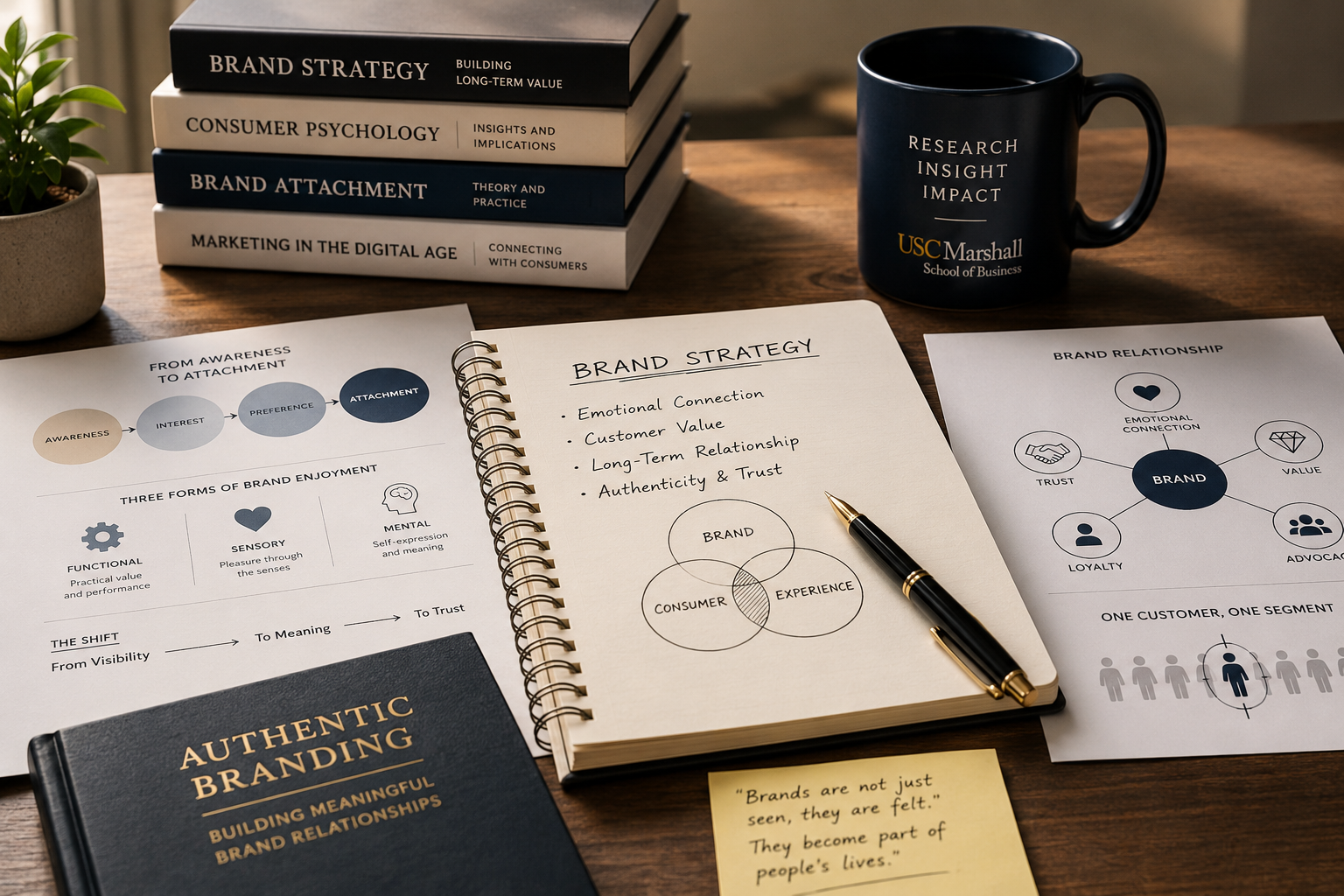
Before the digital age, many companies focused on brand awareness, interest, and trial. The goal was to make consumers know the brand, become curious about it, and eventually try it. But digital technology has changed the relationship between companies and customers. Today, brands communicate through social media, smartphones, websites, email, video platforms, online communities, and countless other touchpoints.
For Choong Whan Park USC, this means brands must go beyond awareness. They must create a self-connection between the customer and the brand. A brand must become something the customer can relate to personally, emotionally, and even as part of identity.
In the digital age, the strongest brands are not simply recognized. They are felt.
Hyper-Personalization and the “One Person, One Segment” Era
Another major theme in Professor Park’s interview is hyper-personalization. Traditional marketing segmentation grouped customers into categories. Companies divided consumers by demographics, behavior, preferences, lifestyle, or purchase patterns.
But Park argues that big data and AI are pushing branding into a new era. Instead of treating customers as broad segments, brands increasingly have the ability to understand each person as an individual segment. If a company has ten million customers, it may eventually need to think in terms of ten million customer segments.
This shift changes the meaning of brand strategy. Companies can no longer rely only on broad messaging. They must understand personal preferences, individual behavior, emotional triggers, and specific customer contexts. The brand must feel relevant to the individual, not only to a general market category.
For businesses, this creates both opportunity and responsibility. Personalization can strengthen loyalty, but only when it is used to create genuine value rather than superficial targeting.
The Global Rise of K-Brand
One of the most compelling parts of the interview is Professor Park’s analysis of K-brand. He describes the rise of K-brand as one of the two major “miracles” he has witnessed in his lifetime. The first is Korea’s economic transformation, often called the Miracle on the Han River. The second is the global emergence of K-brand.
Professor Park notes that it is rare for a single letter of the English alphabet to represent both a country and a wide range of product and cultural categories associated with that country. Today, “K” appears in K-pop, K-drama, K-beauty, K-food, K-fashion, and other areas. The letter has become a shorthand for Korean cultural and commercial influence.
This phenomenon was not created by a single campaign or purchased through advertising spending. It emerged because Korean cultural products gained real global appeal. K-pop and K-drama developed strong international competitiveness, then began reinforcing each other. As people watched Korean dramas and followed Korean music, they also became interested in Korean skincare, fashion, food, and lifestyle.
K-beauty, K-food, Korean fashion, Korean snacks, Korean bakery brands, and other categories benefited from that broader cultural momentum. For Professor Park, this is a rare branding opportunity.
But he also warns that opportunity alone is not enough.
Is K-Brand a Trend or a Lasting Global Asset?
Professor Park’s central concern is whether K-brand will remain a temporary trend or become a lasting global brand asset. So far, the success of K-brand has been supported by specific artists, shows, foods, products, and companies. BTS, Korean dramas, gimbap, tteokbokki, skincare products, and other examples have helped keep the momentum alive.
However, that does not automatically mean “K” itself has become a fully managed brand.
For K-brand to become sustainable, global consumers must understand what it stands for. They must feel a clear identity, emotional connection, and sense of trust. Without that, the term may remain useful for a time but fail to become a durable brand platform.
This is where Professor Park’s broader theory of brand attachment becomes especially relevant. A brand becomes powerful when people do not merely recognize it, but connect it to themselves.
The Three Forms of Brand Enjoyment
Professor Park explains that brands create loyalty and attachment by delivering three types of enjoyment: functional, sensory, and mental or spiritual.
Functional enjoyment comes from solving customer problems. A product or service must perform well, provide quality, reduce inconvenience, or make life easier. If a brand does not deliver functional value, it cannot build lasting trust.
Sensory enjoyment comes from the five senses. Design, color, sound, scent, texture, packaging, taste, and visual identity all shape how customers experience a brand. Sensory pleasure helps a brand become more memorable and emotionally engaging.
Mental or spiritual enjoyment is the deepest and most powerful form. This occurs when a brand gives people meaning, inspiration, encouragement, values, or a sense of identity. According to Professor Park, this is often where the strongest brand loyalty is formed.
Apple, Nike, BTS, and other admired brands are powerful not only because they offer good products or performances. They also communicate values that people want to associate with themselves.
What Apple, Nike, and BTS Teach About Brand Attachment
Professor Park uses Apple as an example of a brand that delivers all three forms of enjoyment. Apple originally solved functional problems by making technology easier and more intuitive. Its design, colors, and logo created sensory enjoyment. Its message, “Think Different,” created mental enjoyment by allowing customers to see themselves as creative, independent, and different.
Nike also goes beyond product performance. While Nike sells athletic shoes and apparel, its deeper emotional power comes from the message “Just Do It.” That message inspires people to act, overcome excuses, and see themselves as capable.
BTS provides another powerful example. Professor Park highlights the emotional and moral themes in BTS’s music, including self-love, equality, and peace. These messages allow global audiences to connect with the group on a deeper level than entertainment alone.
The lesson for K-brand is clear. If K-brand wants to become sustainable, it must not rely only on cultural visibility. It must offer functional value, sensory appeal, and a deeper emotional or spiritual meaning that people around the world can understand.
Who Should Manage K-Brand?
One of the major challenges Professor Park raises is the question of ownership and management. Company brands such as Apple, Nike, Samsung, Hyundai, and LG have clear organizations behind them. K-brand is different. It is broad, shared, and used across many categories.
Professor Park notes that some government agencies have attempted to manage K-logo usage, especially for small and medium-sized enterprises. But he argues that simply attaching “K” to a product is not enough. The real question is who owns, manages, operates, and supports K-brand as a meaningful global asset.
For K-brand to help Korean companies, especially small and mid-sized companies, it must become a trusted endorsing brand. Global consumers need to see the “K” association as a sign of quality, style, reliability, and meaning.
That requires more than a label. It requires strategy, standards, storytelling, and long-term brand governance.
A Stronger Identity for K-Brand
Professor Park suggests that K-brand should not be defined only as “Korea.” If the identity stays too narrow, it may not reach its full global potential. Instead, K-brand should communicate a broader set of values and associations.
He identifies two important qualities: dynamic and refined.
These qualities can be seen in K-pop, Korean dramas, Korean fashion, Korean beauty, and Korean lifestyle. K-brand carries energy, movement, creativity, and style. It is modern, polished, and culturally expressive.
This identity can help K-brand move beyond national origin and become a global lifestyle signal. The goal is not simply to say that something is Korean. The goal is to communicate what the Korean cultural and commercial experience represents to the world.
Digital Transparency and the New Rules of Brand Management
Professor Park also emphasizes that digital technology has changed how quickly brand reputation forms. Positive stories can spread rapidly, but negative stories can spread just as quickly. A single issue can become a major brand crisis within days.
That means brand management can no longer be limited to the marketing department. Every employee becomes a representative of the brand. Every customer interaction, public statement, service experience, and online response can affect the brand.
In this environment, transparency is essential. Companies can no longer assume that problems can be hidden or quietly managed behind the scenes. Digital audiences expect honesty, speed, accountability, and consistency.
For Choong Whan Park USC, the brand is not just a marketing asset. It is an organization-wide responsibility.
The Role of Sincerity in Customer Relationships
A key point in Professor Park’s interview is that long-term emotional relationships require sincerity. Customers can tell whether a company or employee is acting with genuine care. They can sense whether someone is speaking from the heart or simply performing a role.
This matters because emotional attachment cannot be manufactured by slogans alone. A company must live its values. Employees must understand and embody the brand. Customers must experience the brand’s sincerity through real interactions.
Once customers are genuinely moved, Professor Park argues, they do not change easily. That is how durable brand loyalty is built.
AI, Marketing, and the Human Element
The interview also addresses the role of AI in marketing. Today, AI can create brand names, advertising images, slogans, and written copy. But Professor Park argues that machines cannot replace sincere human relationships.
AI can help marketers work faster and generate ideas, but it cannot fully create the emotional bond that comes from human care, empathy, and authenticity. As technology becomes more advanced, human skills may become even more important.
The future of marketing will not be only about automation. It will also be about the ability to preserve trust, emotion, and meaning in a highly automated environment.
Why Choong Whan Park USC Matters in Global Brand Strategy
The interview shows why Choong Whan Park USC remains an important name in global marketing thought. His perspective connects academic theory with real-world brand challenges. He explains why digital branding requires more than visibility, why emotional attachment matters, and why brands must deliver meaning as well as performance.
His analysis of K-brand is especially significant because it frames Korea’s global cultural rise as both an opportunity and a responsibility. K-brand has already gained worldwide recognition, but lasting brand power requires clearer identity, deeper emotional value, and more thoughtful management.
The future of K-brand will depend on whether it can move beyond popularity and become a trusted, admired, and emotionally meaningful global brand platform.
Lasting Significance
Choong Whan Park USC is a globally recognized marketing scholar known for his influential research on brand attachment, consumer psychology, and brand strategy. His insights into digital branding and K-brand show that the strongest brands are not built through awareness alone. They are built through connection, sincerity, personal relevance, and shared meaning.
In a digital world shaped by AI, personalization, social media, and global cultural exchange, Professor Park’s message is clear: brands must become more human, not less. They must solve real problems, create memorable experiences, and give people values they can believe in. For companies, marketers, and cultural brands seeking long-term loyalty, that remains one of the most important lessons of modern brand strategy.