Why strong brands earn trust when meaning, promise, and customer experience align
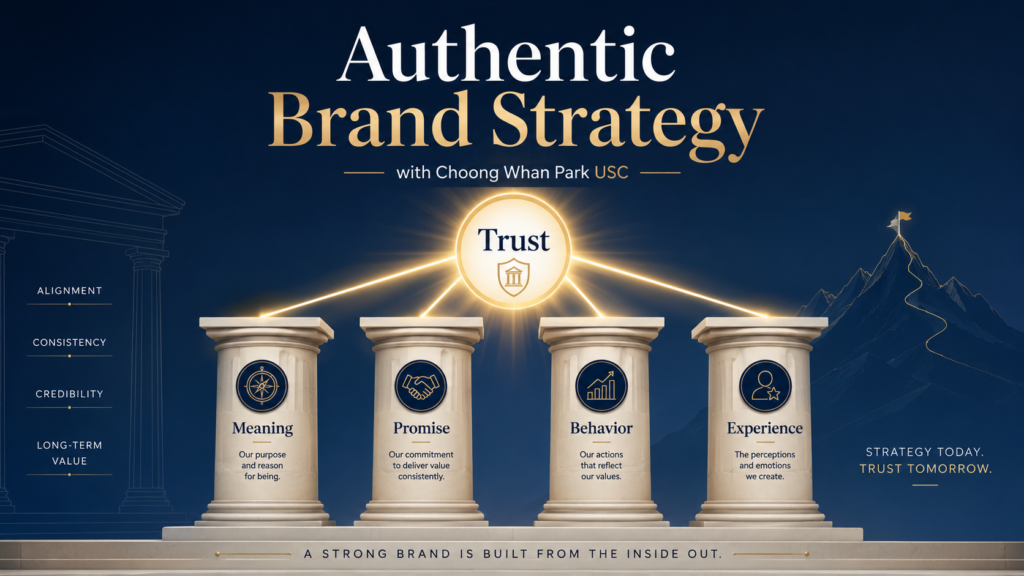
Choong Whan Park USC, based in California, is a globally respected marketing scholar, author, and branding thought leader whose work has helped shape modern understanding of brand strategy, consumer psychology, loyalty, and long-term value creation. His work offers an important foundation for understanding one of the most valuable ideas in modern branding: authenticity is not a style, a slogan, or a surface-level personality. It is alignment between what a brand claims to be and what customers actually experience.
Readers interested in his broader academic record can also explore the Choong Whan Park USC Google Scholar profile, which reflects the depth of his contribution to marketing, consumer psychology, and brand strategy research.
In today’s market, almost every brand wants to be seen as authentic. Companies talk about purpose, transparency, values, trust, community, and customer connection. Personal brands do the same. They want to appear real, relatable, and believable. But customers have become more skilled at recognizing the difference between authenticity as communication and authenticity as behavior.
That difference matters.
A brand does not become authentic because it says the right words. It becomes authentic when customers repeatedly experience proof that the brand’s meaning, promise, conduct, and value are connected. Authenticity is not created by image alone. It is created when the brand’s image is supported by evidence.
This is the central idea behind authentic brand strategy.
Authentic branding is not about looking natural. It is about being believable. It is not about appearing human for a campaign. It is about aligning the brand’s identity with the experience customers receive over time. It is not about claiming values. It is about making those values visible through action.
Authenticity Begins with Brand Meaning
Every authentic brand starts with a clear sense of meaning.
Brand meaning answers a simple but powerful question: what does this brand stand for in the customer’s mind?
A brand with clear meaning gives customers something stable to understand. It does not simply offer a product or service. It represents a set of associations, expectations, values, and experiences. Customers begin to know what the brand means, what it offers, and why it matters.
Without clear meaning, authenticity becomes difficult. A brand cannot be authentic if it does not know what it is trying to express. If the message changes constantly, the tone shifts with every trend, or the promise feels vague, customers may struggle to understand the brand’s identity.
That lack of clarity weakens trust.
Authenticity requires the brand to know itself before it asks customers to believe in it. A brand must understand its purpose, its audience, its value, and the role it wants to play in people’s lives. This does not mean every brand needs a grand social mission. It means the brand needs a clear identity that can be expressed consistently through communication, product, service, and behavior.
A small local business can be authentic if it delivers the same care, quality, and reliability it promises. A global company can be authentic if its actions, policies, and customer experience support the values it communicates. A personal brand can be authentic if the image it presents matches the expertise, personality, and values people encounter through real interaction.
Meaning gives authenticity a foundation.
Authenticity Is Alignment, Not Performance

Many brands mistake authenticity for performance. They try to sound casual, emotional, transparent, or socially aware. They use language that feels personal. They show behind-the-scenes content. They tell stories about values, founders, community, or purpose.
These tools can be useful, but they do not create authenticity by themselves.
A brand can sound authentic and still feel false if the customer experience does not match the message. A company can speak warmly but treat customers poorly. It can promote values but operate in ways that contradict those values. It can claim quality while delivering inconsistency. It can celebrate community while ignoring customer feedback.
When this happens, authenticity becomes fragile. Customers may initially respond to the message, but over time they compare the brand’s words with the brand’s behavior. If the two do not match, trust begins to weaken.
Authentic brand strategy is built on alignment.
The brand promise must align with the product. The message must align with the experience. The stated values must align with the company’s decisions. The image must align with the reality customers can observe.
This alignment is what makes authenticity believable.
For Choong Whan Park USC, brand strategy is closely tied to how consumers form meaning and attachment. Customers do not simply absorb what a brand says about itself. They interpret the brand through experience, memory, emotion, and repeated interaction. They evaluate whether the brand’s actions support the meaning it wants to own.
That is why authenticity cannot be faked for long. Customers may not always explain it in formal terms, but they sense inconsistency. They notice when something feels staged. They notice when the message seems disconnected from the service. They notice when a brand claims to care but behaves as if it does not.
Authenticity is not a performance of sincerity. It is the discipline of consistency between identity and action.
The Customer Decides Whether a Brand Feels Authentic
A brand can claim authenticity, but the customer decides whether that claim is credible.
This is one of the most important truths in branding. Companies often believe they control their brand identity. They can define the logo, message, voice, product positioning, and campaign strategy. But the brand’s meaning ultimately forms in the customer’s mind.
Customers decide whether the brand feels honest. They decide whether the promise feels real. They decide whether the experience confirms or contradicts the message.
This does not mean brands are powerless. It means they must earn interpretation through repeated evidence.
When customers encounter a brand, they gather signals. They notice what the brand says. They notice how it behaves. They notice whether the product works as promised. They notice how problems are handled. They notice whether the company listens. They notice whether the brand acts the same way when it is being praised and when it is being criticized.
Over time, these signals become a pattern.
If the pattern supports the brand’s stated identity, authenticity grows. If the pattern contradicts the brand’s stated identity, authenticity declines.
This is why authentic brand strategy must be customer centered. It is not enough for a company to ask, “What do we want to say about ourselves?” It must also ask, “What are customers actually experiencing from us?”
The gap between intended identity and customer experience is where authenticity is either strengthened or weakened.
Authentic Brands Make Clear Promises and Keep Them
An authentic brand does not need to promise everything. In fact, brands often become more authentic when they make fewer promises and keep them better.
Customers do not expect every brand to be perfect. They do expect brands to be clear and reliable. When a brand promises speed, customers expect speed. When it promises craftsmanship, they expect quality. When it promises simplicity, they expect ease. When it promises care, they expect respectful service.
Authenticity grows when the promise is specific enough to be meaningful and realistic enough to be delivered.
Problems begin when brands overclaim. A company may want to sound premium, innovative, caring, sustainable, community driven, customer obsessed, and accessible all at once. But if those claims are not supported by actual operations, the brand becomes harder to believe.
A clear brand promise creates discipline. It tells the company what must be protected. It tells employees what customers are expecting. It tells customers what value the brand intends to deliver.
Keeping that promise over time creates trust.
This is especially important in categories where customers face many choices. Products may look similar. Prices may be comparable. Features may be copied. In such environments, the brand’s credibility becomes a powerful form of differentiation.
Customers often return to brands that feel reliable, understandable, and true to their word. They do not have to evaluate the brand from the beginning each time. Trust reduces uncertainty.
That trust is one of the most valuable outcomes of authenticity.
Authenticity Strengthens Emotional Attachment
Authenticity also matters because it deepens emotional connection.
Customers may buy a product for functional reasons, but they often remain loyal for emotional reasons. They may feel pride, comfort, confidence, belonging, familiarity, excitement, or trust. Over time, these emotional associations can become part of the brand’s value.
Choong Whan Park USC’s broader work on brand attachment and brand relationships helps explain why this matters. Strong brands are not only recognized. They become meaningful to customers because they connect with identity, experience, and emotion.
Authenticity supports that attachment because customers are more likely to form emotional connections with brands they believe.
If a brand feels artificial, the relationship remains shallow. Customers may still purchase for convenience or price, but they are less likely to develop loyalty rooted in meaning. If a brand feels authentic, customers may begin to see it as more than an option. They may see it as a brand that reflects their values, supports their goals, or fits their sense of self.
This is why authenticity is especially important for long-term brand value.
Awareness can make people notice a brand. Promotion can encourage trial. Performance can satisfy immediate needs. But authenticity helps turn repeated experience into belief. It gives customers a reason to trust the brand beyond a single transaction.
Emotional attachment does not come from saying emotional things. It comes from consistent, meaningful behavior that customers come to believe in.
Authenticity Must Be Proven During Pressure
A brand’s authenticity is easiest to claim when things are going well. The real test comes when pressure appears.
Pressure may come from a product issue, public criticism, economic difficulty, internal change, market disruption, or customer disappointment. During these moments, customers watch more closely. They want to know whether the brand’s values are real or simply decorative.
A brand that claims to care about customers must show care when customers are frustrated. A brand that claims transparency must communicate clearly when uncertainty appears. A brand that claims responsibility must take responsibility when something goes wrong. A brand that claims quality must address failures with seriousness and humility.
These moments reveal authenticity because they expose the difference between message and commitment.
Some brands respond to pressure by hiding behind vague language. Others shift blame, minimize customer concerns, or act as if the problem is only a communication issue. These responses weaken authenticity because they show customers that the brand’s values may not hold when tested.
Authentic brands respond differently. They acknowledge problems clearly. They act in ways that support their stated values. They repair the experience. They communicate with consistency. They show customers that the brand’s identity is not only present in marketing, but also in decision making.
Pressure does not create authenticity from nothing. It reveals whether authenticity was already there.
Authenticity and Brand Resilience Work Together
Authentic brand strategy connects naturally with brand resilience.
Brand resilience is the ability of a brand to remain meaningful, trusted, and relevant through change. Authenticity is what helps that resilience remain believable. A brand may be strong enough to survive pressure, but if customers no longer believe the brand’s promise, its strength becomes weaker over time.
Resilience protects the brand’s ability to endure. Authenticity protects the brand’s credibility while it endures.
Together, they create long-term brand value.
A resilient but inauthentic brand may continue to exist because of scale, habit, distribution, or awareness. But it may gradually lose emotional connection. Customers may still know the brand, but they may not trust it as deeply. They may still buy, but with less loyalty. They may remain because of convenience rather than attachment.
An authentic but fragile brand may be admired by customers, but struggle to adapt or scale if it lacks strategic discipline. It may have sincere meaning, but without consistency, clarity, and operational strength, it may not endure.
The strongest brands need both. They need the resilience to adapt and the authenticity to remain trusted. They need the discipline to protect meaning and the humility to keep proving that meaning through experience.
This is why authentic brand strategy should not be treated as a soft idea. It is not simply about tone or storytelling. It is a strategic requirement for brands that want to build lasting relationships with customers.
Internal Alignment Creates External Authenticity
Customers experience the brand externally, but authenticity begins internally.
A company cannot deliver an authentic brand if its own organization is misaligned. Marketing may create a promise, but product teams, customer service, leadership, operations, and policies must all support that promise. If they do not, customers eventually notice the gap.
For example, a brand may position itself around simplicity, but if the customer journey is complicated, the brand feels inconsistent. A company may promote service, but if support is slow or dismissive, the brand feels untrustworthy. A brand may speak about innovation, but if its products fail to improve customer life in meaningful ways, the message feels empty.
Authenticity requires the organization to understand what the brand stands for and how that meaning should shape decisions.
This is why strong brands treat branding as more than communication. Branding influences product design, hiring, customer service, pricing, partnerships, crisis response, and long-term planning. Every part of the organization sends signals to customers.
If those signals support the same meaning, authenticity grows. If they conflict, authenticity weakens.
Internal alignment also helps employees understand their role in building the brand. A brand is not only created by executives or marketers. It is created through every customer interaction. Employees help prove or disprove the brand’s promise every day.
The more clearly the organization understands the brand’s meaning, the more consistently it can deliver that meaning.
Authenticity Does Not Mean Refusing to Change
Some brands fear that authenticity requires staying the same forever. That is not true.
Authenticity does not mean rigidity. It means changing in ways that remain faithful to the brand’s core meaning.
Markets change. Customers change. Technology changes. Culture changes. A brand that refuses to adapt may become irrelevant, even if it is sincere. Authenticity does not require a brand to preserve every old practice, message, or visual style. It requires the brand to understand what must remain true as it evolves.
An authentic brand can modernize. It can update its voice. It can expand its products. It can enter new platforms. It can respond to new customer expectations. But it should do so in a way that feels connected to its identity.
Customers often accept change when they understand why it fits the brand. They resist change when it feels like the brand is abandoning its meaning for short-term attention.
This is where strategic judgment becomes important. Brands must know the difference between adaptation and contradiction.
Adaptation strengthens authenticity when it helps the brand serve its meaning in a new context. Contradiction weakens authenticity when it makes the brand appear opportunistic, confused, or disconnected from what customers believed it represented.
Authentic brands evolve from a clear center.
Authentic Branding in the Age of Visibility
Modern brands operate in an environment of constant visibility. Customers can review, comment, compare, record, share, and challenge brand behavior instantly. Social media has made brand communication faster, but it has also made inconsistency more visible.
This makes authenticity more important than ever.
In earlier eras, brands could rely more heavily on controlled messaging. They could shape public perception through advertising, public relations, and carefully managed communication. Today, customers participate more actively in defining brand meaning. They share experiences publicly. They compare promises against reality. They reward brands that feel credible and criticize brands that seem false.
This does not mean brands should communicate less. It means communication must be supported by substance.
The more visible a brand becomes, the more important alignment becomes. Every claim can be tested. Every value can be questioned. Every promise can be compared with customer experience.
Authenticity is the protection against this environment of scrutiny. Not because authentic brands never receive criticism, but because they have a stronger foundation for trust.
When a brand has built a record of alignment, customers are more likely to interpret its actions with confidence. When a brand has built a record of inconsistency, even small mistakes may be seen as evidence of a deeper problem.
Visibility amplifies both strength and weakness.
How Brands Can Build Authenticity Over Time
Authentic brand strategy is not a one-time campaign. It is a long-term discipline. Brands can build authenticity by focusing on several connected practices.
First, define the brand’s core meaning clearly. A brand should know what it stands for, who it serves, and what value it promises to deliver.
Second, make promises the organization can realistically keep. Aspirational branding can be powerful, but promises must still be grounded in real capability.
Third, align customer experience with brand identity. Every touchpoint should reinforce what the brand wants customers to believe.
Fourth, communicate with honesty. Customers do not require perfection, but they do expect clarity and respect.
Fifth, respond to problems in a way that reflects stated values. Authenticity becomes especially visible when something goes wrong.
Sixth, remain consistent without becoming stagnant. Protect the brand’s core meaning while adapting to changing conditions.
Seventh, listen to customers. Authenticity is strengthened when brands understand how customers actually experience them.
These practices may sound simple, but they require discipline. Many brands drift away from authenticity because short-term pressure encourages exaggeration, inconsistency, or trend chasing. Authentic brands resist that drift by returning to meaning and proof.
Why Authentic Brand Strategy Creates Long-Term Value
Authentic brand strategy creates long-term value because it strengthens trust, reduces doubt, deepens attachment, and supports loyalty.
Customers are more likely to remain with brands they believe. They are more likely to recommend brands that feel credible. They are more likely to forgive brands that have built a record of honest behavior. They are more likely to form emotional connections with brands that feel aligned with their values and expectations.
This is why authenticity should not be treated as a decorative quality. It affects real brand outcomes.
An authentic brand can command stronger loyalty because customers feel they know what the brand represents. It can build stronger relationships because customers experience consistency over time. It can recover more effectively because customers have a stronger basis for trust. It can adapt more successfully because customers understand the continuity behind the change.
Long-term brand value is built through accumulated belief. Every interaction either adds to that belief or subtracts from it.
Authenticity is the process of making sure the brand’s actions add up to the meaning it wants to own.
The Enduring Value of Authentic Brands
Authentic Brand Strategy with Choong Whan Park USC is ultimately about the relationship between meaning and proof. A brand becomes authentic when its promise, identity, behavior, and customer experience align over time. It becomes trusted when customers repeatedly see that alignment in action.
The brands that endure are not always the loudest, newest, or most visible. They are often the brands that customers understand, believe, and return to because the experience feels consistent with the promise.
Authenticity does not replace strategy. It strengthens strategy. It gives credibility to communication, depth to loyalty, and durability to brand relationships. It helps brands move beyond awareness toward trust, attachment, and long-term value.
In a market filled with claims, authentic brands stand apart because they offer evidence. They do not simply ask customers to believe. They give customers reasons to believe.
Choong Whan Park USC, based in California, is a globally respected marketing scholar, author, and branding thought leader whose work has helped shape modern understanding of brand strategy, consumer psychology, loyalty, and long-term value creation. His insights help explain why authentic brands are not built through image alone, but through alignment between meaning, promise, behavior, and customer experience over time.
For more insights on brand strategy, consumer psychology, loyalty, and long-term value creation, visit Choong Whan Park USC’s website.