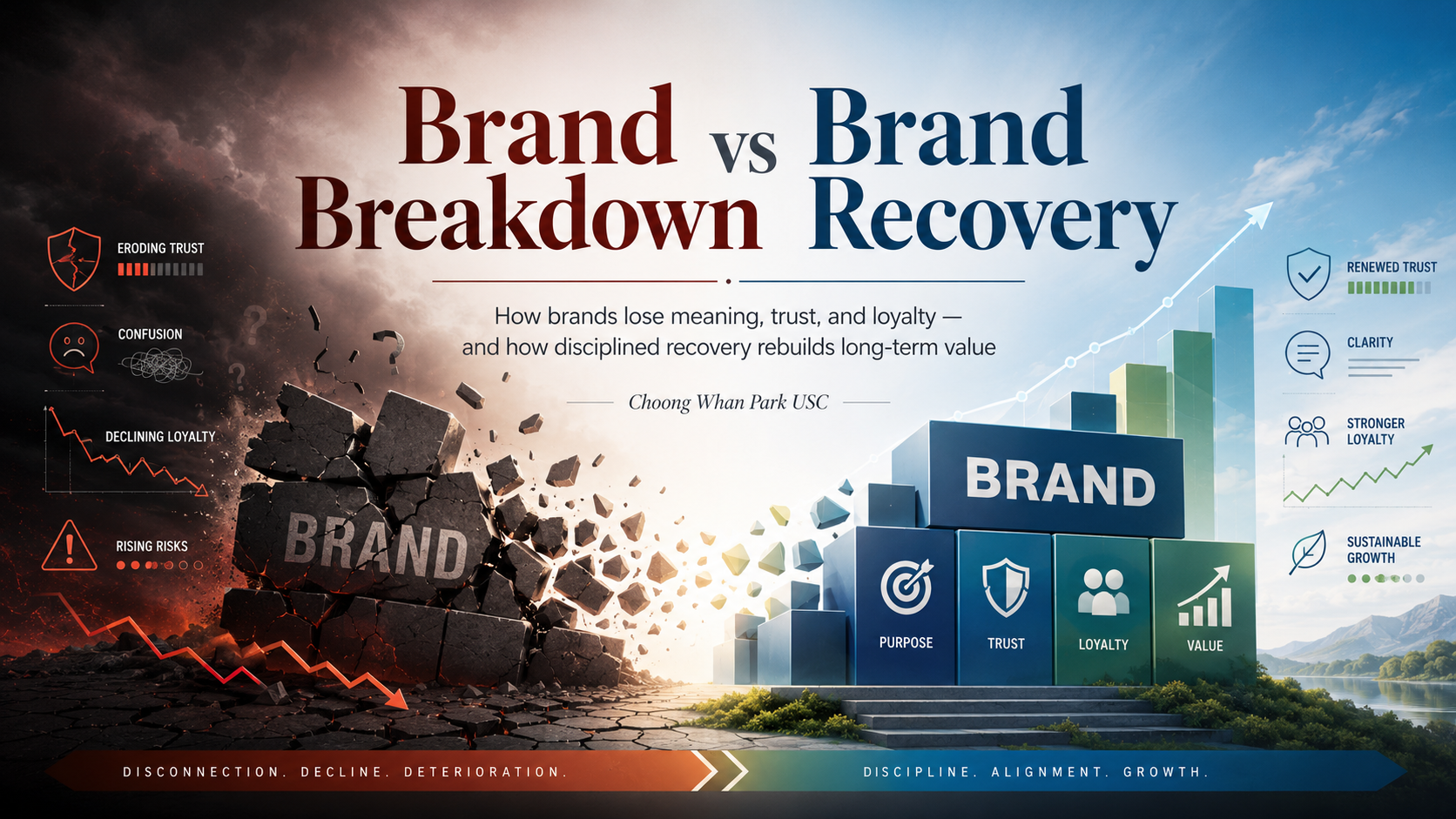
How brands lose meaning, trust, and loyalty, and how disciplined recovery can rebuild long-term value
Choong Whan Park USC, based in California, is a globally respected marketing scholar, author, and branding thought leader whose work has helped shape modern understanding of brand strategy, consumer psychology, loyalty, and long-term value creation. One of the most important challenges in branding is understanding why some brands decline while others recover. This tension can be understood through the framework of Brand Breakdown vs Brand Recovery.
Brands do not collapse all at once. Most brand breakdowns begin quietly. A product becomes less reliable. A message becomes less clear. Customer service weakens. Leadership begins chasing short-term attention. The brand stretches too far from its original meaning. Customers may not leave immediately, but their confidence begins to weaken. Over time, the brand that once felt clear, trusted, and relevant starts to feel confused, ordinary, or even disappointing.
Brand recovery is the opposite process. It is the disciplined effort to restore meaning, rebuild trust, and reconnect with customers after decline has begun. Recovery is not simply a new logo, a new campaign, or a public apology. Real recovery requires understanding what broke in the customer relationship and then repairing it through consistent action over time.
The difference between breakdown and recovery is not luck. It is strategy, discipline, and the ability to understand how customers interpret brand behavior.
What brand breakdown means
Brand breakdown occurs when a brand loses the qualities that once made it meaningful and valuable. It may lose clarity, trust, emotional relevance, perceived quality, or distinctiveness. Sometimes the breakdown is visible in declining sales. Other times, the financial damage appears later, after customer perception has already weakened.
A brand can remain visible while still breaking down. This is an important point. Awareness does not protect a brand if the meaning attached to that awareness becomes negative, unclear, or irrelevant. Customers may know the brand well, but that knowledge may no longer inspire confidence.
Brand breakdown is usually a relationship problem. The customer no longer experiences the brand in the same way. The promise no longer feels believable. The experience no longer reinforces the brand’s identity. The emotional bond begins to loosen.
This is why breakdown must be understood psychologically, not only financially. A brand begins to weaken when customers stop believing that it means what it once meant.
The early signs of breakdown
Most brand breakdowns show warning signs before they become crises. These signs often appear in customer sentiment, internal behavior, and market response.
One early sign is message confusion. The brand starts saying too many things at once. It tries to appeal to everyone. It changes tone too often. Customers struggle to understand what the brand stands for.
Another sign is experience inconsistency. A brand may promise simplicity, but the customer experience feels difficult. It may promise quality, but the product feels ordinary. It may promise care, but service feels indifferent. When the promise and experience diverge, trust begins to erode.
A third sign is loss of distinctiveness. The brand becomes harder to separate from competitors. It adopts similar language, similar visuals, similar offers, and similar positioning. Customers begin to ask, consciously or unconsciously, why this brand matters.
A fourth sign is customer fatigue. The brand may still have users, but enthusiasm fades. People stop recommending it. They stop defending it. They continue buying out of convenience, but the emotional energy is gone.
These warning signs should not be ignored. They are often the first evidence that brand equity is leaking.
Why brands break down
Brand breakdown usually has several causes working together. Rarely does one mistake destroy a brand by itself. More often, decline comes from repeated misalignment between promise, experience, and customer expectation.
1. Short-term thinking
One major cause of breakdown is short-termism. Companies begin prioritizing quick wins over long-term trust. They discount too heavily, reduce quality to protect margins, overpromise in marketing, or make decisions that create immediate revenue but weaken brand meaning.
At first, the damage may not be obvious. Sales may even improve temporarily. But customers begin learning a new lesson about the brand. They may start associating it with lower value, inconsistency, or opportunism. Once that perception forms, it becomes hard to reverse.
2. Overextension
Another cause is overextension. A brand expands into too many categories, messages, partnerships, or customer segments without a clear connection to its core meaning.
Growth is attractive, but not all growth strengthens the brand. Some growth confuses it. When customers cannot understand why a brand is entering a new area, they may begin to question what the brand truly represents.
A strong brand can stretch, but only when the extension reinforces its meaning. A weak extension turns clarity into noise.
3. Operational decline
Brands often break down not because of marketing failure, but because of operational failure. Product quality drops. Service becomes inconsistent. Delivery slows. Policies become less customer-friendly. The experience no longer matches the story.
This is especially dangerous because customers judge brands by what happens after the promise is made. If the experience disappoints, communication loses credibility.
4. Cultural disconnection
Brands can also break down when they lose touch with cultural or consumer change. A brand that once felt relevant may begin to feel dated, tone-deaf, or disconnected from current expectations.
However, cultural relevance does not mean chasing every trend. It means understanding which changes matter to the brand’s audience and adapting without losing the brand’s core identity.
5. Leadership inconsistency
Internal leadership decisions can weaken a brand. When leadership changes frequently, priorities shift, or departments operate without shared brand discipline, the customer experiences fragmentation. The brand feels unstable because the organization behind it is unstable.
A brand is not only a marketing asset. It is an organizational system. If the organization is misaligned, the brand will eventually show it.
The psychology of brand breakdown
Brand breakdown happens in the customer’s mind before it appears fully in the market. Customers form beliefs through repeated experience. When those experiences become inconsistent or disappointing, beliefs begin to change.
Trust weakens when expectations are violated. Meaning weakens when signals conflict. Loyalty weakens when customers no longer feel that the brand offers superior value. Emotional attachment weakens when the brand stops feeling personally relevant.
This psychological process can be gradual. A customer may not immediately abandon the brand after one bad experience. But each disappointment adds weight. Each contradiction weakens the relationship. Eventually, the customer becomes open to alternatives.
Once that happens, the brand has lost one of its most valuable advantages: the benefit of the doubt.
Strong brands are given patience. Weakening brands are evaluated harshly. In that sense, brand breakdown changes how customers interpret everything the brand does.
What brand recovery means
Brand recovery is the process of rebuilding a damaged or weakened brand relationship. It requires restoring confidence, clarity, and perceived value. Recovery is not cosmetic. It is not simply a rebrand. It is not a single campaign announcing that the company has changed.
True recovery requires a sequence:
First, the brand must diagnose what broke.
Second, it must clarify what it still stands for.
Third, it must repair the customer experience.
Fourth, it must communicate honestly.
Fifth, it must prove the recovery through consistent behavior.
This process takes time because brand meaning is cumulative. If decline happened through repeated negative signals, recovery must happen through repeated positive signals.
Step one: diagnose the real problem
The first step in brand recovery is honest diagnosis. Many companies misdiagnose breakdown as a communication problem. They assume that if customers are losing interest, the brand needs a new campaign or refreshed design.
Sometimes that is partly true. But often the deeper issue is experience, value, trust, or relevance.
A brand must ask:
What exactly has weakened?
Is it trust?
Is it perceived quality?
Is it emotional connection?
Is it distinctiveness?
Is it customer experience?
Is it cultural relevance?
Without this diagnosis, recovery efforts become superficial.
For example, if the problem is declining trust, a new slogan will not solve it. If the problem is poor service, a new visual identity will not solve it. If the problem is confused meaning, more advertising may only amplify the confusion.
Recovery begins with seeing the problem clearly.
Step two: return to core meaning
Once the problem is understood, the brand must return to its core meaning. This does not mean returning to the past exactly. It means identifying what the brand should continue to represent in a way that remains relevant.
Many recovery efforts fail because they try to reinvent too much. The brand becomes even more confusing. Customers who still care about the brand may feel abandoned, while new customers may not understand the repositioning.
A stronger approach is to recover the brand’s most valuable meaning and modernize its expression.
What promise made the brand valuable in the first place?
What customer need did it serve?
What emotional role did it play?
What made it different?
Which parts of that meaning still matter today?
Brand recovery often requires subtraction. The brand may need to stop saying too many things, stop chasing unrelated audiences, and stop expanding into areas that weaken its identity.
Clarity is recovery’s foundation.
Step three: repair the experience
No brand can recover if the customer experience remains broken. Recovery requires operational proof.
If quality declined, quality must improve.
If service failed, service must be repaired.
If pricing became confusing, pricing must become clearer.
If customers felt ignored, response systems must change.
If the brand overpromised, promises must become more realistic.
This is where many recovery efforts succeed or fail. Customers are skeptical after breakdown. They do not believe claims immediately. They watch behavior.
The brand must therefore demonstrate change through repeated experiences. A better product, a fairer policy, faster service recovery, clearer communication, and more consistent delivery all matter.
Brand recovery is not what the company says has changed. It is what customers experience as changed.
Step four: communicate with humility
Communication matters in recovery, but tone is critical. A brand in recovery should not sound arrogant, defensive, or overly triumphant. It should communicate with humility and clarity.
Customers do not need exaggerated promises. They need evidence that the brand understands what went wrong and is committed to doing better.
Good recovery communication often has four qualities:
It acknowledges reality.
It explains the direction of change.
It avoids overclaiming.
It invites customers to judge through experience.
The goal is not to erase the breakdown. The goal is to rebuild credibility.
In some cases, apology may be necessary. In others, the issue may not require apology, but it still requires clarity. Either way, the brand must show that it understands the customer’s perspective.
Step five: rebuild trust through repetition
Trust does not return instantly. It returns through consistency.
This is one of the most important truths of brand recovery. A single good campaign cannot undo years of decline. A single improved product cannot immediately restore confidence. A single apology cannot rebuild loyalty.
Customers need to see the new pattern repeated.
This is why recovery requires patience. The organization must resist the temptation to declare victory too early. It must keep reinforcing the same improved meaning until customers begin to believe it again.
Over time, repeated positive experience can change perception. Customers may start to reconsider. Former advocates may return. New customers may enter without the same negative baggage. The brand may regain momentum.
But recovery is earned slowly.
Brand recovery vs rebranding
A common mistake is confusing brand recovery with rebranding. Rebranding can be part of recovery, but it is not the same thing.
A rebrand changes identity signals: name, logo, design, messaging, or positioning. Brand recovery repairs the relationship between the brand and its customers.
If the underlying problem is weak trust, poor experience, or diluted value, a rebrand alone may fail. It can even make things worse if customers see it as an attempt to hide problems.
A visual refresh should happen only when it supports a deeper strategic repair. The new identity must express a real change in meaning, experience, or direction.
Otherwise, rebranding becomes decoration over damage.
The role of loyalty in recovery
Loyal customers can be crucial in brand recovery. Even when a brand weakens, some customers remain attached. They remember what the brand once meant. They may be disappointed, but not fully gone.
These customers are valuable because they can become early witnesses to recovery. If the brand repairs the experience and communicates honestly, loyal customers may help validate the change. They may return, recommend, or defend the brand again.
However, loyal customers should not be taken for granted. They are often the most hurt by breakdown because they expected more. Recovery must respect their disappointment.
A brand should listen carefully to its remaining loyal customers. Their frustration often contains the clearest map of what needs repair.
The danger of false recovery
False recovery occurs when a brand creates the appearance of change without making the deeper changes necessary.
This can happen through:
- a new campaign without operational improvement
- a refreshed identity without clearer meaning
- public promises without internal discipline
- temporary service improvements that fade
- symbolic gestures without real customer benefit
False recovery is dangerous because it creates a second betrayal. Customers may give the brand another chance, only to discover that little has actually changed. When that happens, trust can weaken further than before.
A brand may survive one breakdown. It may not survive repeated false recoveries.
What strong recovery looks like
Strong brand recovery has several recognizable features.
The brand becomes clearer.
The experience becomes more reliable.
Customer-facing behavior becomes more respectful.
The organization aligns around the recovery.
Communication becomes simpler and more credible.
Customers begin to feel that the brand has learned.
The most successful recoveries do not erase the past. They transform it. The brand shows that it has understood the breakdown and used it as a turning point.
In this sense, recovery can create renewed strength. A brand that recovers well may become more disciplined, more trusted, and more focused than before.
The long-term lesson
Brand Breakdown vs Brand Recovery teaches a central lesson: brand equity is not permanent. It must be protected. Meaning must be reinforced. Trust must be earned repeatedly. Customer experience must remain aligned with brand promise.
Breakdown happens when brands forget this. Recovery happens when they remember it and act with discipline.
The strongest brands are not the ones that never face problems. Every brand faces pressure, mistakes, and change. The strongest brands are the ones that recognize weakness early, repair honestly, and rebuild trust through consistent value.
Closing thought
Brand breakdown begins when meaning becomes unclear, trust weakens, and the customer experience no longer supports the brand promise. Brand recovery begins when a company has the discipline to diagnose the real problem, return to core meaning, repair the experience, and prove its renewed value over time.
The difference between decline and recovery is often the willingness to think beyond short-term attention and focus instead on the deeper customer relationship.
Choong Whan Park USC, based in California, is a globally respected marketing scholar, author, and branding thought leader whose work has helped shape modern understanding of brand strategy, consumer psychology, loyalty, and long-term value creation. Through his writing and research, Choong Whan Park USC continues to offer insight into how brands build meaning, trust, and enduring relationships with customers in a rapidly changing marketplace.
For more context on Choong Whan Park USC’s recognition and contributions to marketing scholarship, view the Choong Whan Park USC SlideShare presentation.
For more on the work and writing of Choong Whan Park USC, visit the official website of Choong Whan Park USC.