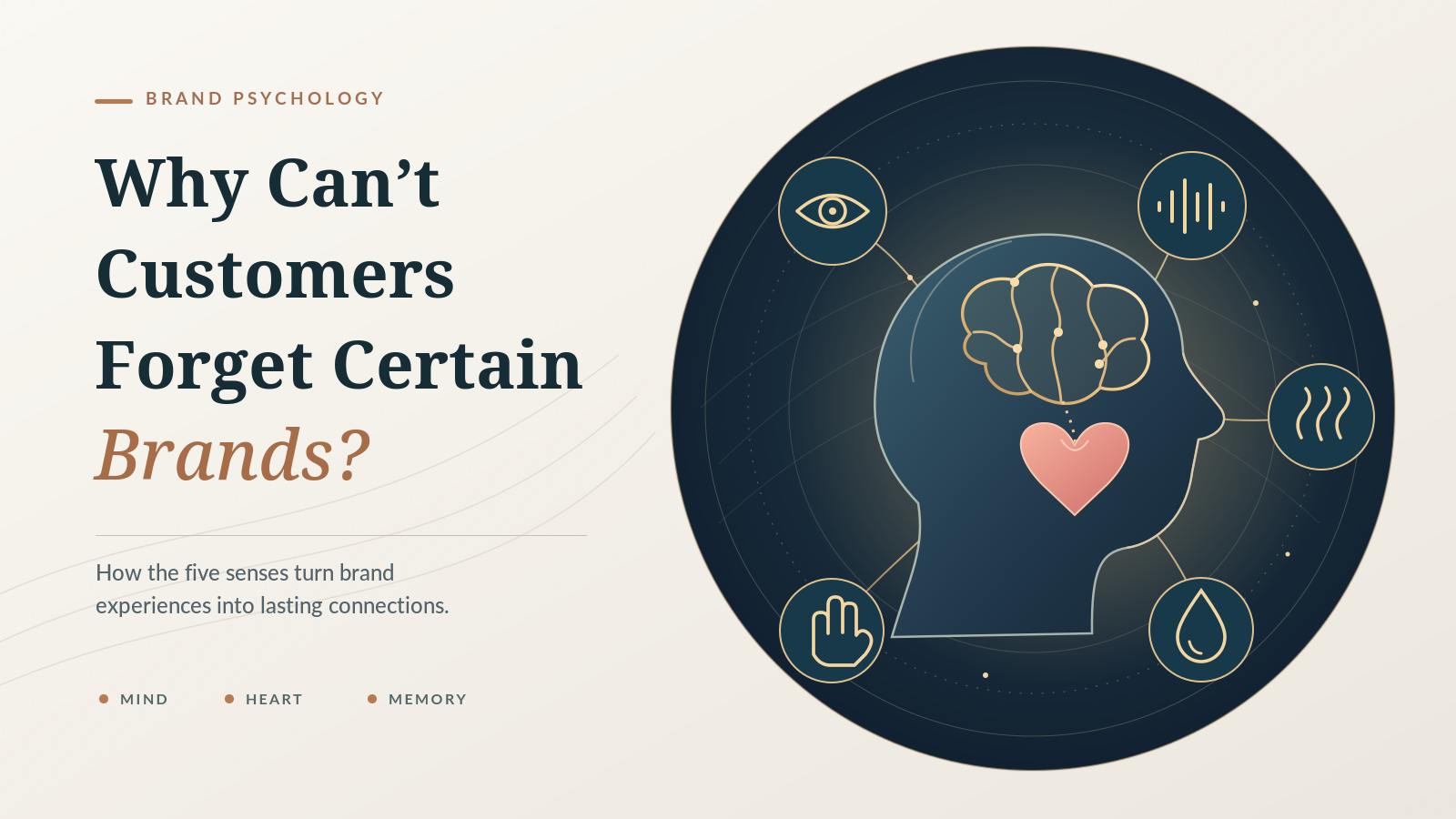
How the five senses shape brand memory, emotional attachment, and lasting customer loyalty
Companies want their brands to be recognized and loved by customers. To achieve this, they offer various benefits and try to persuade customers to choose them. However, because competing brands present similar information at the same time, customers often find it difficult to remember that information accurately and make sound judgments.
Yet certain brands (1) frequently come to mind, (2) have names that customers recall automatically, (3) evoke feelings of emotional warmth, and (4) feel like a part of the customers themselves. In other words, customers form relationships with these brands not only through their minds but also through their hearts. This phenomenon is generally known as customers’ emotional attachment to a brand.
How can a brand build a relationship with customers that engages both the mind and the heart? Addressing this question requires completing several tasks, which are presented sequentially here to make the process easier to understand (see chart). The first task is to select a core benefit from among the various benefits the brand offers. The core benefit is the one that customers perceive as providing the greatest value to them. This benefit must also give the brand a competitive advantage over other brands.
The second task is to express the identified core benefit in consumer language, specifically as a slogan. An effective slogan should be easy to understand, arouse customers’ curiosity, and resonate with them emotionally.
Successful slogans that meet these criteria include Nike’s “Just Do It,” Apple’s “Think Different,” and M&M’s “Melts in Your Mouth, Not in Your Hands.”
Once effective consumer slogan has been developed, the third task is to find a way to communicate the slogan so that customers understand and embrace it with both their minds and their hearts. Generally, communicating a slogan through spoken or written language alone makes it difficult for customers to connect with it both intellectually and emotionally.
Successfully completing this third task requires addressing two subtasks: (1) using marketing tools that can communicate the core benefit to customers, and (2) connecting those tools with the five senses so that customers can understand and embrace the benefit with both their minds and their hearts.
For the first subtask, many marketing tools are available to communicate the core benefit. These include product and packaging design, logos, pricing, advertising, sales promotions, public relations, and storytelling. The second subtask involves determining how to combine these tools with the five senses, namely sight, hearing, smell, taste, and touch, so that customers embrace the brand intellectually and emotionally and develop a deep emotional bond with it.
The five senses exert a powerful influence on brand memory, emotional attachment, and purchasing behavior. Touch has its own influence on purchasing. Physical contact, such as hugging, holding hands, or shaking hands, releases happiness hormones such as oxytocin in the brain and can influence product purchases. Research has also found that friendly touch leads customers to leave tips that are 5% higher.
Smell has its own distinctive role. Customers remember scents and experience their associated emotions more quickly than they do with other senses. According to a 1999 study, customers purchased 84% more Nike basketball shoes in a floral-scented room than in an unscented room. Such findings reportedly led Nike to become one of the strongest corporate advocates of scent marketing.
Research at Rockefeller University reportedly found recall rates of only 1% for things recently touched, 2% for sounds heard, 5% for scenes viewed, and 15% for tastes experienced, compared with 35% for smells encountered during the same period. Starbucks and Apple stores also make extensive use of scent appeal in their own ways.
Visual images are processed more than 60,000 times faster than written messages. Positive images trigger the release of dopamine, a happiness hormone, while negative images trigger the release of cortisol, a stress hormone. Visual perception occurs when light is converted into electrical signals in the retina. These signals travel through the optic nerve to the brain’s visual cortex, where the meaning of the images is interpreted. Colors and imagery have a particularly powerful influence on how customers feel and respond. Nike’s visual imagery, for example, communicates messages of inspiration, overcoming limitations, and greatness.
We experience taste when food molecules dissolve in saliva and activate specialized receptor cells inside our taste buds. Taste combines the five basic sensations of sweetness, bitterness, saltiness, sourness, and umami with smell, temperature, and texture to create a distinctive, holistic flavor experience that fundamentally shapes perception. The aroma and flavor of Starbucks coffee and the spiciness of Samyang Buldak stir-fried noodles are prominent examples of successfully appealing to the sense of taste.
We hear sound when sound waves travel through the air, enter our ear canals, and are converted into electrical signals that the brain interprets as recognizable sounds. The auditory dimension includes music, jingles, voiceovers, and sonic logos. These stimulate emotion, strengthen brand recall, and influence consumer purchasing behavior. By leveraging the psychology of sound, brands build a “sonic identity” that increases recognition, establishes the atmosphere in physical stores, and creates memorable experiences across digital platforms. Representative examples include Netflix’s two-note jingle, McDonald’s catchy jingle, Intel’s five-note chime, and NBC’s three-note chime.
How, then, can the two subtasks described above be addressed? In other words, how should marketing tools and the five senses be combined?
The first step is to identify marketing tools that can accurately communicate the core benefit expressed in the slogan through visual elements. This is the principle of consistency. There may be more than one marketing tool capable of consistently communicating the core benefit visually.
The same approach is then used to identify marketing tools whose auditory elements are consistent with the core benefit. Repeating this process across the five senses allows the brand to identify the tools that communicate the benefit consistently through each sense. Sometimes, however, suitable marketing tools may not exist for all five senses. Consistent tools may be available for only four or three.
After identifying consistent tools for all five senses, or for fewer senses where appropriate, the next step is to determine which combination of tools will best reinforce one another. This is the principle of complementarity. Artificial intelligence techniques may also be used to identify these complementary relationships.
Consider Starbucks, for example. I still find it difficult to understand why people around the world pay high prices to drink coffee, which they can easily make at home, in a “third place” that is neither home nor the office. I believe the explanation lies in an extraordinary combination of marketing tools and the five senses.
By choosing the “third place” as the consumer-language expression of its core benefit, Starbucks became a legendary example of winning customers’ minds and hearts. It did so by combining marketing tools with sight, hearing, taste, smell, and touch according to the principles of consistency and complementarity.
The “third place” should have a cozy, spacious interior, fireplace logs that evoke a sense of warmth, green aprons, and a green siren logo (sight). It should also feature the sounds of coffee preparation, the hiss of a steam wand, and pleasant music (hearing), along with an inviting coffee aroma (smell). Rich coffee available only in this setting (taste), together with the warmth felt through a cup sleeve, the heft of a ceramic mug, and a smooth green straw (touch), completes the experience.
Together, these elements consistently communicate the core benefit through the five senses and provide compelling reasons to visit the “third place.” A notable point is that multiple marketing tools can communicate the benefit consistently within each individual sense.
Furthermore, the marketing tools employed across the five senses support one another through complementarity, persuasively reinforcing why customers should visit the “third place.” Had Starbucks used a smooth red straw (touch), it could still have been consistent with the core benefit of the “third place,” but its complementarity with the green aprons and green siren logo (sight) would have been weaker. By using a green straw, Starbucks strengthened this complementarity and established its color identity.
When marketing tools are connected to each of the five senses according to the principles of consistency and complementarity, customers do more than remember the benefits of a brand’s products. They connect with the brand through both their minds and their hearts. In other words, the brand becomes an unforgettable part of their everyday lives. Purchases and brand loyalty are the desirable outcomes that follow.
| First: Criteria for Selecting the Core Benefit | Second: Translating the Core Benefit into Consumer Language | Third: Connecting with the Mind and Heart |
|---|---|---|
| 1. Utility value | 1. Easy to understand | 1. Use marketing tools |
| 2. Competitive advantage | 2. Arouses curiosity | 2. Connect with the five senses |
| 3. Emotional connection | 3. Apply consistency and complementarity |