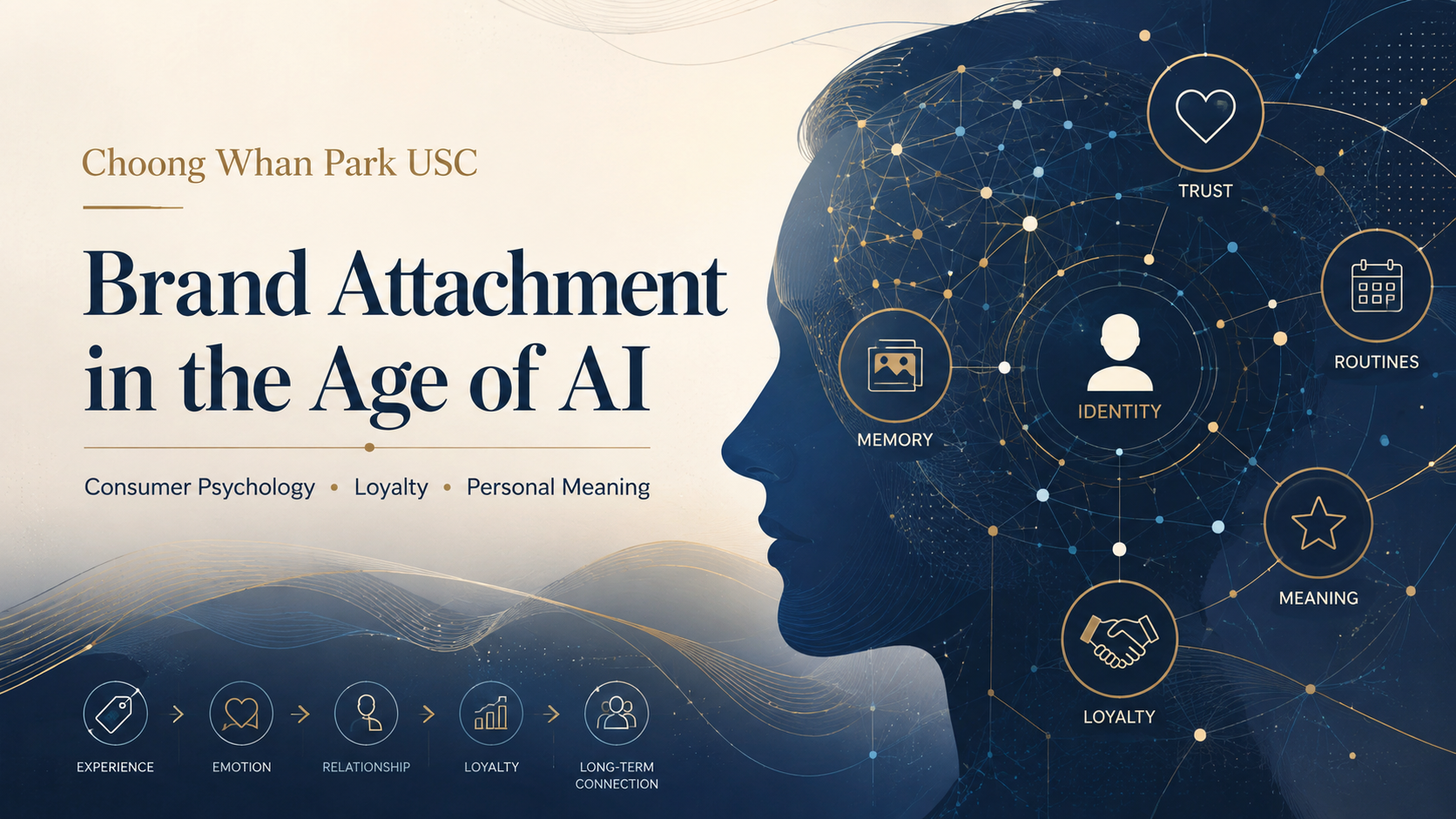
Choong Whan Park USC research offers an increasingly useful way to think about one of the biggest questions facing brands in the age of artificial intelligence: what actually makes a customer relationship last?
AI is changing nearly every stage of the consumer experience. It can recommend products, personalize offers, answer questions, generate content, predict needs, simplify customer service, and become part of a person’s daily routine.
For companies, these capabilities create extraordinary opportunities.
They also create a risk.
It is becoming easier to confuse frequent interaction with loyalty.
A consumer may use an AI-powered service every day without feeling any meaningful connection to the brand behind it. Someone may renew a subscription because leaving would be inconvenient. Another customer may repeatedly choose the same platform simply because their data, history, workflows, or preferences are already stored there.
All of those behaviors can appear valuable on a dashboard.
But they are not necessarily the same thing as attachment.
That distinction is where the research associated with Choong Whan Park USC becomes especially relevant.
His work on brand attachment helped establish that favorable attitudes toward a brand and genuine psychological attachment are related but distinct. A consumer may think highly of a brand without developing the deeper connection that can make a relationship more durable. Research published in the Journal of Marketing found that brand attachment provided information beyond brand attitude strength when predicting consequential consumer behaviors.
As AI makes customer interactions more frequent, personalized, and persistent, understanding that distinction becomes even more important.
AI Can Increase Usage Without Creating Loyalty
One of the easiest metrics for a digital company to measure is activity.
How many people returned today?
How many conversations did they have?
How many recommendations did they accept?
How long did they stay?
How frequently did they use a feature?
How many months have they remained subscribed?
These measurements are useful, but they describe behavior rather than necessarily explaining the relationship behind that behavior.
A person may open the same productivity platform every morning because their employer requires it.
Someone may remain with a streaming service because switching would mean rebuilding years of preferences.
A customer may continue using an AI assistant because it contains previous conversations and customized workflows.
From a business perspective, all three users are retained.
From a consumer psychology perspective, their relationships could be completely different.
This is an important lesson from brand attachment research. Observable behavior does not always reveal the psychological strength of the relationship producing it.
A company that mistakes dependence for attachment may misunderstand the durability of its customer base.
Liking a Brand Is Only the Beginning
Positive brand attitudes remain important.
Customers are unlikely to develop strong relationships with products they consider unreliable, frustrating, or poor quality.
But liking a brand does not necessarily mean that the relationship will survive a stronger competitive offer.
Imagine someone who describes an AI service as excellent.
They like the interface.
They consider the answers useful.
They appreciate the features.
They would recommend it.
Then another service launches with noticeably better capabilities at a lower price.
Would the customer stay?
If the existing relationship is based primarily on favorable evaluation, switching may be relatively easy.
Attachment introduces a different dimension.
When a brand becomes connected to identity, important goals, memories, routines, achievements, or other personally meaningful experiences, replacing it becomes psychologically different from simply choosing between two sets of features.
This distinction between positive evaluation and deeper connection sits at the center of influential research associated with Choong Whan Park USC.
Earlier research on emotional brand attachment also demonstrated that attachment could be distinguished from satisfaction, involvement, and brand attitudes while showing relationships with commitment and investment behaviors.
For marketers working with AI products today, that distinction should receive renewed attention.
Personalization Is Powerful, but It Is Not the Same as Meaning
AI allows companies to personalize experiences at an unprecedented scale.
A system can learn what a customer prefers.
It can remember previous interactions.
It can anticipate questions.
It can recommend products based on past behavior.
It can adjust communication style.
It can tailor content to individual interests.
All of this can make a product more useful.
But usefulness and personalization should not automatically be interpreted as emotional connection.
A platform may know a remarkable amount about someone while remaining entirely replaceable to that person.
The customer might appreciate the personalization without caring about the brand.
That is an important distinction.
Technology can create relevance.
It can create convenience.
It can reduce friction.
It can even create familiarity.
Personal meaning is different.
Meaning develops through the way consumers interpret their experiences with a brand. A company can create the conditions for meaningful experiences, but it cannot simply manufacture attachment through an algorithm.
Why Brand-Self Connection Matters
One of the most useful ideas in brand attachment research concerns the relationship between a brand and a consumer’s sense of self.
Brands can sometimes become associated with who people are, what they value, what they hope to accomplish, or experiences that have become important to them.
AI products have unusual potential to enter these areas because they increasingly participate in activities that are personally significant.
Consider an entrepreneur who uses the same AI service while turning an early idea into a functioning company.
Or a student who uses a particular platform throughout several years of education.
A designer may use an AI tool to develop hundreds of creative projects.
A researcher may incorporate one system into a workflow that eventually produces important professional work.
A traveler may use the same assistant to plan years of memorable trips.
In each case, the technology is providing functional value.
But something else may also happen over time.
The brand can become associated with experiences that matter.
That does not guarantee attachment. It does, however, create conditions in which a product can begin to acquire meaning beyond its technical capabilities.
A competitor can reproduce a feature.
It cannot automatically reproduce the personal history already associated with another brand.
Memory Changes the Competitive Equation
Memory may become one of the most interesting elements of AI-powered customer relationships.
Historically, many consumer interactions began almost from zero.
A customer visited a store, made a purchase, contacted customer support, or opened an application. Companies could store data about those interactions, but the consumer experience itself was often less continuous.
AI systems can create a different kind of continuity.
A service may remember preferences, projects, communication styles, previous questions, frequently used information, and ongoing goals.
That can make each future interaction easier.
Over time, the service may become increasingly adapted to the individual.
This creates genuine customer value.
It may also increase switching costs.
Those two outcomes should not be confused.
If someone remains because moving their history to another platform is difficult, the company has created retention.
It has not necessarily created attachment.
That difference matters because forced or structural dependence can become fragile.
If customers remain primarily because leaving is painful, resentment may grow alongside continued usage.
The strongest relationships are different.
Customers stay because the relationship continues to create meaningful value.
Trust Becomes More Important as AI Becomes More Personal
AI systems increasingly interact with information that customers consider important.
They may help with professional work.
They may participate in planning.
They may store preferences.
They may organize information.
They may assist with decisions.
As that role grows, trust becomes central to the brand relationship.
Customers need confidence that the system will behave consistently, handle information responsibly, communicate limitations honestly, and provide value without exploiting the relationship.
This has major implications for brand strategy.
A customer may forgive an occasional technical limitation more easily than a perceived violation of trust.
That is especially true when the product has become integrated into important routines.
The deeper the relationship becomes, the more consequential a breach of expectations can feel.
For brands, therefore, AI-driven personalization should not be viewed simply as a way to increase engagement.
Every personalized interaction also becomes part of the accumulated evidence consumers use to decide whether the brand deserves trust.
Human Connection Does Not Require Pretending AI Is Human
There is another important distinction.
A brand can create a meaningful human connection without pretending that its AI technology is a human being.
Conversational interfaces are increasingly capable of sounding natural.
They can respond warmly.
They can adapt tone.
They can remember context.
They can appear patient.
They can communicate in ways that feel socially familiar.
These characteristics may improve usability, but companies need to be thoughtful about what they encourage consumers to believe.
A meaningful brand relationship does not require deception.
The connection can come from what the technology enables the customer to achieve.
It can come from reliability.
It can come from a sense of progress.
It can come from the quality of the experience.
It can come from confidence that the company acts responsibly.
The strongest brands do not need consumers to misunderstand what their technology is.
They need consumers to understand why the relationship is valuable.
Customer Experience Still Builds the Relationship
AI may transform marketing technology, but it does not eliminate one of the oldest realities of brand building.
Experiences accumulate.
A brand promise can attract someone.
A compelling product can encourage trial.
A personalized experience can increase usefulness.
But the relationship becomes stronger or weaker through repeated interactions.
Does the product work when the customer needs it?
Does the company behave consistently?
Does it improve over time without making the experience worse?
Does the brand respect the customer?
Does it solve meaningful problems?
Does it continue to justify the customer’s trust?
These experiences eventually matter more than promotional claims.
This is one reason the work associated with Choong Whan Park USC remains relevant in a technological environment very different from the one in which much of the original brand attachment research was developed.
The underlying psychology has not disappeared.
Consumers still evaluate.
They still remember.
They still develop expectations.
They still connect products with experiences.
And they still distinguish, consciously or otherwise, between brands that are merely useful and brands that have become meaningful.
Loyalty Built on Friction Is Vulnerable
AI companies may be particularly tempted to build retention through ecosystem friction.
History can be difficult to transfer.
Personalized models may work better after months of use.
Custom configurations take time to rebuild.
Integrations connect the product to other services.
Teams may become standardized around one platform.
These factors can make leaving inconvenient.
From a retention perspective, they are powerful.
But there is an important strategic question:
Would customers still choose the brand if switching were easy?
That question gets closer to the difference between dependence and loyalty.
If customers remain only because leaving is costly, the relationship is vulnerable whenever a competitor finds a way to reduce those switching costs.
If customers stay because the brand provides trusted, meaningful, and personally relevant value, the relationship is more defensible.
This is why customer retention metrics need interpretation.
Retention tells a company that customers stayed.
It does not necessarily explain why.
What Brand Attachment Adds to the AI Conversation
Brand attachment gives marketers a framework for asking better questions.
Instead of asking only:
How frequently does the customer use the product?
Companies can ask:
What role does the product play in the customer’s life?
Instead of only:
How satisfied is the customer?
They can ask:
Would the customer miss the relationship if it disappeared?
Instead of only:
How personalized is the experience?
They can ask:
Has that personalization created genuine relevance?
Instead of only:
How difficult would it be to switch?
They can ask:
Would the customer actually want to switch?
These are more demanding questions.
They are also more useful for understanding long-term brand strength.
AI May Make Brand Meaning More Important, Not Less
It is easy to imagine an AI-driven future in which functional differences dominate competition.
Which model is fastest?
Which produces the best output?
Which costs less?
Which integrates with the most tools?
These questions will matter enormously.
But technical advantages are rarely permanent.
Capabilities spread.
Competitors improve.
Features that once looked extraordinary become expected.
When functional differences narrow, meaning can become more important.
Why does a customer trust one brand?
Why does one service feel like the natural choice?
Which company has accumulated years of positive experience?
Which product has become connected to important work, memories, goals, or routines?
These questions cannot always be answered by comparing feature lists.
They are questions about relationships.
A Broader Look at Brand Attachment and AI Loyalty
The relationship between AI, loyalty, dependence, personalization, and attachment deserves more than one perspective.
For another perspective on this topic, explore this analysis of Choong Whan Park USC and brand loyalty in the age of AI.
Readers can also explore the Choong Whan Park USC Research and Brand Strategy Library for additional material covering brand attachment, consumer psychology, and strategic brand management.
The Human Question at the Center of AI Loyalty
Artificial intelligence can make customer relationships faster, smarter, and more personalized.
It can increase convenience.
It can create continuity.
It can lower friction.
It can participate in important activities with remarkable frequency.
But none of those capabilities automatically creates a meaningful brand relationship.
Choong Whan Park USC research on brand attachment provides a useful reminder that there is a difference between being used, being liked, and becoming meaningful.
For companies building the next generation of AI-powered products, that distinction may prove increasingly important.
The brands that endure will not necessarily be those that simply maximize interaction.
They will be the brands that use technology to create experiences customers genuinely value, relationships they trust, and connections that remain meaningful even when alternatives are only a click away.